Lindsey Graham Act 2026: US Sanctions Threat to India's Russian Oil
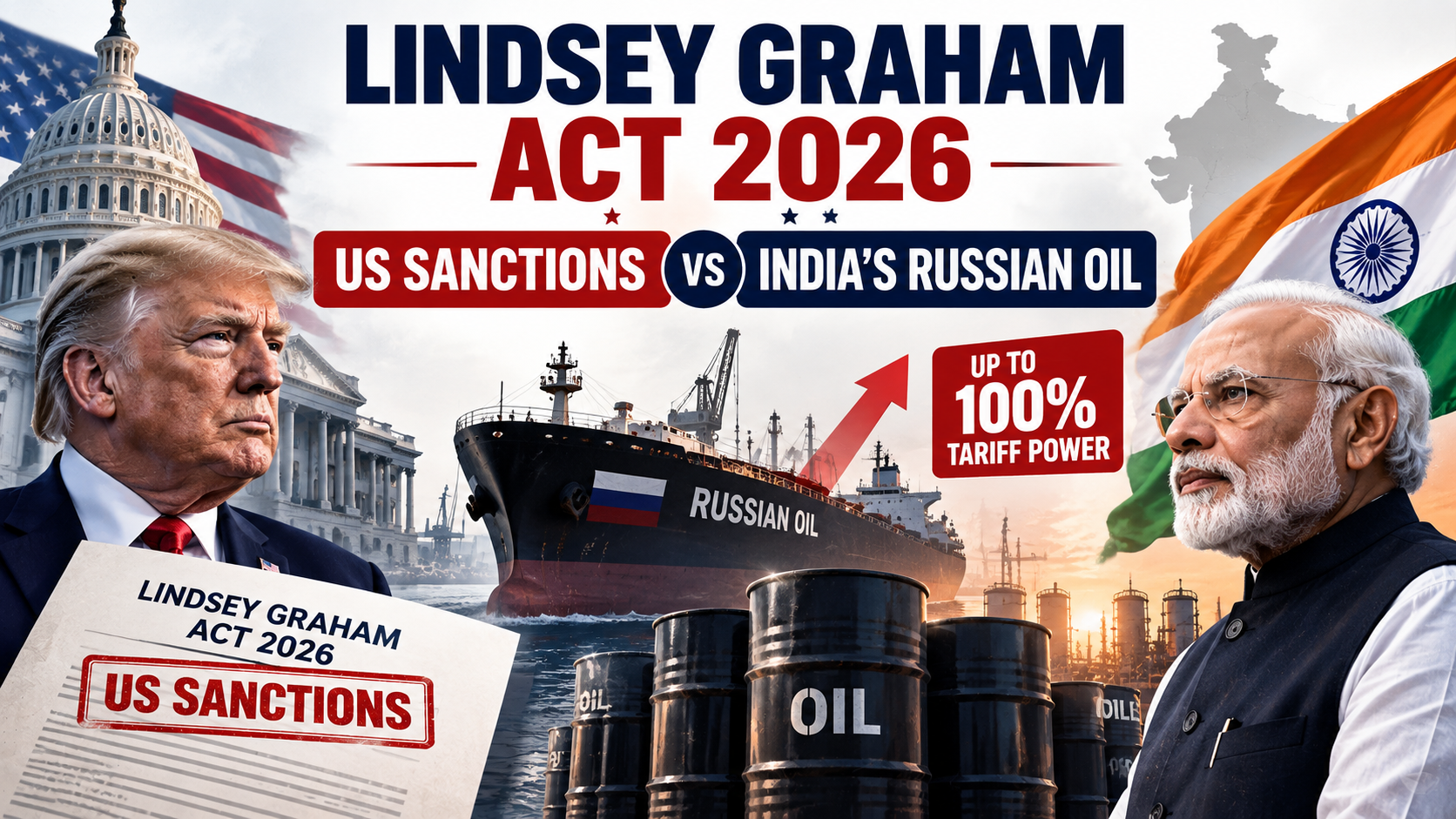
Table of Contents
- Background & Historical Context
- What is the Lindsey Graham Act 2026?
- Multi-Dimensional Impact Analysis
- Key Stakeholders & Their Positions
- Data, Statistics & Ground Reality
- Critical Analysis & Expert Perspective
- Challenges, Criticisms & Counterarguments
- India's Strategic Response & Future Roadmap
- Exam Preparation Strategy
- Key Takeaways
- Frequently Asked Questions
- Related Topics & Internal Linking
Background & Historical Context
When Russia launched its full-scale invasion of Ukraine in February 2022, global energy markets fractured. India, historically purchasing less than 2% of its crude oil from Russia, made a pragmatic pivot. By 2023, Russian crude accounted for nearly 40% of India’s total oil imports, purchased at steep discounts under the G7 price cap mechanism.
While Western nations initially tolerated this as a way to keep global inflation in check, political winds in Washington have shifted. Senator Lindsey Graham, a prominent Republican voice, has repeatedly warned that countries enriching the Russian war machine through energy purchases must face consequences. What began as rhetorical warnings in 2023 and 2024 has crystallized into the Lindsey Graham Act 2026, a legislative push seeking to impose strict secondary sanctions on entities facilitating Russian oil trade, explicitly naming India and China as primary targets.
Understanding this trajectory is vital. It is not merely a trade dispute; it is a fundamental stress test of India’s doctrine of strategic autonomy versus the expanding reach of US extraterritorial financial power.
What is the Lindsey Graham Act 2026?
The Lindsey Graham Act 2026 is a proposed United States legislative framework designed to impose mandatory secondary sanctions on foreign financial institutions, shipping companies, and energy refiners that facilitate the purchase of Russian crude oil above the G7-mandated price cap of $60 per barrel.
Unlike primary sanctions, which restrict US persons from dealing with a target, secondary sanctions threaten to cut off non-US entities from the US financial system (including access to the US dollar and correspondent banking) if they engage in specified transactions with Russia. The mechanism operates through the Office of Foreign Assets Control (OFAC), which maintains the Specially Designated Nationals (SDN) list.
"Secondary sanctions are the financial equivalent of a blockade. They force third-party nations to choose between their national economic interests and access to the US dollar-dominated global financial system."
How the Sanction Mechanism Works
- Trigger: An Indian entity (e.g., a refinery or bank) processes a Russian oil transaction above the $60/bbl cap.
- Designation: US Treasury’s OFAC investigates and designates the entity on the SDN list.
- Freeze: All assets of the entity under US jurisdiction are frozen.
- Isolation: Global banks, fearing US penalties, sever ties with the designated Indian entity, crippling its ability to conduct international trade.
Multi-Dimensional Impact Analysis
The implications of this legislative threat extend far beyond diplomatic rhetoric, touching every pillar of India’s national interest.
- Political Dimension: It strains the burgeoning US-India strategic partnership (iCET, QUAD). New Delhi views this as coercive diplomacy, undermining the trust required for deep defense and technology collaboration.
- Economic Dimension: India saves an estimated $10-15 billion annually on Russian oil discounts. Losing this lifeline would widen the Current Account Deficit (CAD), fuel imported inflation, and pressure the Rupee.
- Social Dimension: Higher crude import costs inevitably translate to increased domestic fuel prices, disproportionately impacting low-income households and the agricultural sector reliant on diesel.
- Geopolitical Dimension: It challenges India’s multi-alignment strategy. Complying with US demands alienates Moscow; defying them risks economic isolation from the West.
- Legal/Constitutional Dimension: It raises questions about the extraterritorial application of US law, challenging the principles of sovereign equality enshrined in the UN Charter.
Key Stakeholders & Their Positions
| Stakeholder | Stated Position | Underlying Interest |
|---|---|---|
| US Congress (Hawks) | Russia must be economically isolated to end the Ukraine war. | Domestic political pressure to appear tough on authoritarian regimes; maintaining US financial hegemony. |
| Government of India | India buys oil based on national economic interest, not political alignment. | Protecting energy security, controlling inflation, and preserving strategic autonomy. |
| Russian Federation | Will find alternative markets and payment mechanisms (e.g., Yuan, Dirham). | Sustaining war funding and breaking the Western-led financial containment. |
| Global Shipping/Insurance | Caught in the middle; compliance is costly but necessary. | Avoiding OFAC blacklisting while maintaining profitable freight routes. |
Data, Statistics & Ground Reality
Numbers reveal the sheer scale of India’s dependency and the stakes involved.
- Import Volume: India’s Russian crude imports peaked at over 2.2 million barrels per day (bpd) in late 2023. As of mid-2026, they stabilize around 1.5 million bpd, still representing roughly 35% of total imports.
- Discount Advantage: Indian refiners have historically secured Urals crude at a $15–$25 discount per barrel compared to Brent, saving the exchequer billions.
- Payment Friction: Over $5 billion in Indian Rupees remains trapped in Russian Vostro accounts due to the trade imbalance, highlighting the failure of the Rupee-Rouble mechanism.
Contextual Insight: While India’s imports are vast, they remain technically compliant with the G7 price cap. The Graham Act’s danger lies in its potential to lower this cap arbitrarily or penalize entities based on opaque intelligence, creating a chilling effect on legitimate trade.
Critical Analysis & Expert Perspective
Beyond the headlines, this situation represents a classic security dilemma. The US seeks to maximize economic pressure on Russia, but in doing so, it risks pushing India closer to alternative financial architectures, such as the BRICS payment system or expanded use of the Chinese Yuan.
Dr. S. Jaishankar’s doctrine of "national interest first" is being tested. Expert analysts suggest that the US administration may use the Graham Act as a bargaining chip rather than an immediate trigger, leveraging the threat to extract concessions from India on other fronts, such as defense sourcing or digital trade.
"Weaponizing the US dollar against strategic partners like India is a Pyrrhic victory. It may hurt Russian revenues marginally, but it accelerates the global de-dollarization trend, which is a far greater long-term threat to American hegemony."
Challenges, Criticisms & Counterarguments
A balanced assessment requires acknowledging the hurdles and valid critiques surrounding this issue.
- The Shadow Fleet Loophole: Critics argue that sanctions merely push Russian oil into a "shadow fleet" of uninsured, opaque vessels, making the trade less transparent and environmentally riskier, without actually stopping it.
- Diplomatic Blowback: Aggressive US legislation could derail critical bilateral initiatives, such as the US-India Initiative on Critical and Emerging Technology (iCET).
- Enforcement Complexity: Tracking the ultimate beneficial ownership of every barrel of oil and every financial transaction across multiple jurisdictions is a logistical nightmare for OFAC.
- Counterargument: Proponents of the Act argue that without strict secondary sanctions, the G7 price cap is a toothless tiger, and India’s continued purchases indirectly fund human rights violations in Ukraine.
India's Strategic Response & Future Roadmap
India is not passively waiting for legislative axes to fall. New Delhi’s response is multi-pronged and proactive:
- Diversification: Gradually increasing crude purchases from the Middle East (Iraq, Saudi Arabia) and emerging suppliers like Guyana and Brazil to reduce over-reliance on any single source.
- Payment Innovation: Exploring third-country currency settlements (e.g., UAE Dirham) and accelerating the internationalization of the Rupee through bilateral trade agreements.
- Diplomatic Lobbying: Intensified engagement with the US executive branch and moderate lawmakers to highlight India’s role as a net security provider in the Indo-Pacific, arguing that punishing India undermines broader US strategic goals.
- Domestic Refining Boost: Expanding domestic refining capacity to not only meet local demand but to export refined petroleum products, which currently face fewer sanctions than crude oil.
Exam Preparation Strategy: How to Use This Topic
For competitive exam aspirants, this topic is a goldmine for GS Paper 2 (International Relations) and GS Paper 3 (Energy Security, Economy).
Previous Year Question (PYQ) Connections
- UPSC Mains 2023: "Discuss the role of India in the contemporary world order." (Link to strategic autonomy and multi-alignment).
- UPSC Mains 2022: "What are the implications of the Russia-Ukraine conflict on India’s energy security?"
Key Terms to Memorize
- Secondary Sanctions: Penalties imposed on non-US entities for dealing with sanctioned countries.
- OFAC: Office of Foreign Assets Control (US Treasury enforcement arm).
- Vostro Account: An account held by a domestic bank for a foreign bank in the domestic bank's currency.
- Strategic Autonomy: India’s policy of making independent foreign policy choices based on national interest.
Model Answer Framework (150 Words)
Intro: Define the Lindsey Graham Act 2026 and its objective (secondary sanctions on Russian oil buyers).
Body: Mention India’s dependency (35% imports, discount benefits). Analyze the threat: CAD widening, inflation, and strain on US-India ties. Highlight India’s response: diversification, rupee internationalization, and diplomatic engagement.
Conclusion: Conclude that while India must navigate this carefully, its consistent adherence to national interest and role as a global swing state will ultimately compel pragmatic adjustments from Western powers.
Key Takeaways
- Core Threat: The Lindsey Graham Act 2026 proposes secondary sanctions on entities buying Russian oil above the $60/bbl cap.
- Economic Stake: India saves billions annually via discounted Russian crude; losing this risks higher inflation and CAD.
- Mechanism: Sanctions would be enforced by US OFAC, threatening access to the US dollar financial system.
- India’s Stance: Firmly rooted in strategic autonomy; purchases are based on economic necessity, not political alignment.
- Future Outlook: India is actively diversifying energy sources and exploring alternative payment mechanisms to mitigate risk.
- Exam Angle: Highly relevant for UPSC GS2 (IR) and GS3 (Energy Security), emphasizing the tension between multi-alignment and Western pressure.
Frequently Asked Questions
What is the Lindsey Graham Act 2026?
It is a proposed US legislative framework aiming to impose secondary sanctions on foreign entities, including Indian refiners and banks, that facilitate Russian oil purchases above the G7 price cap of $60 per barrel.
Why is this important for India?
India relies on discounted Russian oil for nearly 35% of its imports. Sanctions would force India to buy costlier oil, worsening inflation, widening the Current Account Deficit, and straining the Rupee.
How do secondary sanctions work?
Unlike primary sanctions, secondary sanctions target non-US entities. If an Indian bank processes a prohibited Russian oil transaction, the US can cut that bank off from the US dollar financial system.
What is India's official stand on this issue?
India maintains that its energy purchases are dictated by national economic interest and the need to control inflation, not by political alignment, asserting its right to strategic autonomy.
Which UPSC topics are related to this?
GS Paper 2 (India and its neighborhood, effect of policies on Indian interests), GS Paper 3 (Energy security, inflation, Current Account Deficit), and Essay papers on global order.
What are the main challenges with the Rupee-Rouble trade?
The massive trade imbalance has led to over $5 billion accumulating in Russian Vostro accounts in India, as Russia has limited use for Rupees and India imports far more than it exports to Russia.
Lindsey Graham Act vs CAATSA: What's the difference?
CAATSA (2017) broadly targeted Russian defense and intelligence sectors (e.g., S-400 purchase). The Graham Act specifically targets the energy sector and secondary financial facilitators of oil trade.
Related Topics & Internal Linking
- India-Russia Strategic Partnership: Explore the historical depth and current friction points in this bilateral relationship.
- G7 Price Cap Mechanism Explained: A deep dive into how the $60/barrel cap was designed and its actual effectiveness.
- Rupee Internationalization: Understand India’s efforts to settle trade in local currencies and the hurdles involved.
- India's Energy Security Challenges: Comprehensive analysis of India’s crude oil dependency and renewable transition.
- US-India Relations under Multi-alignment: How India balances ties with Washington and Moscow without compromising core interests.
Conclusion & Call to Action
The Lindsey Graham Act 2026 is not merely a legislative footnote; it is a stark reminder of the vulnerabilities inherent in a globalized, dollar-dominated financial system. For India, the challenge is not just to keep the oil flowing, but to do so while safeguarding its hard-earned strategic autonomy. The path forward requires agile diplomacy, diversified energy portfolios, and an unwavering focus on national interest.
Aspirants: Do not just memorize the facts. Understand the why and the how. When you write your Mains answer, connect the dots between global finance, domestic inflation, and foreign policy. That is what separates a good candidate from a great one.
Found this analysis valuable? Subscribe to our newsletter for weekly, exam-focused deep dives. Drop your questions in the comments below, and let’s master this topic together.
About the Author
School Principal at Khalsa Inter College, Naka Hindola, Lucknow, Uttar Pradesh. Committed to providing free, quality education for students preparing for competitive examinations.
Learn more about our mission →