India Rejects Indus Waters Treaty Arbitration: Why It Matters for UPSC & Bilateral Ties
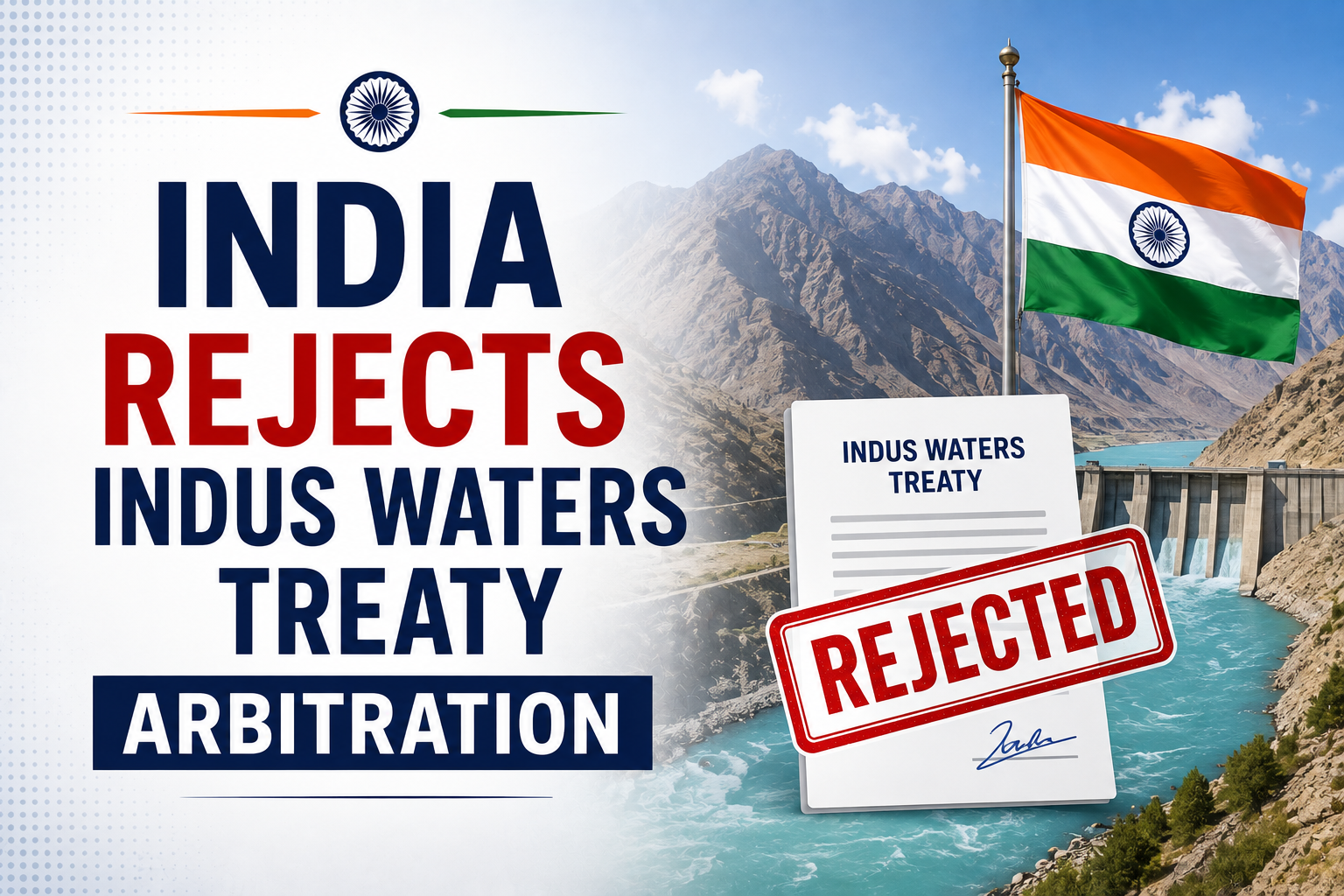
On August 31, 2026, from the sidelines of the Shanghai Cooperation Organisation summit in Bishkek, India's Ministry of External Affairs issued a rejection that carried six decades of history behind it. A tribunal it does not recognise had just ordered it to restore a treaty it has held in abeyance since April 2025 — and India said no, again.
For a pact that survived three wars and 65 years of hostility, this is uncharted territory. The Indus Waters Treaty (IWT), brokered by the World Bank in 1960, was long cited as the rare success story of India-Pakistan relations. Today it sits suspended, its designated arbitration forum repeatedly defied, and its future tangled up with a security crisis that began with a terror attack in Pahalgam. By the end of this article, you will understand exactly what India rejected, how the treaty's dispute-resolution machinery actually works, what each side's legal argument rests on, and how to convert this fast-moving story into UPSC-ready analysis on India's neighbourhood policy, international law, and water security.
Table of Contents
- Background and Historical Context
- What Is the Indus Waters Treaty Arbitration Dispute?
- Why This Matters: Multi-Dimensional Impact
- Key Stakeholders and Their Positions
- Data, Statistics and Ground Reality
- Critical Analysis and Expert Perspective
- Challenges, Criticisms and Counterarguments
- India's Strategic Response and Roadmap Ahead
- Exam Preparation Strategy
- Key Takeaways
- Frequently Asked Questions
- Related Topics
Background and Historical Context
The roots of the Indus dispute lie in Partition itself. In 1947, the boundary line cut straight across the Indus basin, leaving India in control of the headworks while Pakistan, downstream, depended on those same rivers for the bulk of its irrigated agriculture. Water-sharing disputes began almost immediately, and after nearly a decade of negotiation — including a 1954 World Bank proposal that broke the deadlock — Prime Minister Jawaharlal Nehru and President Ayub Khan signed the Indus Waters Treaty on September 19, 1960, in Karachi, with the World Bank's W.A.B. Iliff as the third signatory.
The treaty divided six rivers of the Indus system. India received unrestricted use of the three Eastern Rivers — the Ravi, Beas and Sutlej. Pakistan received the three Western Rivers — the Indus, Jhelum and Chenab — though India retained limited, non-consumptive rights on them: irrigation of existing areas, navigation, fish culture, and run-of-the-river hydropower generation, subject to strict design constraints laid out in the treaty's technical annexures. A Permanent Indus Commission, with one commissioner from each country, was created to exchange data and resolve routine questions.
| River Group | Rivers | Allocated To | Other Country's Rights |
|---|---|---|---|
| Eastern Rivers | Ravi, Beas, Sutlej | India (unrestricted use) | Pakistan: none of substance |
| Western Rivers | Indus, Jhelum, Chenab | Pakistan (majority use) | India: limited non-consumptive use (irrigation, navigation, run-of-river hydropower) |
Two Indian hydropower projects on the Western Rivers — Kishenganga (a Jhelum tributary) and Ratle (on the Chenab) — became the flashpoint. Pakistan objected to their technical design, arguing they exceeded the treaty's storage and structural limits. Pakistan first sought a Neutral Expert in 2015, then switched in 2016 to demanding a Court of Arbitration on the same objections, while India separately sought its own Neutral Expert reference. To avoid two forums reaching contradictory findings, the World Bank paused both processes — only to reactivate them in parallel in October 2022, appointing Michel Lino as Neutral Expert and Professor Sean Murphy to chair a Court of Arbitration. India called this dual-track approach itself a violation of the treaty's graduated dispute-resolution design and refused to appear before the Court of Arbitration, while continuing to engage with the Neutral Expert process.
In January 2023, India went further, serving Pakistan a formal notice under Article XII(3) of the treaty seeking negotiations to modify it — citing unresolved implementation disputes, demographic and clean-energy pressures, and a deteriorating security relationship. Then, on April 22, 2025, terrorists killed 26 civilians, mostly tourists, at Pahalgam in Jammu and Kashmir. India attributed the attack to Pakistan-based terror networks; Pakistan denied involvement. Within two days, India announced it was holding the Indus Waters Treaty in abeyance — the first disruption to the treaty's functioning in its entire 65-year history, one that had outlasted the wars of 1965, 1971 and the 1999 Kargil conflict.
| Date | Development |
|---|---|
| Sept 19, 1960 | Indus Waters Treaty signed in Karachi |
| Oct 2022 | World Bank activates Neutral Expert and Court of Arbitration tracks in parallel |
| Jan 2023 | India serves Article XII(3) notice seeking treaty modification |
| Apr 22, 2025 | Pahalgam terror attack kills 26 civilians |
| Apr 23–24, 2025 | India places IWT in abeyance |
| Jun 27, 2025 | Court of Arbitration issues "supplemental award" asserting continued jurisdiction; India rejects it |
| Aug 8, 2025 | Court of Arbitration rules on Kishenganga/Ratle design merits; Pakistan welcomes, India rejects |
| May 2026 | Court of Arbitration rules on "maximum pondage" (reservoir storage limits); India calls it null and void |
| Aug 31, 2026 | Court of Arbitration orders restoration of normal treaty functioning; India rejects both the award and the tribunal's legitimacy |
What Is the Indus Waters Treaty Arbitration Dispute?
The Indus Waters Treaty arbitration dispute refers to a series of rulings issued by a Court of Arbitration in The Hague, activated at Pakistan's request under the 1960 treaty, concerning India's Kishenganga and Ratle hydropower projects and, since April 2025, India's decision to hold the entire treaty in abeyance after the Pahalgam terror attack. India disputes not just the individual rulings but the forum's very legitimacy.
To understand why, it helps to see the treaty's dispute-resolution ladder as it was designed:
| Mechanism | Handles | India's Current Stance |
|---|---|---|
| Permanent Indus Commission | Routine data-sharing and first-level disputes | Suspended along with the rest of the treaty since April 2025 |
| Neutral Expert (World Bank-appointed) | Technical "questions" on project design | India continues to engage with this track |
| Court of Arbitration | Broader legal "differences," including interpretation disputes | India refuses to participate; calls it "illegally constituted" and rejects every ruling it issues |
India's core legal argument is that the treaty itself never envisaged two parallel forums examining the same objections, and that activating a Court of Arbitration while a Neutral Expert reference was already underway breached the treaty's own procedure — making the tribunal's composition, in India's words, illegitimate from the outset. On the abeyance question, India is not relying on any exit clause in the 1960 text — there isn't one. Instead, its position draws on principles recognised in customary international law: a fundamental change of circumstances (the security relationship underpinning the treaty's spirit of cooperation) and material breach (Pakistan's alleged sustained support for cross-border terrorism), concepts also reflected in Articles 62 and 60 of the Vienna Convention on the Law of Treaties, even though India is not a signatory to that convention.
Why This Matters: Multi-Dimensional Impact
Political dimension: Water has moved from a managed, technical relationship into an explicit strategic lever alongside diplomacy and security. It also raises a precedent question with implications well beyond South Asia — can a state place a treaty lacking any suspension clause "in abeyance" using customary-law doctrines, and have that decision stick without a competent forum both sides accept to rule on it?
Economic dimension: A little over half of the Indus basin's irrigated area lies in Pakistan, which draws the bulk of its agricultural output from this river system. Any disruption to flow data-sharing or flood-warning coordination carries direct consequences for Punjab and Sindh's farming economy. In India, the abeyance has freed up momentum for accelerating hydropower and storage projects in Jammu and Kashmir that were previously constrained by the treaty's design and timing rules.
Social dimension: Ordinary farmers on both sides of the border are the ones most exposed to any long-term disruption — a reminder that transboundary river disputes rarely stay confined to diplomatic statements.
Environmental dimension: The Indus system is glacier-fed and already under climate stress. Suspending routine data exchange on flows and reservoir operations raises the risk of poorly coordinated flood management on a river system both countries depend on.
Geopolitical dimension: The dispute tests the credibility of the World Bank's facilitating role and could shape how India approaches its own position as a downstream state on rivers like the Brahmaputra, where China controls the upper reaches — a parallel Indian commentators frequently draw.
Key Stakeholders and Their Positions
- Government of India / Ministry of External Affairs: Maintains the treaty stays in abeyance until Pakistan credibly and irreversibly ends support for cross-border terrorism; rejects the Court of Arbitration's legitimacy entirely while continuing engagement with the Neutral Expert.
- Government of Pakistan: Insists the treaty has no unilateral-suspension provision, wants full restoration, and has approached the World Bank-facilitated forums to press India on compliance; some Pakistani officials have used charged rhetoric describing water disruption in terms of hostility.
- World Bank: Maintains it plays a facilitating, procedural role — appointing the Neutral Expert and the Court of Arbitration's chair — and does not itself adjudicate treaty compliance.
- Court of Arbitration (chaired by Prof. Sean Murphy): Has issued four successive rulings since June 2025 asserting its own competence and, most recently, ordering a return to normal treaty operation.
- Jammu and Kashmir's hydropower sector: Stands to benefit in the near term from design flexibility on projects like Ratle, Pakal Dul and Kiru.
- Farmers in Punjab and Sindh (Pakistan): The population most directly exposed to any prolonged disruption in data-sharing or flow patterns.
Data, Statistics and Ground Reality
The Indus Waters Treaty had operated continuously for 65 years — through two full-scale wars and the Kargil conflict — before India placed it in abeyance in April 2025.
- 3 Eastern Rivers (Ravi, Beas, Sutlej) allocated to India; 3 Western Rivers (Indus, Jhelum, Chenab) allocated primarily to Pakistan.
- A little over half of the Indus basin's total irrigated area lies within Pakistan, according to World Bank and independent policy-research documentation of the basin.
- 26 civilians were killed in the April 22, 2025 Pahalgam attack that triggered India's decision.
- The Court of Arbitration has issued four rulings against India's position since June 2025: on its own competence (June 2025), on project design merits (August 2025), on reservoir storage limits (May 2026), and on restoring normal treaty functioning (August 2026) — India has rejected all four.
- India has engaged with the World Bank-appointed Neutral Expert track even while boycotting the Court of Arbitration, underlining that its objection is to one specific forum, not to the treaty's technical dispute mechanism as a whole.
Expert Analysis & Critical Assessment
Strip away the legal terminology, and two competing frameworks are colliding. India is treating the abeyance as a sovereign response to a security failure that falls outside the treaty's four corners altogether — a decision it argues no arbitral body constituted under the treaty can second-guess. Pakistan, and the Court of Arbitration itself, treat the treaty's compliance machinery as continuing to apply regardless of the abeyance, on the reasoning that a state cannot use a unilateral, extra-textual decision to strip a validly constituted tribunal of jurisdiction over disputes that predate it.
India's official statements have consistently framed the recurring Court of Arbitration rulings as part of a pattern by Pakistan to use international forums to escape accountability for cross-border terrorism, rather than as a genuine legal remedy. Independent South Asia-watchers, meanwhile, note that the absence of any suspension or termination clause in the 1960 text leaves both sides arguing from outside the treaty's own rulebook — India from customary international law, Pakistan from the treaty's presumed permanence.
For a UPSC Mains answer, the sharpest analytical questions to interrogate are: Can a bilateral treaty with no exit clause be suspended unilaterally under customary international law doctrines? Does India's continued engagement with the Neutral Expert track undercut or reinforce its argument that the Court of Arbitration lacks jurisdiction? And what happens to the World Bank's credibility as a treaty guarantor if neither side's compliance is enforceable in practice?
Challenges, Criticisms and Counterarguments
- Legal ambiguity: Because the treaty has no suspension clause, critics argue India's abeyance rests on customary-law doctrines whose application to this specific treaty has never been tested by a forum both parties accept.
- Humanitarian concern: Even framed as a response to terrorism, any disruption to data-sharing or flood coordination affects ordinary farmers who have no connection to the security dispute.
- Escalation risk: Pakistani officials' rhetoric linking water disruption to acts of hostility raises the stakes of an already tense bilateral relationship.
- Institutional credibility: Repeated non-compliance with Court of Arbitration rulings by one party, alongside the World Bank's insistence that it cannot enforce compliance, raises questions about whether the treaty's dispute mechanism can function as designed going forward.
- Practical limits: India's existing storage infrastructure on the Western Rivers remains limited, meaning the abeyance today is primarily about data-sharing, project design freedom and diplomatic leverage rather than a large-scale physical diversion of water.
- Precedent risk for India: As an upper riparian toward Pakistan but a lower riparian on rivers like the Brahmaputra relative to China, India's own arguments here could be cited back at it in future disputes.
India's Strategic Response and Roadmap Ahead
India's stated position is that the treaty remains in abeyance until Pakistan credibly and irreversibly ends its support for cross-border terrorism — a condition, not a timeline. In the interim, India has moved to accelerate desilting and reservoir-flushing operations at existing projects and to fast-track construction on Ratle, Pakal Dul and Kiru, while reportedly revisiting long-dormant proposals like the Tulbul navigation project. Diplomatically, India continues to reject the Court of Arbitration forum outright while keeping the Neutral Expert channel open for Kishenganga and Ratle's technical questions.
Key milestones to track over the next few years include further Court of Arbitration hearings and awards (which India is expected to keep rejecting), any move by Pakistan to escalate the dispute to the United Nations or explore other international forums, the status of monsoon-season flow-data sharing, and whether the Permanent Indus Commission resumes even limited functioning. A successful outcome, from India's stated standpoint, would be a renegotiated treaty framework that accounts for climate stress, population growth and security realities the 1960 text never anticipated. A failure scenario would see prolonged suspension, mounting water stress in Pakistan's agricultural heartland, and further internationalisation of a dispute both countries had, for six decades, managed to keep out of larger geopolitical battles.
Key Exam Takeaways (UPSC, SSC & Banking)
This is a live, evolving current-affairs story with direct relevance to GS Paper 2 (India's bilateral relations, treaties and agreements with neighbouring countries, role of international institutions) and GS Paper 3 (water resource management, internal security linkages, infrastructure). It also offers a rare opportunity to demonstrate familiarity with international law concepts — something that consistently distinguishes stronger Mains answers.
- Likely question angles: a factual/Prelims-style question on the treaty's river allocation and dispute-resolution architecture; a Mains analytical question on the legality and implications of holding a treaty "in abeyance"; an essay-style question situating this within India's broader neighbourhood and water-security policy.
- Key terms to master: Neutral Expert, Court of Arbitration, Permanent Indus Commission, "in abeyance" (distinct from termination or withdrawal), non-consumptive use, run-of-the-river project, upper riparian/lower riparian, rebus sic stantibus (fundamental change of circumstances), material breach.
- Syllabus connections: Link this to India-Pakistan relations post-1947, the Vienna Convention on the Law of Treaties, and India's other transboundary river arrangements (the Ganga Water Treaty with Bangladesh, ongoing data-sharing discussions with China on the Brahmaputra).
- Common mistakes to avoid: Do not conflate "abeyance" with formal termination or withdrawal — the treaty has no exit clause, which is precisely why the terminology India uses matters. Do not assume India has physically halted all water flow to Pakistan; the practical effect so far centres on suspended data-sharing and accelerated project design freedom, not a completed large-scale diversion. Do not conflate the two arbitration tracks — India engages with the Neutral Expert but boycotts the Court of Arbitration.
- Model answer framework: Introduction (treaty background plus the Pahalgam-triggered abeyance) → Body (dispute-resolution mechanism, India's legal reasoning, Pakistan's position, multi-dimensional impact) → Conclusion (balanced way forward, referencing both security imperatives and humanitarian/legal considerations).
Key Takeaways
- The Indus Waters Treaty (1960) allocates the Eastern Rivers to India and the Western Rivers primarily to Pakistan, brokered by the World Bank.
- India placed the treaty in abeyance in April 2025 after the Pahalgam terror attack — the first disruption in the treaty's 65-year history.
- A Court of Arbitration in The Hague has issued four rulings against India's position since June 2025; India rejects all of them, calling the forum illegitimate.
- India distinguishes between the Neutral Expert track, which it continues to engage with, and the Court of Arbitration, which it boycotts entirely.
- Pakistan's irrigated agriculture depends heavily on the Indus system, making this a livelihood issue for millions downstream.
- India's legal argument rests on customary international law doctrines, not any suspension clause in the 1960 treaty text, since none exists.
- This is a live, testable GS2 and GS3 topic for 2026-27 exam cycles.
- Watch the Permanent Indus Commission's status and future Court of Arbitration hearings as the next milestones to track.
Frequently Asked Questions
What is the Indus Waters Treaty?
It is a 1960 water-sharing agreement, brokered by the World Bank, that allocates the Indus system's Eastern Rivers to India and Western Rivers mainly to Pakistan, with a built-in mechanism for resolving disputes.
Why did India reject the Court of Arbitration's ruling?
India considers the Court of Arbitration illegitimately constituted because it was activated alongside a separate Neutral Expert process examining the same objections, which India says breached the treaty's own dispute-resolution design.
What does "holding the treaty in abeyance" mean?
It means India has paused the treaty's normal functioning — including data-sharing through the Permanent Indus Commission — without formally terminating or withdrawing from it, since the treaty has no exit clause.
Is the Indus Waters Treaty terminated?
No. India has placed it in abeyance, a distinct legal position from termination, and has tied its resumption to conditions regarding Pakistan's conduct on cross-border terrorism.
What is the difference between the Neutral Expert and the Court of Arbitration?
The Neutral Expert handles technical "questions" on project design and India continues to engage with this track, while the Court of Arbitration handles broader legal "differences" and India refuses to participate in it.
How does this dispute affect Pakistan?
Pakistan's Punjab and Sindh provinces depend heavily on the Indus system for irrigated agriculture, so any disruption to flow data-sharing or coordinated flood management carries direct economic and livelihood consequences.
What is India's stand on the treaty going forward?
India has said the treaty stays in abeyance until Pakistan credibly and irreversibly ends its support for cross-border terrorism, while also pursuing a separate track seeking to modify the treaty's terms.
Which UPSC topics connect to the Indus Waters Treaty dispute?
It links to GS2 topics on India-Pakistan relations and international institutions, GS3 topics on water resource management and security, and international law concepts like treaty suspension and material breach.
Related Topics to Explore
- Permanent Indus Commission and Article IX dispute mechanism — the treaty's original three-tier framework now under strain.
- Kishenganga and Ratle hydroelectric projects — the technical disputes that first brought this arbitration process into being.
- The Pahalgam terror attack and India's security response — the security-policy backdrop driving the abeyance decision.
- India-Pakistan relations since 1947 — for the broader bilateral context examiners often expect.
- India's other transboundary river arrangements — including the Ganga Water Treaty with Bangladesh and data-sharing discussions with China on the Brahmaputra.
- The Vienna Convention on the Law of Treaties — for the customary international law doctrines underpinning India's legal position.
- India's 2023 Article XII(3) notice — the earlier, less-covered move to formally seek modification of the treaty.
Conclusion
The Indus Waters Treaty was built to survive politics — and for 65 years, through wars and near-wars, it did. What is unfolding now is not simply another round of India-Pakistan friction; it is a genuine stress test of whether a treaty with no exit clause can be paused by one party's sovereign judgment, and whether an arbitral forum neither side fully controls can compel compliance when it says otherwise. For exam aspirants, that tension — between sovereign security judgment and treaty-based dispute resolution — is exactly the kind of question that separates a descriptive answer from an analytical one. Follow how the Permanent Indus Commission's status evolves and how the Court of Arbitration's next ruling is received, because this story is still being written. If you found this breakdown useful, explore the related topics above and share your own view: can a treaty like this survive without an exit clause built for a crisis like this one?
Editorial & Verification Standards
This article was researched, written, and verified by the CurrentAffairs360 editorial team in collaboration with educators at Khalsa Inter College, Naka Hindola, Lucknow. All insights are cross-verified against official government sources (PIB, RBI, The Hindu, Indian Express) to ensure rigorous exam authenticity.
Meet our editorial and teaching team →