BRICS Summit 2026 Agenda: What Modi-Putin Talks Mean for India & the World
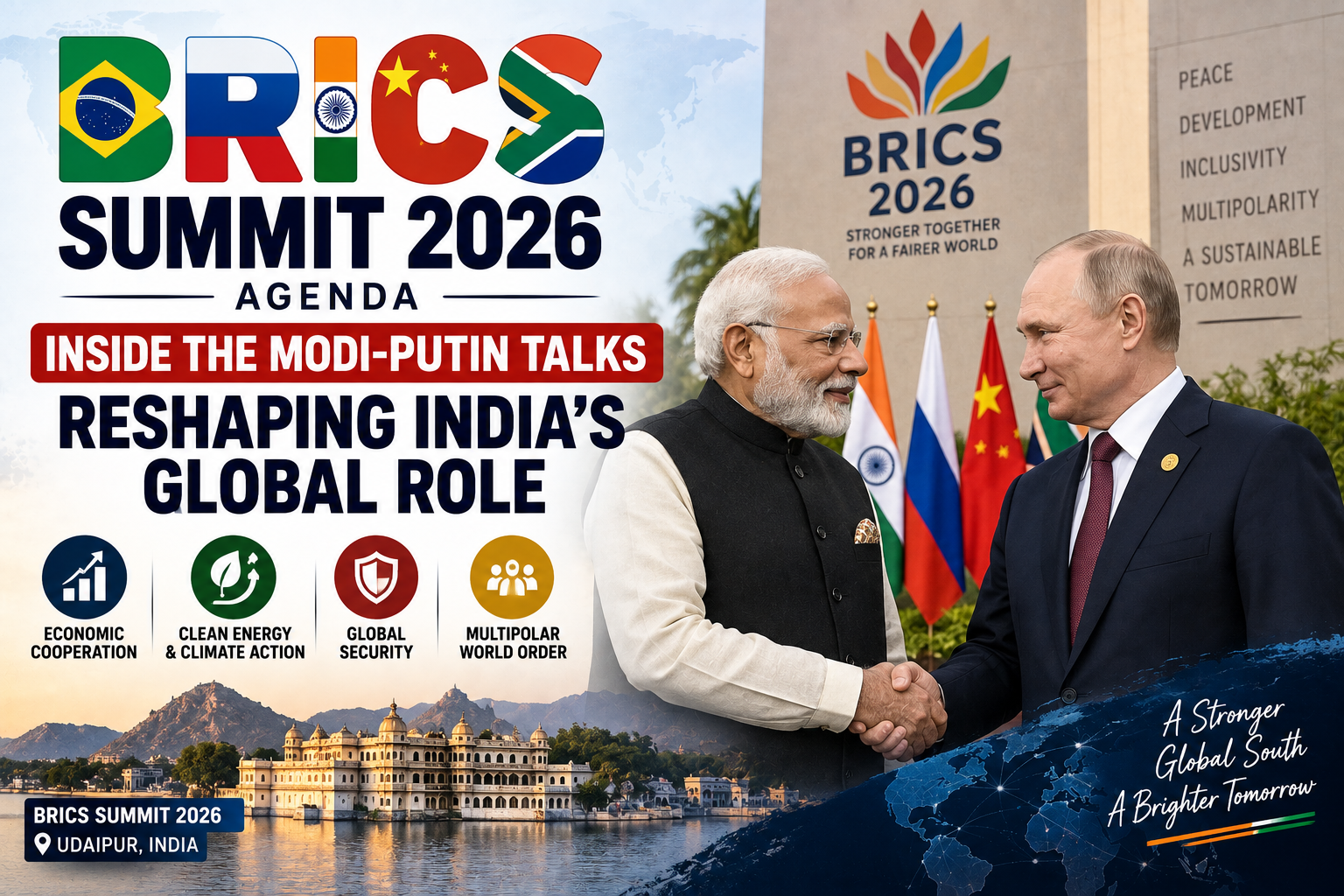
On September 11, 2026, a day before the formal opening of the 18th BRICS Summit, a motorcade will pull up outside Hyderabad House in New Delhi carrying Russian President Vladimir Putin. He is travelling to India specifically for a one-on-one meeting with Prime Minister Narendra Modi, confirmed by Kremlin spokesperson Dmitry Peskov — a full day before Putin even needs to be in the capital for the summit itself.
That single bilateral has generated more headlines than most items on the official BRICS agenda, and for good reason. It sits at the crossroads of three of the biggest live stories in world affairs: an unresolved war in Ukraine, a US-India trade relationship that swung from a punishing 50 percent tariff wall down to an 18 percent truce within six months, and a BRICS grouping quietly trying to build payment systems that do not run through Washington.
For UPSC, SSC, Banking, Railway and State PSC aspirants, the BRICS Summit 2026 is close to a perfect current affairs topic — it touches International Relations, the Indian economy, and India's foreign policy doctrine all in one event. By the end of this article, you will know exactly what the Modi-Putin talks are expected to cover, how the wider BRICS agenda connects to India's tariff troubles and the de-dollarization debate, and how to convert all of it into exam-ready answers.
Table of Contents
- Background: From BRICS to an 11-Member Bloc
- What Is the BRICS Summit 2026?
- The Modi-Putin Bilateral: What's on the Table
- Why This Summit Matters: Multi-Dimensional Impact
- Key Stakeholders and Their Positions
- Data, Statistics and Ground Reality
- Critical Analysis and Expert Perspective
- Challenges, Criticisms and Counterarguments
- India's Strategic Response and Future Roadmap
- Exam Preparation Strategy
- Key Takeaways
- Frequently Asked Questions
- Related Topics
Background: From BRICS to an 11-Member Bloc
The BRICS grouping traces back to a 2001 Goldman Sachs research term coined for four fast-growing economies — Brazil, Russia, India and China. The four countries turned the acronym into an actual forum, holding their first leaders' summit in Yekaterinburg, Russia, in 2009. South Africa joined in 2010, extending the acronym to BRICS.
The bloc stayed at five members for over a decade before a major expansion took effect from January 2024, when Egypt, Ethiopia, Iran and the United Arab Emirates became full members alongside the original five. Indonesia's accession followed in 2025, taking the grouping to an 11-member bloc, with Saudi Arabia still holding an invitation it has not formally converted into membership.
India took over the rotating BRICS chairship from Brazil on January 1, 2026 — its fourth time chairing the grouping — and unveiled its chairship logo, theme and website on January 13, 2026, at an event led by External Affairs Minister S. Jaishankar. Over the following months, India organised more than 350 meetings and high-level engagements across 25 Indian cities, from trade ministers in Jaipur to competition regulators in Udaipur, building toward the September leaders' summit in the capital.
| Milestone | Date |
|---|---|
| First BRICS Summit (Yekaterinburg) | 2009 |
| South Africa joins (BRIC → BRICS) | 2010 |
| Egypt, Ethiopia, Iran, UAE become full members | January 2024 |
| Indonesia's accession completed | 2025 |
| India assumes 2026 BRICS chairship | January 1, 2026 |
| Chairship theme, logo and website launched | January 13, 2026 |
| 18th BRICS Leaders' Summit, New Delhi | September 12-13, 2026 |
What Is the BRICS Summit 2026?
The BRICS Summit 2026 is the 18th annual leaders' summit of the BRICS grouping, hosted by India in New Delhi on September 12-13 at Bharat Mandapam. It brings together the 11-member bloc, its partner countries and outreach invitees under the theme "Building for Resilience, Innovation, Cooperation and Sustainability" to negotiate cooperation on trade, payments, technology and global governance reform.
The programme actually begins a day earlier. The BRICS Business Forum and engagements of the BRICS Women's Business Alliance are scheduled for September 11 at Bharat Mandapam, meaning the full BRICS calendar in New Delhi runs from September 11 to 13. India's Ministry of External Affairs formally confirmed the summit dates on August 27, 2026.
| Detail | Information |
|---|---|
| Official name | 18th BRICS Summit (BRICS Leaders' Summit 2026) |
| Host country | India (BRICS Chair since January 1, 2026) |
| Venue | Bharat Mandapam, Pragati Maidan, New Delhi |
| Business Forum | September 11, 2026 |
| Leaders' Summit | September 12-13, 2026 |
| Theme | Building for Resilience, Innovation, Cooperation and Sustainability |
| Guiding spirit | "Humanity First" — people-centric development |
| Presiding leader | Prime Minister Narendra Modi |
The Modi-Putin Bilateral: What's on the Table
Ahead of the leaders' summit, Modi and Putin are scheduled to hold a dedicated bilateral meeting in New Delhi on September 11 — a sequencing that itself signals how much weight both sides attach to the relationship. Kremlin spokesperson Dmitry Peskov confirmed the engagement, describing the two leaders as remaining in close and continuing contact.
According to reports ahead of the visit, the talks are expected to cover a defence-heavy agenda alongside broader bilateral issues:
- S-400 air defence system — status of the ongoing delivery schedule for India's Russian-origin missile shield
- Su-57 fighter jets — a possible sale and technology-transfer arrangement, which would deepen India's dependence on Russian combat aircraft technology
- BrahMos missile upgrades — continued joint development of the India-Russia cruise missile programme
- Energy and nuclear cooperation — including the trajectory of Russian crude oil supply and civil nuclear projects
- Trade and payments — building further on a bilateral relationship where close to 95 percent of trade already settles in rupees and rubles rather than dollars
This is not a one-off encounter. It continues a running pattern of high-frequency Modi-Putin contact — a bilateral on the sidelines of the 16th BRICS Summit in Kazan in October 2024, and a phone call in August 2023 to discuss the Johannesburg summit outcomes — that underlines how India has kept its Russia channel open even as its relationship with Washington has swung sharply in the past year.
Chinese President Xi Jinping is also expected in New Delhi, though Beijing had not formally confirmed his attendance at the time of writing. China's foreign ministry has said it values BRICS cooperation and supports India's hosting role, language that stops short of a firm confirmation — a reminder that unresolved India-China border tensions still shadow the bloc's biggest annual gathering.
Why This Summit Matters: Multi-Dimensional Impact
Political: Hosting the summit lets India showcase its "multi-alignment" foreign policy in action — deepening defence and energy ties with Russia while simultaneously managing its economic relationship with the United States and its complicated one with China, all without picking a permanent camp.
Economic: The centrepiece economic project is BRICS Pay, a payment-linkage effort connecting Russia's SPFS, China's CIPS, India's UPI and Brazil's Pix, which officials are targeting for operational movement around the New Delhi summit. Alongside it sits "The Unit," a gold-referenced settlement concept that completed a 100-unit pilot on October 31, 2025 — still experimental, not a reserve currency.
Social: Cheaper, faster cross-border payment rails could eventually lower transaction costs for exporters and remittance-sending households across BRICS economies, though the near-term effect on ordinary consumers remains limited.
Environmental: Energy security and climate resilience carry extra weight this year given continuing volatility in global oil and shipping markets tied to the Ukraine war and Western sanctions on Russian energy exports.
Geopolitical: The summit unfolds against the backdrop of Washington's direct warning that it would impose tariffs of up to 100 percent on BRICS members that build a rival reserve currency — a threat that keeps the bloc's de-dollarization language deliberately cautious.
Key Stakeholders and Their Positions
| Stakeholder | Stated Position | Underlying Interest |
|---|---|---|
| India | Host and 2026 chair; frames the summit around "practical, people-centric" outcomes | Wants deliverables (payment systems, MSME cooperation) without an anti-Western framing that could complicate US and EU ties |
| Russia | Full support for India's chairship; seeks expanded defence and energy cooperation | Needs sanctions-resilient trade channels and reliable arms/energy buyers |
| China | "Values BRICS cooperation," attendance unconfirmed at writing | Wants to expand its economic weight in the bloc while managing unresolved border friction with India |
| United States (non-member) | Publicly hostile to any BRICS reserve-currency ambitions | Wants to protect dollar dominance and preserve leverage over India via trade policy |
| Other BRICS+ members | Vary — Brazil retains strong Western economic ties; UAE and Saudi Arabia balance Gulf-US relationships | Diversify trade options without severing existing dollar-based commerce |
Data, Statistics and Ground Reality
Numbers tell the India-Russia-US triangle story better than any single headline. Consider the whiplash in US tariff policy toward India over the past thirteen months:
| Date | Development |
|---|---|
| July 30, 2025 | US announces an initial 25% tariff on Indian goods |
| August 6, 2025 | Trump signs an executive order adding a further 25% tariff over India's Russian oil purchases, taking the total to 50% |
| August 27, 2025 | The 50% combined tariff takes effect — among the highest US tariff rates on any trading partner |
| February 2, 2026 | Trump announces a bilateral deal cutting the tariff from 50% to 18%, alongside an Indian commitment to move toward zero tariffs on US goods and pull back Russian oil purchases |
| February 20, 2026 | The US Supreme Court strikes down the IEEPA tariffs underpinning the deal, unsettling the timeline |
| June 2026 | Negotiations continue amid fresh US proposals for forced-labour and "excess capacity" tariffs on Indian textiles |
On the BRICS side of the ledger, close to 95 percent of India-Russia trade now settles in rupees and rubles rather than dollars — a bilateral shift achieved without any bloc-wide currency decision. The mBridge central bank digital currency platform, built with the Bank for International Settlements, had processed transactions worth $55.49 billion by November 2025. Yet the US dollar's share of global reserves, tracked by the Atlantic Council's Dollar Dominance Monitor, stood at roughly 58 percent against the euro's 20 percent — figures that have moved little despite years of BRICS de-dollarization rhetoric.
Expert Analysis & Critical Assessment
The gap between BRICS rhetoric and BRICS reserve data is the single most important nuance for exam answers on this topic. India's own external affairs minister has been unambiguous about where New Delhi stands.
External Affairs Minister S. Jaishankar has stressed that India has no policy of trying to displace the dollar, describing "the dollar as the reserve currency" as "the source of global economic stability."
Independent analysts broadly agree the New Delhi summit is likelier to produce declaratory language on payment-system cooperation than any structural break from the dollar. The bloc has formally shelved the idea of a single common currency — Brazil dropped the proposal during its own 2025 presidency — leaving BRICS Pay and CBDC interoperability as the more realistic, incremental 2026 deliverables. Analysts caution, though, that a genuine shock — such as a fresh round of US secondary sanctions on banks handling Russian oil payments — could accelerate de-dollarization far faster than any summit communique.
Challenges, Criticisms and Counterarguments
- Bloc coherence: An 11-member grouping with sharply different relationships to Washington — from Russia and Iran's adversarial ties to Brazil and the UAE's much warmer ones — makes unanimous language on sensitive issues harder to achieve.
- China's economic weight: China accounts for roughly 70 percent of combined BRICS GDP, feeding concerns among smaller members about free-rider dynamics and unequal benefit-sharing.
- India-China friction: Xi Jinping's unconfirmed attendance, even as China voices general support for India's chairship, reflects how border tensions continue to complicate the bloc's biggest members working in lockstep.
- Skepticism on de-dollarization: Critics argue the "de-dollarization" narrative is overstated relative to hard reserve-currency data, and that fragmented national-currency deals are a weak substitute for a genuinely unified alternative.
- External pressure: Washington's explicit tariff threat against any BRICS move toward a rival currency functions as a standing deterrent that shapes how cautiously the bloc frames its own communique language.
Strategic Outlook & Future Roadmap
India has deliberately pitched its chairship year around delivery rather than confrontation — the "Humanity First" framing is designed to keep the summit's economic outcomes (payment infrastructure, MSME support, digital trade) separate from any perception of an anti-Western bloc. Watch for three signals in the coming weeks: the exact wording the summit declaration uses on payment systems and currency cooperation; whether Xi Jinping's attendance is finally confirmed and what, if anything, a Modi-Xi bilateral produces; and whether the Modi-Putin talks yield an announced defence deal on the Su-57 or a firmer S-400 delivery timeline.
On the US front, India's diplomatic tightrope will only get more delicate. New Delhi must manage the still-unsettled fallout from the Supreme Court's tariff ruling and the newer forced-labour and excess-capacity tariff threats, even as it deepens defence and energy cooperation with Moscow in full public view at Bharat Mandapam.
Key Exam Takeaways (UPSC, SSC & Banking)
This topic is genuinely multi-paper material for UPSC Mains, and equally useful for SSC, Banking and State PSC current affairs sections.
- GS Paper 2 (International Relations): India's bilateral relationship with Russia; the significance of multilateral groupings like BRICS for India's foreign policy; effect of developed and developing countries' policies on India's interests
- GS Paper 3 (Economy): De-dollarization and its implications for India; cross-border payment infrastructure; the impact of US tariff policy on Indian exports
- Likely Mains angle: "Discuss the significance of India's BRICS chairship for its foreign policy and economic diplomacy in 2026." or "Critically examine the prospects and limitations of de-dollarization for BRICS economies."
- MCQ-ready facts: summit dates and venue, the 11-member composition, chairship theme, Modi-Putin meeting date
Key terms glossary: BRICS Pay, mBridge, The Unit, New Development Bank (NDB), Contingent Reserve Arrangement (CRA), CBDC, SPFS, CIPS, de-dollarization, reciprocal tariff, IEEPA.
Model answer framework: Introduction (define BRICS+ and its 2026 expansion) → Body (political, economic and strategic significance for India, with one paragraph each on Russia ties, US tariff context, and payment-system cooperation) → Conclusion (balanced note acknowledging both the summit's real deliverables and its structural limits).
Common mistake to avoid: Don't conflate "de-dollarization" with "a new BRICS currency" — the bloc has formally shelved the common-currency idea, and examiners reward candidates who make that distinction precisely.
Key Takeaways
- The 18th BRICS Summit runs September 11-13, 2026, in New Delhi at Bharat Mandapam, under India's chairship.
- Modi and Putin hold a dedicated bilateral on September 11, expected to cover the S-400, Su-57, BrahMos and energy cooperation.
- Xi Jinping's attendance remained unconfirmed by China at the time of writing, reflecting continuing India-China friction.
- BRICS Pay, linking UPI, SPFS, CIPS and Pix, is the summit's realistic economic deliverable — not a new common currency, which the bloc has shelved.
- US tariffs on India swung from 50% to 18% between August 2025 and February 2026, then faced fresh uncertainty after a Supreme Court ruling.
- Roughly 95% of India-Russia trade already settles in rupees and rubles, though the dollar still holds about 58% of global reserves.
- For exams, this topic spans GS Paper 2 (IR) and GS Paper 3 (Economy) simultaneously.
Frequently Asked Questions
What is the BRICS Summit 2026?
It is the 18th BRICS Leaders' Summit, hosted by India in New Delhi on September 12-13, 2026, at Bharat Mandapam, bringing together the bloc's 11 members under India's 2026 chairship theme.
When is the Modi-Putin meeting at BRICS 2026?
Prime Minister Modi and President Putin are scheduled to hold a bilateral meeting in New Delhi on September 11, 2026, a day before the formal summit opens.
Is BRICS launching a new currency in 2026?
No. BRICS has shelved plans for a common currency. The 2026 focus is BRICS Pay, a payment-linkage system, and continued national-currency trade settlement, not a shared reserve currency.
Why is BRICS important for India's UPSC preparation?
BRICS connects India's foreign policy (GS Paper 2) with economic diplomacy (GS Paper 3), covering multilateral groupings, de-dollarization, and India's bilateral ties with Russia and China in a single current-affairs theme.
How did US-India tariffs change ahead of BRICS 2026?
Tariffs rose to 50% in August 2025 over India's Russian oil purchases, fell to 18% after a February 2026 deal, then faced renewed uncertainty following a Supreme Court ruling and new tariff proposals.
Is China's Xi Jinping attending the BRICS Summit 2026?
Xi Jinping's participation was widely expected but had not been formally confirmed by China as of the reporting available, unlike Russia's Putin, whose attendance and bilateral meeting were confirmed by the Kremlin.
What defence deals are expected between India and Russia at BRICS 2026?
Reports point to discussions on S-400 delivery status, a possible Su-57 fighter jet sale with technology transfer, and BrahMos missile upgrades during the Modi-Putin bilateral.
Related Topics
- India's Multi-Alignment Foreign Policy — how India balances ties with Russia, the US and China simultaneously, the doctrinal backdrop to this summit.
- US-India Trade Relations 2026 — the tariff rollercoaster that forms the backdrop to India's Russia outreach.
- New Development Bank (NDB) — the BRICS-founded lender central to the bloc's alternative-finance ambitions.
- India-Russia Defence Cooperation — the S-400, BrahMos and potential Su-57 deals shaping military ties.
- De-dollarization Explained — a deep dive into BRICS Pay, mBridge and CBDC interoperability.
- SCO Summit and India's Multilateral Diplomacy — how BRICS fits alongside India's other regional groupings.
Conclusion
Strip away the headlines about handshakes and photo-ops, and the BRICS Summit 2026 tells a clear story: India is trying to prove that "multi-alignment" is a workable foreign policy, not just a diplomatic buzzword. Hosting Putin for defence talks a day before welcoming a still-uncertain Xi Jinping, while nursing a tariff relationship with Washington that has swung wildly in thirteen months, is exactly the kind of balancing act future exam questions will ask you to analyse — not celebrate or condemn, but explain.
If you take one thing into your revision notes, make it this: BRICS 2026 is about payment plumbing and diplomatic positioning, not a new currency or a new Cold War bloc. Read the summit declaration when it drops on September 13, compare it against what this article predicted, and you will have one of the sharpest current-affairs answers in your exam hall. Explore our related coverage on India's foreign policy and the US-India trade deal to build the complete picture — and share your questions in the comments below.
Editorial & Verification Standards
This article was researched, written, and verified by the CurrentAffairs360 editorial team in collaboration with educators at Khalsa Inter College, Naka Hindola, Lucknow. All insights are cross-verified against official government sources (PIB, RBI, The Hindu, Indian Express) to ensure rigorous exam authenticity.
Meet our editorial and teaching team →