Operation Sankalp 2.0: India's Gulf Seafarer Shield 2026
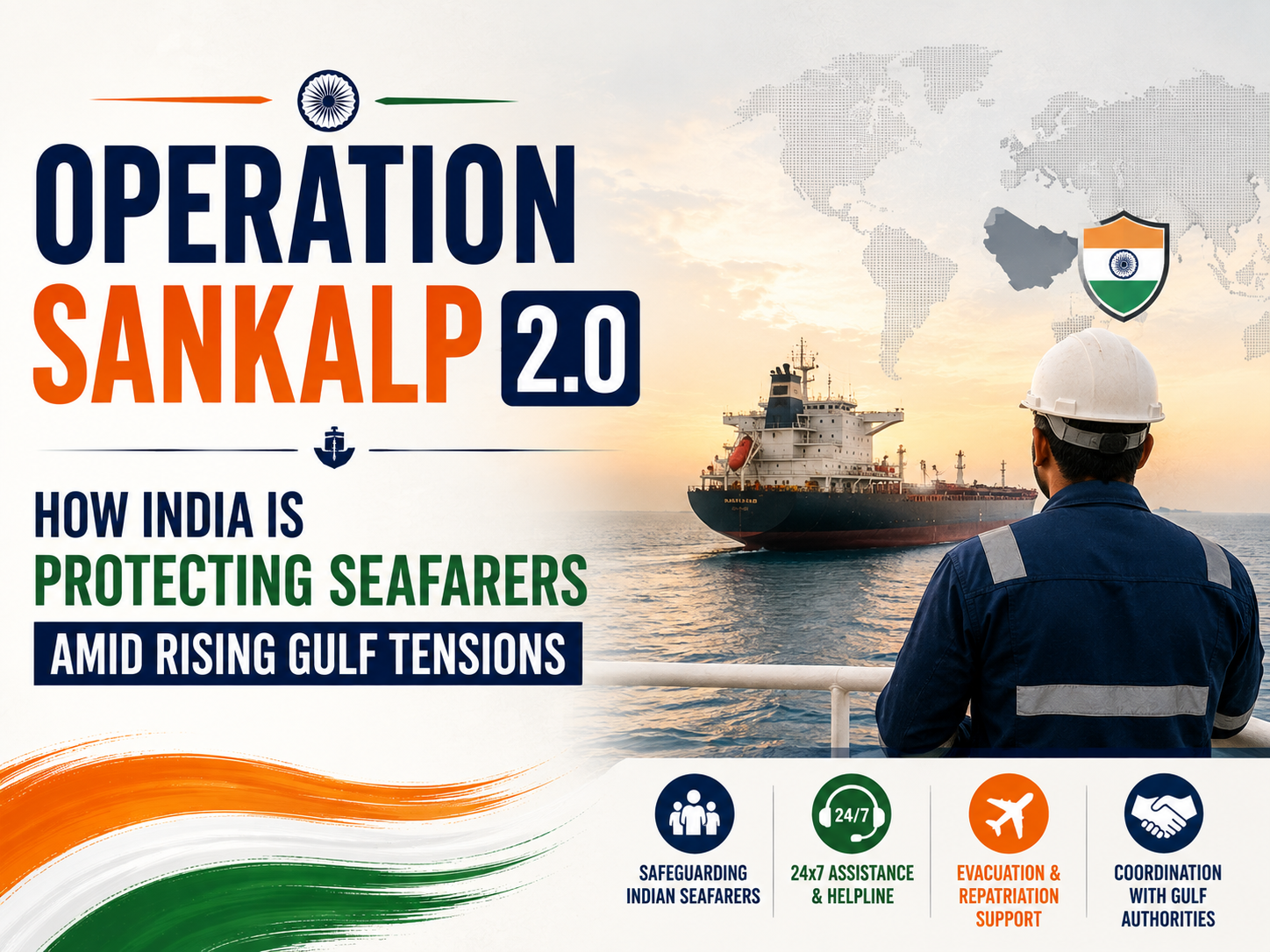
On the night of 14 July 2026, Iranian cruise missiles struck two UAE-flagged supertankers, the Bahyah and the Mombasa, in the southern reaches of the Strait of Hormuz. Among the twelve Indian nationals aboard the Bahyah, one did not survive. Nine of the eighteen Indian sailors on the Mombasa were airlifted to hospitals in the Northern Emirates. Two days later, New Delhi did something it had never done before in the operation's seven-year history: it ordered every Indian seafarer off every ship bound through the Strait of Hormuz, "until further orders."
That order — Circular No. 36 of 2026 from the Directorate General of Shipping — is the latest and most drastic turn in a maritime security effort that has quietly protected Indian sailors and Indian trade for years: Operation Sankalp. What began in 2019 as a single-ship presence mission has, through the 2026 Strait of Hormuz crisis, evolved into a far more assertive posture that many analysts and sections of the press are now calling Operation Sankalp 2.0 — a scaled-up, multi-agency response built around escort corridors, real-time threat tracking, and an unprecedented decision to pull India's own citizens out of harm's way entirely.
This article traces exactly how Operation Sankalp has changed shape since February 2026, what it means for India's energy security and its 300,000-strong seafarer workforce, and — critically for exam aspirants — how to use this single current affairs story to answer questions across GS2 (International Relations), GS3 (Internal Security and Economy), and Essay papers.
By the end of this article, you will be able to explain the origins of Operation Sankalp, map the 2026 Hormuz crisis timeline, analyse India's "non-escalatory" naval posture, and construct a UPSC Mains-ready answer connecting maritime security to energy security and diaspora welfare.
Table of Contents
- 1. Background: From Operation Sankalp to the 2026 Hormuz Crisis
- 2. What Is Operation Sankalp 2.0, Exactly?
- 3. Why This Matters: Multi-Dimensional Impact Analysis
- 4. Key Stakeholders and Their Positions
- 5. Data, Statistics and Ground Reality
- 6. Critical Analysis: Reading Between the Headlines
- 7. Challenges, Criticisms and Counterarguments
- 8. India's Strategic Response and Future Roadmap
- 9. Exam Preparation Strategy
- 10. Key Takeaways
- 11. Frequently Asked Questions
- 12. Related Topics
Background: From Operation Sankalp to the 2026 Hormuz Crisis
Operation Sankalp — Sanskrit for "commitment" — was launched by the Indian Navy on 19 June 2019, days after explosions damaged two oil tankers in the Gulf of Oman amid an earlier round of US-Iran tension. The mission's original mandate was narrow but vital: keep one Indian warship with an embedded helicopter continuously present off Ra's al Hadd, in the Gulf of Oman and the Persian Gulf, to reassure Indian shipping and respond to emergencies.
The operation runs through coordination between the Navy and the Ministries of Defence, External Affairs, Ports, Shipping and Waterways, and Petroleum and Natural Gas, alongside the Directorate General of Shipping. Between June 2019 and May 2021 alone, roughly twenty Indian warships rotated through the mission, safely escorting more than 200 Indian-flagged vessels carrying over 21 million tonnes of cargo. The legal backbone was strengthened in 2022 with the Maritime Anti-Piracy Act, which for the first time gave India a dedicated law to prosecute piracy rather than relying on borrowed provisions.
Op Sankalp's anti-piracy credentials were on global display in March 2024, when Indian MARCOS commandos were air-dropped roughly 2,600 kilometres from the Indian coast — using an IAF C-17 — to end a 40-hour standoff with 35 armed Somali pirates who had hijacked the merchant vessel MV Ruen. In just the 100 days preceding that operation, the Navy said it had saved 110 lives (45 Indian and 65 foreign nationals) across more than 90 recorded maritime incidents, including 57 drone or missile attacks and 39 piracy or hijacking attempts.
Then came 2026. On 28 February, the United States and Israel launched air strikes on Iran, including the assassination of Supreme Leader Ali Khamenei, igniting the 2026 Iran War. Iran retaliated with missile and drone strikes on Israel, US bases, and Gulf states, and — critically for shipping — its Revolutionary Guard Corps (IRGC) declared the Strait of Hormuz off-limits, boarded and attacked merchant vessels, and laid sea mines. The strait, which carries roughly a fifth of the world's traded oil and LNG, was effectively closed. This is the moment Operation Sankalp stopped being a steady-state presence mission and became a live crisis-response operation.
What Is Operation Sankalp 2.0, Exactly?
Operation Sankalp 2.0 is the informal but increasingly common name for the intensified, multi-layered phase of India's Gulf maritime security effort that has unfolded since the 2026 Strait of Hormuz crisis began. It is not a single, separately notified mission but an evolution of Operation Sankalp itself, reinforced by a dedicated sister operation — Operation Urja Suraksha ("energy protection") — launched by the Navy on 23 March 2026 specifically to escort Indian-flagged and India-bound energy shipments in the crisis's aftermath.
Where the original Sankalp model relied on a handful of ships providing "presence" and occasional escort on request, the 2026 posture is built around several distinct, verifiable elements:
- A larger, dedicated flotilla — over half a dozen warships, including logistics support vessels, positioned east of the Strait of Hormuz to escort Indian-flagged tankers as they exit the Gulf of Oman.
- A deliberately non-escalatory posture — Indian warships do not enter the strait itself, choosing to shepherd vessels from the safer eastern approaches rather than confront Iranian forces directly.
- Diplomatic access-brokering — Iran's Foreign Minister publicly stated in March 2026 that India, along with China and Russia, would be treated as a "friendly nation" permitted to keep using the strait, a status India appears to have used to keep select cargo moving even at the height of the crisis.
- A seafarer-safety override — the July 2026 DG Shipping order that, for the first time, prioritises pulling Indian crew off Hormuz-bound voyages over keeping cargo moving, regardless of the diplomatic access India otherwise enjoys.
In short: Operation Sankalp 2.0 is best understood not as a rebranded operation but as Operation Sankalp's crisis mode — the same commitment, executed under wartime conditions, now split between protecting ships (Urja Suraksha) and protecting people (the seafarer deployment ban).
Why This Matters: Multi-Dimensional Impact Analysis
Economic dimension: India imports roughly 85% of its crude oil needs, and the Gulf has historically supplied well over half of that. Every disruption to Hormuz transits pushes up freight rates, war-risk insurance premiums, and ultimately fuel and LPG prices for Indian households and industry. Yet Indian-flagged tankers — including the Green Asha, Jag Laadki, Jag Prakash, and Green Sanvi — continued making crude, gasoline, and LPG runs through April 2026, showing the trade could not simply stop.
Social dimension: India is the world's third-largest supplier of seafarers, with more than 300,000 sailors serving on fleets worldwide, many of them from coastal districts of Kerala, Maharashtra, Gujarat, and Tamil Nadu. For these families, remittances are not supplementary income — they are often the primary household income. The deaths and injuries of July 2026 turned an abstract shipping-lane statistic into a domestic political and emotional issue overnight.
Political dimension: The government's decision to override commercial logistics in favour of an outright seafarer deployment ban signals that domestic political pressure to protect citizens can, and did, override the usual calculus of keeping trade flowing at any cost.
Geopolitical dimension: India's "non-escalatory" posture — escorting from outside the strait rather than confronting Iranian forces — and its reported "friendly nation" access illustrate India's long-standing strategy of maintaining working relationships with Iran, the Gulf Arab states, and the US-Israel bloc simultaneously, rather than aligning fully with any one side.
Legal dimension: The Maritime Anti-Piracy Act 2022 and the regulatory authority of the Directorate General of Shipping (through Circular No. 36 of 2026) together illustrate the two legal tools India now has to both police threats at sea and control its own citizens' exposure to them.
Key Stakeholders and Their Positions
| Stakeholder | Stated Position / Role |
|---|---|
| Indian Navy | Executes escort and presence missions under Operation Sankalp / Urja Suraksha; maintains a non-escalatory posture east of the strait |
| Directorate General of Shipping | Regulates deployment of Indian seafarers; issued the July 2026 ban on Hormuz voyages |
| Ministry of External Affairs | Condemned attacks on seafarers and on freedom of navigation; manages diplomatic channels with Iran and Gulf states |
| Iran / IRGC | Closed the strait to hostile-linked shipping, attacked and mined vessels, but granted continued access to India, China, and Russia as "friendly nations" |
| United States and Israel | Conducted the air campaign against Iran and a naval blockade aimed at reopening the strait to international shipping |
| Seafarer unions (e.g., All India Seafarer and General Worker Union) | Welcomed the deployment ban as a necessary protective step for crew safety |
| Shipping companies and ship managers | Required to comply with the DG Shipping order; face crewing and scheduling disruption |
Data, Statistics and Ground Reality
Numbers make the human stakes concrete. As the Hormuz crisis unfolded through 2026, independently tracked figures painted a sobering picture: at least one tugboat sunk, more than seventeen merchant vessels damaged (several abandoned), two ships captured, and around a dozen seafarers killed or reported missing across the crisis, alongside casualties among port workers in Bahrain.
- 22 India-flagged merchant ships carrying 611 seafarers were trapped inside the Persian Gulf as of 18 March 2026, unable to exit through the closed strait.
- India sources roughly 85% of its crude oil requirement through imports, with the Gulf historically accounting for well over half of that volume.
- India supplies more than 300,000 seafarers to the global merchant fleet, making it the world's third-largest source of maritime crew.
- In the week before the July 2026 ban, two Indian seafarers were killed and several more injured in successive attacks on tankers in the strait.
The scale of the July 2026 order is unprecedented: never before has India suspended its own citizens' deployment through an entire international strait rather than simply escorting them through it.
Critical Analysis: Reading Between the Headlines
The most important shift in 2026 is not naval hardware — it is a change in India's risk calculus. For most of Operation Sankalp's history since 2019, the underlying assumption was that presence and escort could manage risk to an acceptable level while trade continued largely uninterrupted. The July 2026 order breaks that assumption: it accepts, at least temporarily, that no level of naval escort can fully guarantee crew safety inside an active war zone, and that protecting citizens must take precedence over protecting cargo flow.
This has a quieter but equally significant second layer: by keeping its warships east of the strait rather than inside it, India has avoided being drawn into the US-led blockade or the wider Iran war, preserving the diplomatic space that let Iran's foreign minister describe India as a "friendly nation" even as Tehran fought a shooting war with Washington and Tel Aviv. Few countries with comparable trade exposure to the Gulf have managed to keep that balance intact through 2026.
A likely UPSC Mains question building on this could ask: "Discuss how India's response to the 2026 Strait of Hormuz crisis reflects continuity and change in its West Asia policy." A strong answer would argue continuity in India's non-alignment instinct and multi-vector diplomacy, alongside genuine change in its willingness to prioritise citizen safety over trade continuity.
Challenges, Criticisms and Counterarguments
- Economic cost of the ban: Removing Indian crew from Hormuz-bound vessels can strand ships, disrupt crewing schedules for shipping companies, and, if prolonged, dent the income of thousands of seafarer families dependent on those specific routes.
- Escalation risk despite restraint: Even a non-escalatory posture carries risk — Indian-flagged vessels have already been targeted or threatened (as with the Jag Laadki at Fujairah), meaning presence alone cannot guarantee immunity from attack.
- Dependence on Iranian goodwill: India's continued access as a "friendly nation" rests on Tehran's unilateral discretion, not a binding guarantee — a diplomatic asset that could be withdrawn if the broader war escalates further.
- War-risk insurance and freight costs: Elevated premiums for Hormuz transits raise costs across the energy import chain, a burden that eventually reaches Indian consumers.
- Coordination complexity: Running Operation Sankalp, Operation Urja Suraksha, and the DG Shipping deployment ban simultaneously requires close coordination across the Navy, MEA, and the shipping ministry — any gap risks confusion for shipowners and crew.
India's Strategic Response and Future Roadmap
In the near term, the DG Shipping ban remains in force "until further orders," meaning its lifting will likely track the security situation in the strait rather than a fixed calendar date. The Navy is expected to maintain its east-of-strait escort posture under Operation Urja Suraksha for as long as the broader Iran war and the US naval blockade of Iranian ports continue.
- Watch for any ceasefire or de-escalation announcement between the US, Israel, and Iran — this is the single biggest variable determining when Hormuz transits normalise.
- Track whether Iran maintains its "friendly nation" access commitment to India, China, and Russia as the conflict evolves.
- Expect continued diversification talk — India accelerating alternative crude and LPG sourcing (Russia, US Gulf Coast, West Africa) to reduce Hormuz dependence over the medium term.
- Expect India to press, through multilateral shipping and maritime-labour forums, for stronger international protection norms for seafarers caught in conflict zones.
Exam Preparation Strategy: How to Use This Topic
GS2 (International Relations) angle: Use this as a live case study of India's West Asia balancing strategy — maintaining ties with Iran, the Gulf Arab states, Israel, and the US simultaneously.
GS3 (Economy and Security) angle: Connect it to energy security, chokepoint dependence, and the Maritime Anti-Piracy Act 2022 as an example of legal capacity-building for maritime security.
Likely question formats:
- MCQ: "Operation Sankalp was launched in which year and in response to which incident?" (Answer: 2019, tanker attacks in the Gulf of Oman)
- MCQ: Identify the strait through which roughly one-fifth of global oil and LNG trade passes (Strait of Hormuz)
- Mains (GS2): Analyse India's diplomatic balancing act in the Gulf amid the 2026 Iran War.
- Mains (GS3): Discuss the linkage between maritime chokepoint security and India's energy security strategy.
Key terms to memorise: chokepoint, flag state, non-escalatory posture, war-risk premium, IRGC, Directorate General of Shipping, Maritime Anti-Piracy Act 2022, net security provider.
Model answer framework (Mains): (1) Introduce with the immediate trigger — the 2026 Hormuz crisis and the seafarer deployment ban; (2) Body — trace Operation Sankalp's evolution 2019 to 2026, cover economic/social/geopolitical dimensions; (3) Conclusion — link to India's broader "net security provider" role in the Indian Ocean Region.
Common mistake to avoid: Do not conflate Operation Sankalp (2019, ongoing presence mission) with Operation Sindoor or other unrelated operations — examiners specifically test for this kind of naming confusion.
Key Takeaways
- Operation Sankalp began in June 2019 to protect Indian-flagged shipping after tanker attacks in the Gulf of Oman.
- "Operation Sankalp 2.0" refers to the intensified 2026 posture, anchored by the dedicated Operation Urja Suraksha escort mission launched on 23 March 2026.
- India keeps its warships east of the Strait of Hormuz rather than inside it — a deliberately non-escalatory choice.
- In July 2026, India took the unprecedented step of banning its own seafarers from Hormuz-transiting voyages after fatal attacks on the tankers Bahyah and Mombasa.
- India is the world's third-largest seafarer-supplying nation, with over 300,000 sailors at sea globally.
- Iran has reportedly granted India "friendly nation" access even amid its wider conflict with the US and Israel.
- The Maritime Anti-Piracy Act 2022 gives India a dedicated legal framework for prosecuting piracy at sea.
- For exams, this topic bridges GS2 (foreign policy) and GS3 (energy security and internal security) syllabi.
Frequently Asked Questions
What is Operation Sankalp?
Operation Sankalp is the Indian Navy's ongoing maritime security mission, launched in June 2019, to protect Indian-flagged commercial vessels transiting the Strait of Hormuz, Gulf of Oman, and wider Persian Gulf region.
Why is Operation Sankalp important for India?
It safeguards the sea lanes carrying the bulk of India's crude oil and LPG imports and protects the safety of Indian seafarers, who make up a major share of the global merchant marine workforce.
What is "Operation Sankalp 2.0"?
It is the informal name used for the intensified 2026 phase of the mission, combining an expanded naval escort presence (Operation Urja Suraksha) with a first-ever ban on deploying Indian seafarers through the Strait of Hormuz.
Why did India ban seafarers from the Strait of Hormuz?
Following fatal missile strikes on the tankers Bahyah and Mombasa in mid-July 2026 that killed and injured Indian nationals, the Directorate General of Shipping ordered a halt to Indian crew deployment on Hormuz-transiting vessels until further notice.
Is India directly involved in the Iran war?
No. India has maintained a non-escalatory posture, keeping its naval assets outside the strait itself and avoiding direct engagement with Iranian forces while continuing diplomatic outreach.
Which UPSC topics connect to Operation Sankalp?
It links to India's West Asia foreign policy (GS2), energy security and maritime chokepoints (GS3), and anti-piracy law under the Maritime Anti-Piracy Act 2022.
What percentage of India's oil imports come through the Gulf?
Historically, well over half of India's crude oil imports have originated from Gulf countries, making Hormuz-linked disruptions directly relevant to India's energy security.
Operation Sankalp vs Operation Urja Suraksha — what's the difference?
Operation Sankalp is the long-running, broader maritime security mission dating to 2019; Operation Urja Suraksha is a narrower, dedicated escort mission launched in March 2026 specifically to protect energy shipments during the Hormuz crisis.
Related Topics
- 2026 Strait of Hormuz Crisis — the broader conflict and blockade context driving Operation Sankalp's current posture.
- India's Energy Security Strategy — how crude and LPG import diversification connects to chokepoint risk.
- Maritime Anti-Piracy Act 2022 — the legal framework underpinning India's anti-piracy operations.
- India's Indian Ocean Region (IOR) Policy and SAGAR Doctrine — the wider strategic doctrine Operation Sankalp fits into.
- Indian Diaspora and Seafarer Welfare Policy — the human and labour dimension of maritime security.
- India-Iran Relations — the diplomatic balancing act behind India's "friendly nation" access.
- UN Convention on the Law of the Sea (UNCLOS) — the legal backdrop governing strait transit rights.
Conclusion
Operation Sankalp's story since 2019 is really the story of India learning, incident by incident, how far naval presence alone can protect its interests in the Gulf — and where it cannot. The 2026 crisis pushed that lesson to its limit: escort ships, yes; but when missiles start finding tankers with Indian names on the crew list, the only response left is to pull those citizens out entirely. That is the real meaning behind "Operation Sankalp 2.0" — not a bigger fleet, but a harder-won recognition of where the line between calculated risk and unacceptable risk actually sits.
For aspirants, this is exactly the kind of layered, evolving current affairs story examiners reward: one that connects foreign policy, economics, and the lived reality of ordinary Indian workers at sea. Read the full daily current affairs coverage on CurrentAffairs360, attempt today's practice paper, and revisit this article closer to your exam date — the Hormuz situation is still developing, and so is the syllabus around it.
About the Author
School Principal at Khalsa Inter College, Naka Hindola, Lucknow, Uttar Pradesh. Committed to providing free, quality education for students preparing for competitive examinations.
Learn more about our mission →