India-Sri Lanka $350M LoC: Cyclone Ditwah Relief Explained
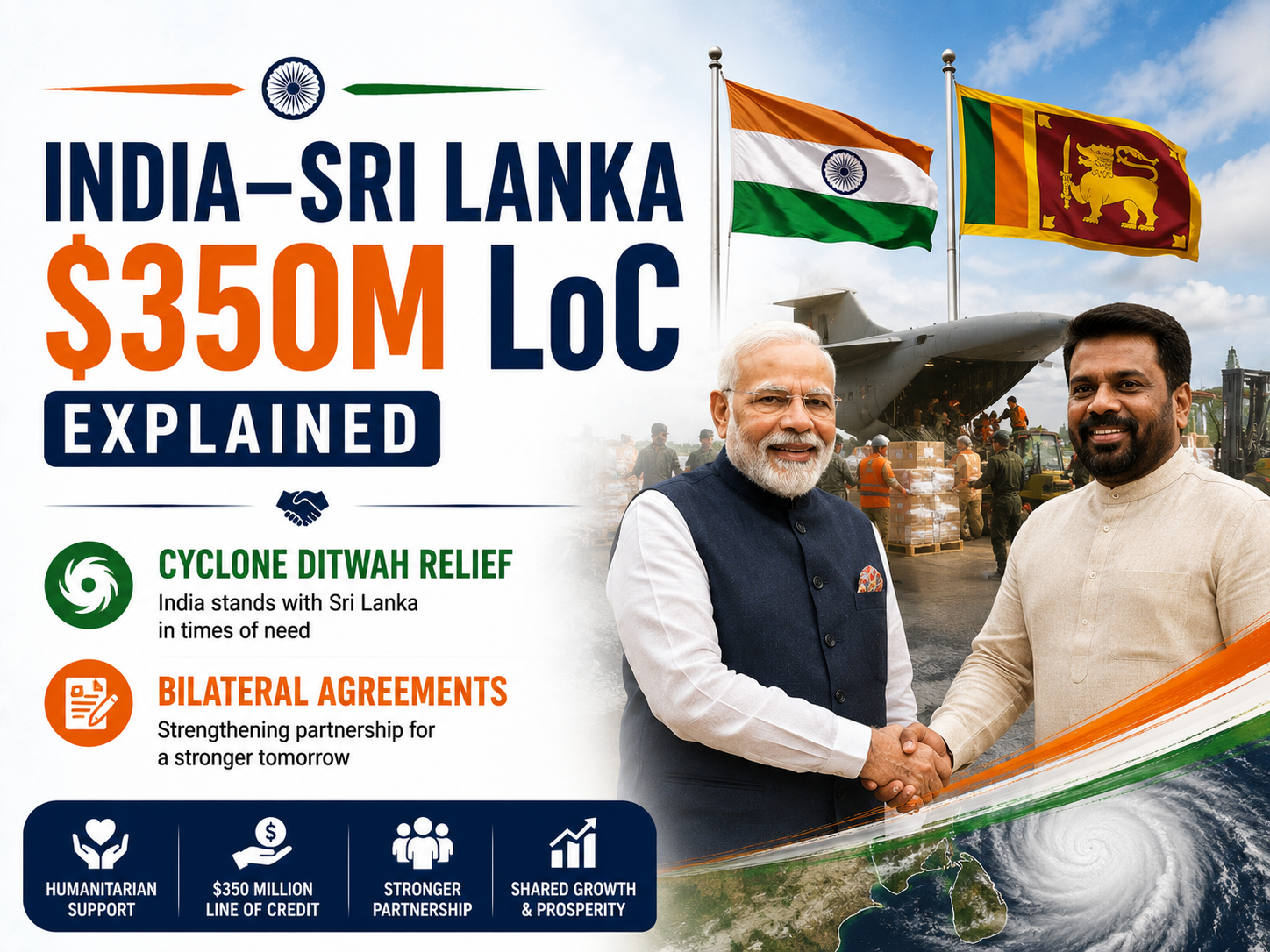
On 5 August 2026, in Colombo, India and Sri Lanka exchanged agreements for an Indian Rupee-denominated Line of Credit (LoC) worth USD 350 million. The signing, following a meeting between Indian Foreign Secretary Vikram Misri and Sri Lankan President Anura Kumara Dissanayake, was not a stand-alone financial event. It was the concrete follow-through on a commitment New Delhi made eight months earlier, in the immediate aftermath of one of Sri Lanka's deadliest natural disasters in recent memory: Cyclone Ditwah.
For competitive exam aspirants, this single news item sits at the intersection of India's neighbourhood diplomacy, its concessional financing architecture, disaster-response doctrine, and its strategic competition with China in the Indian Ocean Region (IOR). By the end of this article, you will understand exactly what was signed, why it matters, how it connects to India's broader MAHASAGAR and Neighbourhood First policies, and how to use this topic in a UPSC, SSC, or state PSC answer.
Table of Contents
- Background: What Was Cyclone Ditwah?
- The $450 Million Reconstruction Package Explained
- What Was Signed on 5 August 2026
- Multi-Dimensional Impact Analysis
- Key Stakeholders
- Data and Ground Reality
- Critical Analysis
- Challenges and Criticisms
- India's Strategic Roadmap
- Exam Preparation Strategy
- Key Takeaways
- FAQs
- Related Topics
Background: What Was Cyclone Ditwah?
Cyclone Ditwah struck Sri Lanka in late November 2025, bringing torrential rain, flash floods, and landslides across the island. According to World Bank assessments cited in international reporting, the cyclone killed more than 640 people and caused roughly USD 4 billion in damage — close to 4% of Sri Lanka's GDP. This places Ditwah among the costliest natural disasters in the country's modern history, striking an economy that was still recovering from its 2022 sovereign debt default and subsequent IMF-backed stabilisation programme.
India moved quickly. Within days, it launched Operation Sagar Bandhu, an HADR (Humanitarian Assistance and Disaster Relief) operation that delivered more than 1,100 tonnes of relief material — food, tents, tarpaulins, hygiene kits, clothing and water purification equipment — along with roughly 14.5 tonnes of medicines and medical equipment. Two modular BHISHM emergency care units were airlifted, and Indian Army engineers built a Bailey bridge at Kilinochchi using equipment flown in aboard C-17 aircraft, with a second bridge undertaken at Chilaw to restore severed connectivity.
The $450 Million Reconstruction Package Explained
On 23 December 2025, External Affairs Minister S. Jaishankar travelled to Colombo as Prime Minister Narendra Modi's Special Envoy and announced a USD 450 million reconstruction package for Sri Lanka. Formalised through a letter from PM Modi, the package was split into two components: USD 350 million in concessional Lines of Credit and USD 100 million in outright grants. Jaishankar met President Dissanayake, Prime Minister Harini Amarasuriya, and Foreign Minister Vijitha Herath during the visit.
In short: a Line of Credit is a sovereign loan extended on concessional (below-market) terms, typically tied to procurement from the lender country, while a grant is aid that does not need to be repaid. The Ditwah package deliberately combined both — grants for the most urgent humanitarian needs, and a larger concessional LoC for medium-term reconstruction of infrastructure.
| Component | Amount | Nature | Purpose |
|---|---|---|---|
| Line of Credit | USD 350 million | Concessional, INR-denominated loan | Reconstruction, infrastructure, procurement |
| Grant | USD 100 million | Non-repayable assistance | Immediate humanitarian and reconstruction needs |
| Total Package | USD 450 million | Combined | Overall Ditwah recovery |
What Was Signed on 5 August 2026
The 5 August signing operationalised the USD 350 million component announced in December. Foreign Secretary Vikram Misri and President Dissanayake formalised the INR-denominated LoC agreements in Colombo. India's High Commissioner to Sri Lanka, Santosh Jha, was present, and Misri separately met Sri Lankan Foreign Secretary Aruni Ranaraja to discuss the broader bilateral relationship.
According to the Indian High Commission's statement, the LoCs will fund reconstruction, infrastructure development, and procurement requirements arising from the cyclone. Sector-wise, the assistance is intended to cover:
- Rehabilitation and restoration of road, railway and bridge connectivity
- Construction of destroyed and damaged houses
- Support to the health and education sectors affected by the cyclone
- Agricultural assistance to address short- and medium-term shortages
- Strengthening disaster response and preparedness capacity
"The LoCs will support reconstruction, infrastructure development, and procurement requirements that arose in the aftermath of the cyclone" — Indian High Commission, Colombo.
Multi-Dimensional Impact Analysis
Political and Diplomatic Dimension
The rapid deployment of aid, followed within months by an actual signed credit agreement, reinforces India's self-styled role as Sri Lanka's "first responder." This matters diplomatically because Sri Lanka sits at a geographic chokepoint that both India and China court intensely — Chinese-financed projects like the Hambantota Port and Colombo Port City remain visible reminders of Beijing's economic footprint on the island.
Economic Dimension
For Sri Lanka, still working through an IMF programme after its 2022 default, a concessional rather than commercial LoC matters — it eases repayment pressure compared to market borrowing. For India, INR-denominated lending (as opposed to USD-denominated) also nudges Sri Lanka's import needs toward Indian goods and services, since LoCs are conventionally tied to procurement from the creditor country.
Social Dimension
The housing, health, and education components of the package directly target the cyclone's most vulnerable victims — families whose homes were destroyed and communities cut off by damaged road and rail links, particularly in hard-hit areas like Kilinochchi and Chilaw.
Geopolitical Dimension
The assistance is explicitly framed by New Delhi under two policy umbrellas: Neighbourhood First, India's decade-old doctrine of prioritising South Asian neighbours in its foreign policy, and MAHASAGAR (Mutual and Holistic Advancement for Security and Growth Across Regions), the maritime vision Prime Minister Modi unveiled in Mauritius in March 2025 as an upgrade to the earlier SAGAR doctrine. MAHASAGAR explicitly speaks of extending cooperation through "technology sharing, concessional loans and grants" — a description that matches the Ditwah package almost exactly.
Key Stakeholders
| Stakeholder | Role |
|---|---|
| Government of India (MEA) | Announced and disbursed the $450M package; represented by EAM Jaishankar and Foreign Secretary Misri |
| Government of Sri Lanka | Recipient; represented by President Dissanayake, PM Amarasuriya, FM Herath, Foreign Secretary Ranaraja |
| Indian High Commission, Colombo | On-ground coordination; High Commissioner Santosh Jha |
| Indian Armed Forces | Delivered Operation Sagar Bandhu relief; built Bailey bridges at Kilinochchi and Chilaw |
| IMF | Sri Lanka's existing debt-stabilisation programme forms the fiscal backdrop against which new borrowing must be assessed |
Data and Ground Reality
Cyclone Ditwah's toll puts the reconstruction package in perspective:
- 640+ confirmed deaths, per World Bank-linked reporting
- Approximately USD 4 billion in total damage — about 4% of Sri Lanka's GDP
- 1,100+ tonnes of relief material and 14.5 tonnes of medicines delivered under Operation Sagar Bandhu
- USD 450 million total reconstruction package (USD 350M LoC + USD 100M grant)
Set against a roughly USD 4 billion damage estimate, India's USD 450 million package covers a meaningful but partial share of reconstruction needs — underscoring that Sri Lanka will also need financing from other bilateral partners, multilateral lenders, and its own budget to fully recover.
Critical Analysis
Three things stand out about this deal beyond the headline number. First, the speed — from cyclone landfall to a fully signed credit agreement in roughly eight months is fast by the standards of sovereign LoC negotiations, which often stretch over a year or more. Second, the currency choice — an INR-denominated LoC is part of India's broader push to internationalise the rupee in its neighbourhood lending, reducing dependence on the US dollar for regional transactions. Third, the policy framing — by explicitly invoking MAHASAGAR, India is trying to demonstrate that its newest maritime doctrine is not just rhetoric but is already generating concrete disbursements.
For UPSC Mains, a useful analytical question to ask is: does concessional bilateral lending of this kind risk adding to a country's debt burden even when framed as "disaster relief," and how does India's approach compare with grant-heavy assistance from other donors?
Challenges and Criticisms
- Debt sensitivity: Sri Lanka's 2022 default and ongoing IMF restructuring mean any new sovereign borrowing, even concessional, draws scrutiny over debt sustainability.
- Implementation risk: LoCs are frequently criticised in South Asia for slow disbursement and procurement delays; the real test will be how quickly the funds translate into rebuilt roads, bridges and homes.
- Strategic competition: Analysts frequently note that Indian assistance to Sri Lanka unfolds against the backdrop of continuing Chinese investment on the island, meaning aid is read as much through a geopolitical lens as a humanitarian one.
- Currency risk: An INR-denominated loan shifts some exchange-rate considerations onto Sri Lanka, which will need to evaluate this against USD-denominated financing options from other lenders.
India's Strategic Roadmap
With the LoC agreements now signed, implementation moves to project-level execution — tendering, procurement, and construction across the housing, road, rail, health and education components. Continued high-level engagement, such as Misri's parallel meetings with Sri Lanka's foreign secretary and foreign minister, signals that New Delhi intends to keep bilateral coordination active through the reconstruction phase rather than treating the signing as the finish line.
Exam Preparation Strategy: How to Use This Topic
This topic is highly relevant for UPSC GS Paper II (India and its neighbourhood; bilateral, regional and global groupings) and GS Paper III (disaster management; infrastructure financing). Suggested preparation approach:
- Key terms to know: Line of Credit (LoC), concessional financing, HADR, Neighbourhood First, MAHASAGAR, SAGAR doctrine, debt sustainability
- Likely question angles: Compare India's LoC-based assistance model with China's BRI-style lending in Sri Lanka; assess how disaster diplomacy strengthens India's Indian Ocean strategy; discuss the difference between grants and concessional loans as instruments of foreign aid
- Mains answer framework: Introduction (state the package and its two components) → Body (link to Neighbourhood First/MAHASAGAR, discuss economic and strategic significance, note debt-sustainability caveats) → Conclusion (assess India's evolving role as a "first responder" in the IOR)
- Common mistake: Conflating the full $450 million with the LoC amount — remember only $350 million is credit; $100 million is a grant.
Key Takeaways
- India and Sri Lanka signed a USD 350 million INR-denominated Line of Credit on 5 August 2026 in Colombo.
- This LoC is part of a larger USD 450 million reconstruction package ($350M LoC + $100M grant) announced by EAM Jaishankar on 23 December 2025.
- The package follows Cyclone Ditwah (November 2025), which killed 640+ people and caused ~$4 billion in damage.
- India's immediate relief came via Operation Sagar Bandhu, including Bailey bridges at Kilinochchi and Chilaw.
- The assistance is explicitly framed under India's Neighbourhood First policy and the MAHASAGAR maritime vision.
- Funds will support roads, railways, bridges, housing, health, education, agriculture and disaster preparedness.
- The deal sits within the wider context of India-China strategic competition for influence in Sri Lanka.
Frequently Asked Questions
What is the India-Sri Lanka $350 million Line of Credit?
It is a concessional, Indian Rupee-denominated sovereign loan India extended to Sri Lanka for post-Cyclone Ditwah reconstruction, signed on 5 August 2026, forming part of a larger $450 million package.
Why is this important for India?
It reinforces India's Neighbourhood First policy and MAHASAGAR vision, positioning New Delhi as Sri Lanka's first responder while countering China's growing economic footprint on the island.
What is the difference between the LoC and the grant in this package?
The $350 million LoC is a loan that Sri Lanka must eventually repay on concessional terms; the $100 million grant is non-repayable assistance for urgent humanitarian and reconstruction needs.
What was Cyclone Ditwah?
Cyclone Ditwah struck Sri Lanka in November 2025, killing more than 640 people and causing an estimated $4 billion in damage, roughly 4% of the country's GDP.
What is Operation Sagar Bandhu?
It was India's immediate humanitarian relief operation after Cyclone Ditwah, delivering over 1,100 tonnes of relief material, 14.5 tonnes of medicines, BHISHM units, and two Bailey bridges.
What is MAHASAGAR?
MAHASAGAR (Mutual and Holistic Advancement for Security and Growth Across Regions) is India's maritime vision for the Global South, announced by PM Modi in Mauritius in March 2025, building on the 2015 SAGAR doctrine.
Which UPSC topics connect to this news?
India's neighbourhood diplomacy, disaster management and HADR operations, concessional financing instruments, and Indian Ocean geopolitics under GS Paper II and III.
Related Topics
- SAGAR and MAHASAGAR doctrine — understand the evolution of India's maritime foreign policy since 2015.
- Sri Lanka's 2022 economic crisis and IMF programme — essential context for why debt sustainability matters here.
- India's Neighbourhood First policy — the broader framework guiding aid to Nepal, Bhutan, Bangladesh, Maldives and Sri Lanka.
- China's Belt and Road Initiative in South Asia — the competing model of infrastructure financing.
- Disaster management and HADR operations — India's role as a regional first responder, from the 2004 tsunami to Ditwah.
Conclusion
The 5 August 2026 signing is a reminder that headline aid announcements only matter once they convert into signed, executable agreements. For Sri Lanka, the $350 million LoC offers concessional breathing room during a fragile fiscal recovery. For India, it is another data point in its attempt to make Neighbourhood First and MAHASAGAR more than slogans — turning disaster response into durable strategic presence in the Indian Ocean. Aspirants should track how quickly these funds translate into rebuilt bridges, homes and schools, since implementation — not announcement — is what will ultimately be tested in exams and in Sri Lanka's recovery alike.
About the Author
School Principal at Khalsa Inter College, Naka Hindola, Lucknow, Uttar Pradesh. Committed to providing free, quality education for students preparing for competitive examinations.
Learn more about our mission →