UPI MDR Deferred Till After Diwali 2026: 0.4% Fee Explained
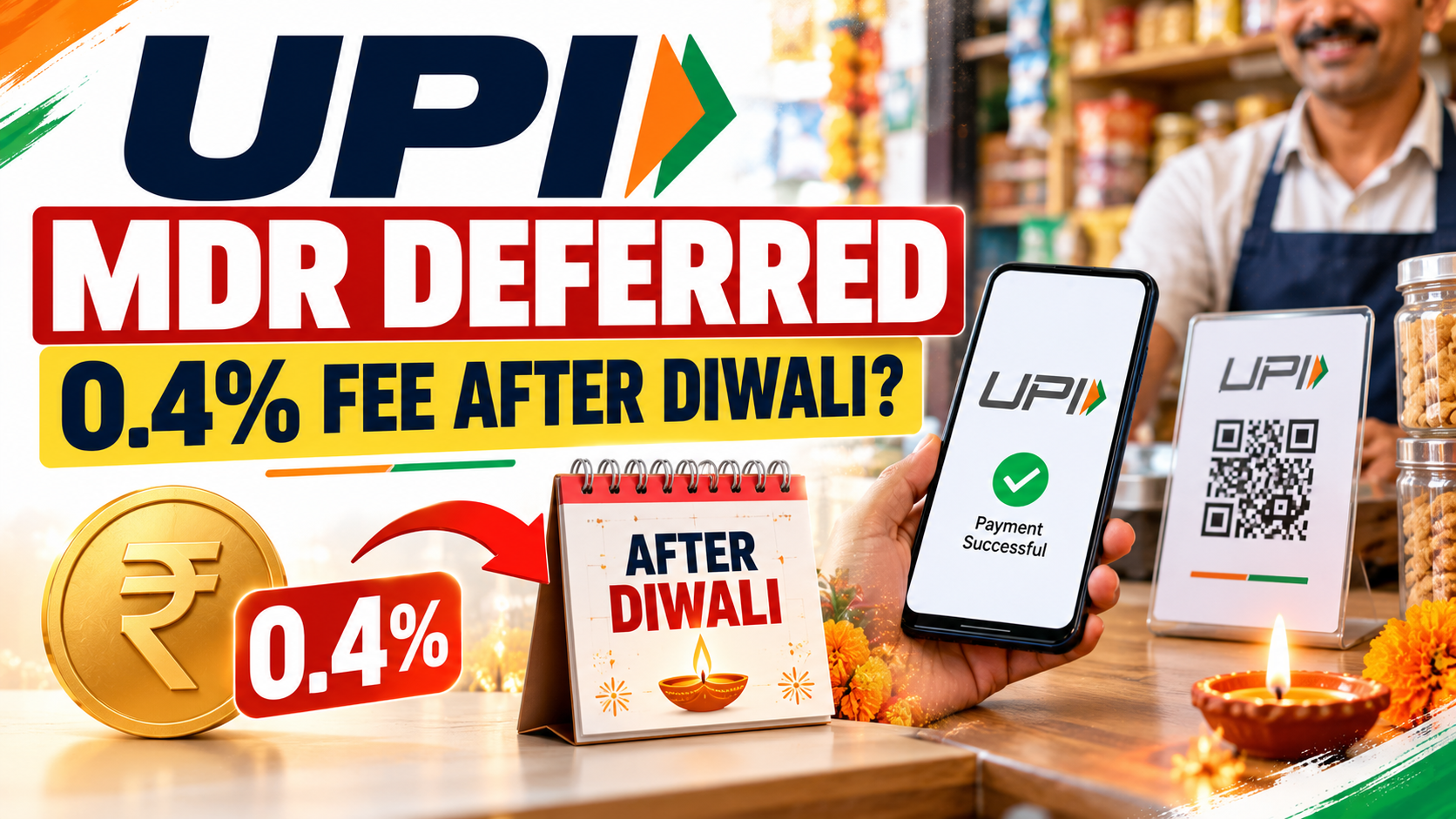
On 13 October 2026, barely forty-eight hours before its scheduled implementation, the National Payments Corporation of India (NPCI) announced a temporary deferral of the Merchant Discount Rate (MDR) on select Unified Payments Interface (UPI) transactions. The levy, originally set to commence on 15 October, was postponed until shortly after the Diwali festivities (scheduled for 8 November 2026), with a revised operational date to be notified in due course.
The decision offers immediate relief to retailers and merchant associations bracing for peak festive consumer spending. For ordinary citizens, peer-to-peer (P2P) transfers remain entirely unaffected, and the regulatory framework strictly prohibits merchants from passing the cost onto consumers via checkout surcharges. Yet, the deferral merely pauses a profound structural debate: how does the world’s largest real-time digital payments ecosystem balance long-term financial sustainability against universal financial inclusion?
The Economic Anatomy of UPI MDR: Why Free Was Never Costless
Merchant Discount Rate (MDR) is the commercial fee paid by businesses to acquiring banks, payment aggregators, and network switches to process electronic transactions. While credit and debit cards have historically commanded MDRs ranging between 1.2% and 2.5%, UPI has operated under an administrative "Zero-MDR" regime since 1 January 2020, following reforms introduced in Budget 2019 and formalised under Section 269SU of the Income Tax Act.
While the zero-MDR mandate was instrumental in driving UPI’s meteoric rise—surpassing 15 billion monthly transactions and handling over ₹20 lakh crore in monthly value—the underlying payment rails carry immense operational costs. Every transaction triggers a complex multi-party settlement chain involving the remitter bank, beneficiary bank, payment service provider (PSP) apps like PhonePe and Google Pay, and the NPCI switch. Server infrastructure, round-the-clock cyber-defense, automated fraud detection, and multi-tier dispute resolution demand sustained capital expenditure.
To compensate the ecosystem, the Union Government has allocated annual budgetary subsidies—typically between ₹1,500 crore and ₹2,500 crore—to promote low-value RuPay and UPI P2M transactions. Industry bodies, notably the Payments Council of India (PCI), have consistently argued that budgetary outlays cover less than half of actual network operating costs, creating an annual financial shortfall that starves payment infrastructure of private innovation and security investment.
Chronology of the Zero-MDR Policy Debate
- July 2019: Union Budget proposes zero merchant charges on digital modes to dismantle cash reliance.
- 1 January 2020: Section 269SU of the Income Tax Act takes effect; MDR abolished on UPI and RuPay debit cards.
- August 2022: RBI releases a Discussion Paper on Charges in Payment Systems seeking public consultation; Finance Ministry promptly clarifies that UPI remains a public good with no charges planned.
- March 2025: Payments Council of India petitions the Prime Minister’s Office, warning that unviable unit economics threaten cybersecurity and technical uptime.
- 15 September 2026: NPCI’s UPI and Services Steering Committee issues circular and operational FAQ notifying a 0.4% tiered MDR from 15 October.
- 28 September 2026: Supreme Court admits a Public Interest Litigation (PIL) challenging the charge, refusing an interim stay while demanding constitutional justification from the Centre and RBI.
- 13 October 2026: NPCI defers the rollout post-Diwali following extensive representations from retail and fintech bodies.
The 2026 Tiered Fee Matrix: Slabs, Exemptions, and Sectoral Caps
The revised architecture formulated by the NPCI steering committee is deliberately calibrated to ring-fence micro-retailers while monetising higher-value commercial transactions. The framework rests on four clear tiers: zero fees for ordinary users and small vendors, concessionary flat charges for essentials, discounted rates for capital markets, and a standard 0.4% charge on commercial transactions above ₹2,000.
| Transaction Category | MDR Structure | Operational Thresholds & Conditions |
|---|---|---|
| Person-to-Person (P2P) Transfers | Nil (0.0%) | Completely free across all volumes and transaction values |
| Low-Value P2M Payments | Nil (0.0%) | All commercial transactions up to ₹2,000 |
| Small Offline Merchants (P2PM) | Nil (0.0%) | Verified vendors with monthly UPI QR turnover up to ₹1,00,000 |
| Standard Commercial P2M | 0.40% | Commercial transactions exceeding ₹2,000 |
| High-Value Commercial P2M | 0.40% (Capped at ₹300) | Transactions of ₹75,000 and above (fee never exceeds ₹300) |
| Essential Public Utilities & Sectors | Flat ₹5 per transaction | Railways, State Transport, Fuel, Telecom, Insurance, and Agricultural Inputs (above ₹2,000) |
| Capital Markets & Securities | 0.02% (Capped at ₹300) | Mutual Fund investments, equity broking, and registered stock dealers |
Transaction Value vs. Effective Merchant Cost
| Transaction Value | Applicable Surcharge | Absolute Fee Paid by Merchant | Effective Merchant Percentage |
|---|---|---|---|
| ₹1,500 (Grocery store) | Exempt (Below ₹2,000) | ₹0.00 | 0.00% |
| ₹4,000 (Apparel retail) | 0.4% Standard Rate | ₹16.00 | 0.40% |
| ₹15,000 (Consumer electronics) | 0.4% Standard Rate | ₹60.00 | 0.40% |
| ₹50,000 (Jewellery purchase) | 0.4% Standard Rate | ₹200.00 | 0.40% |
| ₹75,000 (Wholesale payment) | Capped Rate Trigger | ₹300.00 | 0.40% |
| ₹1,50,000 (Luxury purchase) | Capped at ₹300 Maximum | ₹300.00 | 0.20% |
A critical protection embedded in the circular is the Absolute Prohibition on Pass-Through: merchants, payment aggregators, and UPI applications are legally barred from levying convenience fees or transaction surcharges on consumers. Acquiring banks are mandated to audit merchant billing systems to prevent covert cost transfers. Furthermore, 5% of all MDR collections will be ring-fenced into a dedicated UPI Inclusion Fund to expand digital payment infrastructure across Tier-3 to Tier-6 towns and northeastern states.
Behind the Deferral: Festive Inflation, Retail Pushback, and Technical Readiness
NPCI’s decision to defer the launch just 48 hours before the deadline was driven by a convergence of economic, operational, and commercial pressures:
- Festive Retail Sensitivity: The Confederation of All India Traders (CAIT) and prominent merchant associations submitted urgent memorandums warning that introducing transaction levies during the peak Navratri-Diwali shopping window would dent consumer optimism and inject friction into high-ticket retail sales.
- Operational and Technical Hurdles: Acquiring banks and payment aggregators faced significant technical bottlenecks in categorising merchants under appropriate Merchant Category Codes (MCC). Differentiating between exempt P2PM merchants (under ₹1 lakh monthly turnover) and standard commercial entities required complex backend algorithm updates that were not fully stress-tested across regional banking switches.
- Inflationary Pressures and Cost Perception: Amid heightened food and festive inflation, business chambers cautioned that even small transaction frictions could prompt mid-tier merchants to request cash payments for bills above ₹2,000, undermining years of digital adoption gains.
- Policy Clarifications from the Centre: Union Finance Minister Nirmala Sitharaman clarified on 8 October that the rollout timeline was an ecosystem-driven technical decision rather than an executive imposition, dismissing Opposition allegations of external influence as unfounded.
Stakeholder Matrix: Who Bears the Cost and Who Gains?
Understanding the impact of the MDR rollout requires analyzing the asymmetric structure of India's digital payments traffic:
- Consumers: Retain complete zero-cost access. Peer-to-peer transfers, which constitute roughly 70% of total UPI transaction value, remain completely outside the purview of MDR.
- Small Merchants and Kirana Stores: Because approximately 96% of everyday merchant transactions in India fall below ₹2,000, neighborhood vendors remain fully insulated. Small businesses also retain full protection under the ₹1 lakh monthly turnover threshold.
- Mid-Tier and Enterprise Merchants: Electronics showrooms, branded apparel stores, fine-dining restaurants, and travel portals will absorb the 0.4% cost. However, because standard credit card MDR sits between 1.5% and 2.2%, UPI remains by far the cheapest digital settlement rail for merchants.
- Banks and Fintech PSPs: Banks and payment applications (PhonePe, Google Pay, Paytm) gain an independent revenue stream, reducing their precarious dependence on government subsidies and cross-selling financial products.
- The Union Government: Relieves budgetary pressure by allowing market mechanisms to fund infrastructure, while maintaining zero tax intake from the levy.
The Constitutional and Legal Challenge: Supreme Court’s Core Inquiries
On 28 September 2026, a Supreme Court bench comprising Chief Justice Surya Kant, Justice Joymalya Bagchi, and Justice V. Mohana heard a Public Interest Litigation (PIL) filed by advocate Anjan Datta challenging the legal validity of the NPCI circular. While the bench declined to grant an interim stay, it issued formal notices to the Ministry of Finance, the Reserve Bank of India, and NPCI, raising fundamental jurisprudence questions:
Under what statutory authority can an administrative steering committee mandate payment deductions when Parliament specifically enacted a zero-charge regime under Section 269SU of the Income Tax Act?
Three legal issues form the crux of judicial review:
- Tax, Statutory Fee, or Contractual Settlement Cost? Justice Joymalya Bagchi questioned the constitutional character of the levy. Under Article 265, no tax can be levied without authority of law, whereas a fee requires demonstrable quid pro quo. The Centre argues it is an inter-bank infrastructure cost recovery mechanism governed under the Payment and Settlement Systems Act, 2007 (PSSA).
- Delegated Regulatory Power: The petition examines whether NPCI, as a Section 8 non-profit company, possesses quasi-legislative authority to create commercial levies without explicit gazette notification by the RBI or Parliament.
- Consumer Protection and Anti-Pass-Through Enforcement: The court examined whether regulatory mechanisms exist to prevent merchants from subtly inflating sticker prices to recover backend transaction costs.
Civil Services and Regulatory Exam Masterclass: High-Yield Insights
For candidates preparing for UPSC Civil Services, RBI Grade B, and State Administrative Exams, the UPI MDR debate serves as a premier case study in financial regulation and digital public infrastructure.
Prelims & Objective Exam Factsheet
- Governing Entity: National Payments Corporation of India (NPCI) — an umbrella organization created under the Payment and Settlement Systems Act, 2007 (PSSA), owned by a consortium of major banks.
- Statutory Framework: Section 269SU of the Income Tax Act, 1961 (mandating electronic payment modes) and the Payment and Settlement Systems Act, 2007.
- MDR Rate Parameters: 0.4% standard rate on P2M above ₹2,000; absolute cap of ₹300 at ₹75,000; flat ₹5 for essential public services; 0.02% for capital markets.
- Zero-Charge Ringfence: 100% free for P2P transfers; 100% free for P2M under ₹2,000; zero MDR for P2PM merchants with monthly turnover under ₹1,00,000.
- UPI Inclusion Fund: 5% of gross MDR receipts reserved for deepening digital acceptance in underserved regions.
UPSC Mains Analytical Model Answer (GS Paper 3: Indian Economy & Infrastructure)
Topic: Evaluating the reintroduction of Merchant Discount Rate (MDR) on UPI: Balancing Digital Public Good with Financial Sustainability.
The debate surrounding UPI MDR illustrates the fundamental dilemma of Digital Public Infrastructure (DPI): how to maintain open, zero-cost access for the vulnerable while ensuring that the physical and digital infrastructure remains commercially viable.
1. The Economic Need for Financial Viability: Since the introduction of the zero-MDR policy in 2020, UPI processing volumes have expanded exponentially, handling over 80% of India's retail digital payments. However, processing billions of daily transactions demands continuous capital expenditure in high-throughput server architecture, cyber-resilience, and dispute resolution. Annual budgetary subsidies from the Centre (approx. ₹1,500–₹2,500 crore) cover barely half of the ecosystem's actual operational expenditures, creating a structural shortfall that jeopardizes network reliability.
2. Calibrated Safeguards for Financial Inclusion: The 2026 framework prevents disruption to the retail economy through targeted protections: completely exempting P2P transactions and sub-₹2,000 payments ensures that over 96% of everyday volume remains free. Small kirana vendors are shielded via the ₹1 lakh monthly turnover cap, while essential sectors operate under a nominal flat fee of ₹5.
3. Policy Recommendations: To maintain consumer confidence and prevent a return to cash, authorities must strictly enforce the ban on merchant surcharges, ensure algorithmic transparency in Merchant Category Code (MCC) classification, and harmonise NPCI directives with Section 269SU of the Income Tax Act. A sustainable payments network requires modest, equitable contributions from high-value commercial users to finance the digital public good.
Frequently Asked Questions
Will everyday consumers pay extra when scanning UPI QR codes after Diwali?
No. Consumers will not incur any direct fees. The MDR is strictly a merchant-side acquiring cost, and regulatory directives expressly prohibit merchants and UPI apps from passing the charge onto customers as a checkout surcharge or platform fee.
When is the new UPI MDR rollout date expected to be announced?
NPCI has confirmed that the operational rollout will occur immediately following Diwali (8 November 2026). The exact effective date will be communicated via a formal circular following technical readiness reviews with acquiring banks.
How will small kirana stores and street vendors qualify for zero MDR?
Small merchants operating under the Person-to-Person-Merchant (P2PM) category who collect up to ₹1,00,000 per month via UPI QR codes are completely exempt from MDR, even on individual payments exceeding ₹2,000.
Why are fuel stations and railways charged a flat ₹5 fee instead of 0.4%?
Sectors providing essential public utilities operate on razor-thin operating margins with high transaction volumes. A percentage-based levy would impose severe working-capital burdens, whereas a flat ₹5 nominal settlement fee covers core network processing costs without destabilising operations.
What is the significance of the Supreme Court's notice on UPI MDR?
The Supreme Court is examining whether NPCI has the statutory authority to mandate commercial transaction levies under the Payment and Settlement Systems Act without formal parliamentary amendment to the zero-fee mandate in Section 269SU of the Income Tax Act.
Editorial Perspective: The Future of India's Digital Public Infrastructure
The eleventh-hour deferral of UPI MDR until after Diwali illustrates the delicate political economy of digital transitions. India has successfully built the world's most egalitarian financial highway; the ongoing challenge is maintaining the road without erecting tollbooths that drive commuters away.
By targeting only high-value commercial transactions while protecting small merchants and consumers, the tiered 2026 framework represents a pragmatic compromise. For policy analysts and competitive examination aspirants, the UPI MDR trajectory offers an invaluable case study: sustainable governance lies not in clinging to blanket subsidies, but in designing nuanced, equitable regulatory structures that safeguard the vulnerable while requiring commercial beneficiaries to contribute to the commons.
About the Author
School Principal at Khalsa Inter College, Naka Hindola, Lucknow, Uttar Pradesh. Committed to providing free, quality education for students preparing for competitive examinations.
Learn more about our mission →