BRICS Competition Meet Udaipur 2026: Renewable Energy Outcomes
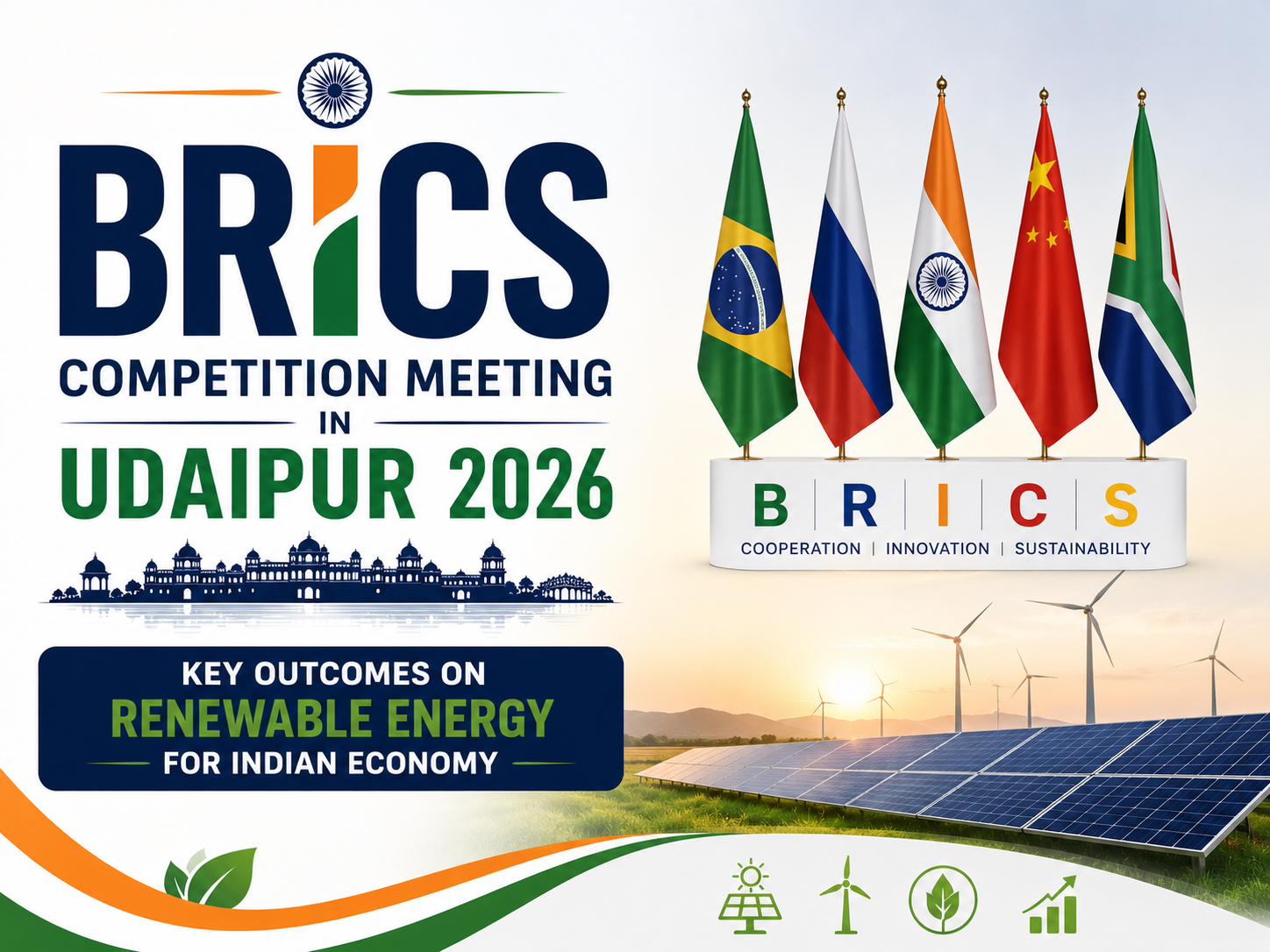
On August 8, 2026, the lake city of Udaipur hosted heads of competition authorities from across the BRICS bloc — a decade after it last held a BRICS event in 2016. The occasion was the Meeting of Heads of BRICS Competition Authorities, organised by the Competition Commission of India (CCI) at the Taj Fateh Prakash Palace, under India's BRICS Chairship for 2026. The single biggest outcome: a joint statement committing member competition regulators to keep the global renewable energy transition fair, competitive, and free of market abuse.
For exam aspirants, this is a compact, high-yield current affairs topic. It touches India's BRICS chairship, the CCI's institutional mandate, and the increasingly important intersection of competition law with the clean energy transition — a theme likely to recur across GS2 (International Relations, governance bodies) and GS3 (Economy, Energy) in UPSC Mains, and as a factual pick in SSC/Banking prelims.
Table of Contents
- Background: India's BRICS Chairship and Udaipur's Return as Host City
- What Exactly Happened in Udaipur
- The Joint Statement: What It Actually Commits To
- The BRICS Renewable Energy Competition Study
- Why Competition Law Matters for Renewable Energy
- Key Stakeholders in the Room
- What This Means for the Indian Economy
- Open Questions and Limitations
- What Comes Next: Brazil 2027 and Beyond
- Exam Preparation Strategy
- Key Takeaways
- Frequently Asked Questions
- Related Topics
Background: India's BRICS Chairship and Udaipur's Return as Host City
India assumed the BRICS chairship on January 1, 2026, succeeding Brazil, and will hold it through the bloc's leaders' summit in New Delhi in September 2026. A chairship year is structured around dozens of ministerial and working-group meetings held across Indian cities — the sherpa-track meetings that set up the eventual leaders' declaration.
Rajasthan featured prominently in this cycle. The 10th BRICS Industry Ministers' Meeting had concluded in Jaipur just days earlier, adopting a joint declaration on MSMEs and startups. The Udaipur meeting of competition authority heads followed almost immediately after, making it part of a cluster of BRICS institutional meetings hosted in the state that week.
Udaipur itself was not a new BRICS venue — the city last hosted a BRICS-related gathering in 2016, meaning this was its return as a host city after nearly a decade. Senior officials and heads of competition authorities from roughly 15 countries, including BRICS members and partner nations, attended.
What Exactly Happened in Udaipur
The Meeting of Heads of BRICS Competition Authorities brought together regulators to exchange views on domestic enforcement developments, emerging market challenges, and — as the headline item — the competitive dynamics of renewable energy markets across BRICS economies.
CCI Chairperson Ravneet Kaur delivered the inaugural address, framing the shared responsibility of BRICS competition authorities as preserving markets that reward efficiency, protect consumer welfare, encourage innovation, and let businesses compete on merit rather than market power. She also flagged the increasingly cross-border nature of digital markets and emerging technologies as a reason sustained cooperation between regulators is becoming more necessary, not less.
Brazil's competition authority, the Administrative Council for Economic Defense (CADE), used the platform to brief participants on preparations for the Xth BRICS International Competition Conference, scheduled for Brazil in 2027 — signalling that this cooperation track continues beyond India's chairship year.
The Joint Statement: What It Actually Commits To
The Joint Statement of Heads of BRICS Competition Authorities, titled "Strengthening Cooperation to Promote Fair Competition, including in Renewable Energy Markets," is a non-binding political commitment — not a treaty or enforceable regulation. It records the shared intent of BRICS competition authorities to promote competitive, innovative, resilient, and sustainable renewable energy markets, and to deepen knowledge-sharing on the competition issues thrown up by the global energy transition.
In practice, this kind of instrument does three things for regulators: it creates a shared vocabulary for identifying anti-competitive conduct in a fast-growing sector, it opens channels for authorities to compare enforcement approaches, and it signals to industry — solar and wind manufacturers, battery makers, grid operators — that regulators across a large bloc of emerging economies are watching market structure, not just individual companies.
"Continued collaboration among BRICS competition authorities would contribute to fostering fair and competitive renewable energy markets while advancing the shared objectives of sustainable growth and energy security." — Ravneet Kaur, Chairperson, Competition Commission of India
The BRICS Renewable Energy Competition Study
Ahead of the meeting, the CCI steered a collaborative research exercise titled "Emerging Competition Landscape in the Renewable Energy Sector in BRICS." Its purpose was to build a shared understanding of how competition dynamics are evolving in renewable energy markets across BRICS jurisdictions, and to flag areas where authorities could cooperate going forward. Its key findings were presented at the Udaipur meeting, though a detailed public breakdown of the study's findings has not been released in the coverage available so far — a gap worth watching for aspirants tracking this topic, since the full report, once public, will likely be cited in future current-affairs updates.
What Is the BRICS Competition Authorities Meeting?
The Meeting of Heads of BRICS Competition Authorities is an annual gathering of the top competition regulators from Brazil, Russia, India, China, South Africa, and BRICS' newer members and partner countries, held in the country holding the year's BRICS chairship. It focuses on aligning enforcement approaches and addressing shared market challenges, such as those emerging in renewable energy.
Why Competition Law Matters for Renewable Energy
Renewable energy is not a naturally competitive sector by default — it has structural features that make it prone to concentration. Three matter most for exam purposes:
- Supply chain concentration: A handful of countries, led by China, dominate global manufacturing of solar photovoltaic cells, wind turbine components, and battery-grade critical minerals processing. This creates chokepoints that a small number of firms can exploit.
- Grid and infrastructure bottlenecks: Renewable power depends on transmission access and storage infrastructure that is often controlled by a limited set of state or private utilities, raising the risk of preferential access or bundling.
- Subsidy and procurement design: Government auctions, feed-in tariffs, and production-linked incentives shape who can enter the market — poorly designed schemes can entrench incumbents rather than encourage new entrants.
This is precisely the gap a body like the CCI is positioned to address domestically, and where BRICS-level cooperation adds value: renewable energy supply chains cross borders, so anti-competitive conduct in one BRICS market (say, cartelisation among solar-cell importers) has spillover effects in others.
| Dimension | Risk in Renewable Energy Markets | Competition Authority Response |
|---|---|---|
| Manufacturing | Concentration in solar/wind component supply | Monitor for cartelisation, abuse of dominance |
| Grid access | Preferential transmission access | Scrutinise vertical integration, bundling |
| Procurement | Auction design favouring incumbents | Advocate for competitive-neutral policy design |
| Cross-border trade | Import cartels, dumping disputes | Cross-jurisdiction information sharing (the BRICS track) |
Key Stakeholders in the Room
- Competition Commission of India (CCI): Host and lead architect of the study and joint statement, represented by Chairperson Ravneet Kaur.
- CADE (Brazil): Briefed the group on the 2027 BRICS International Competition Conference, underlining continuity of this track beyond India's chairship.
- Other BRICS competition authorities (Russia, China, South Africa, and newer BRICS members) and partner-country regulators, among roughly 15 nations represented.
- India's broader BRICS chairship apparatus: This meeting sits inside a packed calendar that also produced the 10th BRICS Industry Ministers' Meeting in Jaipur, feeding into the leaders' summit in New Delhi in September 2026.
What This Means for the Indian Economy
India has one of the world's most ambitious renewable energy build-outs underway, with a stated target of 500 GW of non-fossil-fuel capacity by 2030. A domestic market growing that fast is also a market where competition risks — cartelisation among component suppliers, preferential grid access, opaque auction design — grow in parallel. Hosting this meeting lets India shape the emerging BRICS-level conversation on these risks rather than simply reacting to standards set elsewhere.
There is also a soft-power and diplomatic dimension. Hosting a cluster of BRICS institutional meetings in Rajasthan in the same week — industry ministers in Jaipur, competition chiefs in Udaipur — showcases India's convening capacity ahead of September's leaders' summit, and ties tourism and heritage-city branding (the Taj Fateh Prakash Palace venue) to India's diplomatic calendar.
Open Questions and Limitations
Readers should be clear-eyed about what this meeting did not do. A joint statement is a political commitment, not a binding rule — it does not create new enforcement powers for the CCI or its counterparts, and does not resolve the underlying supply-chain concentration in global solar and battery manufacturing, which remains dominated by a small number of players outside routine BRICS competition-law reach.
The detailed findings of the underlying "Emerging Competition Landscape" study have not yet been made fully public in available reporting, which limits how specific an analysis can currently be about which countries or practices the study actually flagged as concerning. Aspirants should watch for the full study's release and any follow-up enforcement action as the more consequential signal — the Udaipur statement is the starting point of a cooperation process, not its conclusion.
What Comes Next: Brazil 2027 and Beyond
With CADE's briefing on the Xth BRICS International Competition Conference scheduled for Brazil in 2027, the renewable energy competition track is set to continue past India's chairship year. The immediate near-term marker to watch is India's BRICS leaders' summit in New Delhi in September 2026, where outcomes from sherpa-track meetings like this one — alongside the Jaipur industry ministers' meeting — will likely be referenced in the broader summit declaration.
Exam Preparation Strategy: How to Use This Topic
- UPSC Mains (GS2/GS3): Use this as a live example when answering on India's role in South-South cooperation, or on the governance challenges of the global energy transition. Frame it as: institutional cooperation (BRICS) + regulatory instrument (competition law) + sector (renewable energy) = a genuinely current, cross-cutting answer point.
- Prelims (UPSC/SSC/Banking): Remember the core facts — date (August 8, 2026), venue (Udaipur, Rajasthan), host body (Competition Commission of India), chairperson (Ravneet Kaur), the joint statement's exact title, and India's BRICS chairship timeline (Jan 1, 2026 – September 2026 summit in New Delhi).
- Key terms to remember: BRICS Chairship 2026, Competition Commission of India (CCI), CADE (Brazil), Joint Statement on Fair Competition in Renewable Energy Markets, Xth BRICS International Competition Conference (Brazil, 2027).
- Common mistake to avoid: Don't confuse this competition-authorities meeting with the BRICS leaders' summit itself — this was a technical, regulator-level meeting that feeds into the broader summit process, not the summit itself.
Key Takeaways
- CCI hosted the Meeting of Heads of BRICS Competition Authorities in Udaipur on August 8, 2026, under India's BRICS Chairship 2026.
- The meeting adopted a Joint Statement, "Strengthening Cooperation to Promote Fair Competition, including in Renewable Energy Markets."
- A CCI-led study, "Emerging Competition Landscape in the Renewable Energy Sector in BRICS," was presented at the meeting.
- Brazil's CADE previewed the Xth BRICS International Competition Conference, set for 2027.
- Udaipur returned as a BRICS host city after last hosting one in 2016.
- The meeting fits inside India's broader BRICS chairship calendar, ahead of the leaders' summit in New Delhi in September 2026.
- The statement is a political commitment, not a binding regulation — its practical impact depends on follow-through.
Frequently Asked Questions
What is the BRICS Competition Meeting held in Udaipur 2026?
It was the Meeting of Heads of BRICS Competition Authorities, hosted by the Competition Commission of India in Udaipur on August 8, 2026, under India's BRICS Chairship, focused on fair competition in renewable energy markets.
What was the main outcome of the Udaipur BRICS meeting?
The main outcome was a Joint Statement titled "Strengthening Cooperation to Promote Fair Competition, including in Renewable Energy Markets," alongside the presentation of a CCI-led study on renewable energy competition dynamics across BRICS.
Who chaired the CCI at the time of this meeting?
Ravneet Kaur, Chairperson of the Competition Commission of India, delivered the inaugural address and led India's role at the meeting.
Why is this topic important for UPSC and other exams?
It connects India's BRICS chairship, competition-law institutions, and the renewable energy transition — a combination likely to appear in GS2/GS3 Mains answers and as a factual prelims pick.
Is the BRICS joint statement legally binding?
No. It is a political commitment among BRICS competition authorities to cooperate and share knowledge — it does not create binding enforcement powers.
What is India's BRICS Chairship 2026 timeline?
India took over the BRICS chairship from Brazil on January 1, 2026, and will host the BRICS leaders' summit in New Delhi in September 2026.
What happens next in this BRICS competition cooperation track?
Brazil's CADE will host the Xth BRICS International Competition Conference in 2027, continuing the cooperation track beyond India's chairship year.
Related Topics
- India's BRICS Chairship 2026: The full calendar of ministerial meetings leading up to the September leaders' summit in New Delhi.
- Competition Commission of India (CCI): Its statutory role, structure, and recent enforcement actions.
- India's renewable energy targets: The 500 GW non-fossil capacity target and the policy instruments driving it.
- 10th BRICS Industry Ministers' Meeting, Jaipur: The companion meeting held the same week, focused on MSMEs and startups.
- Global critical minerals and solar supply chains: Why manufacturing concentration matters for energy security.
Conclusion
The Udaipur meeting is a useful marker of how competition law and climate policy are starting to intersect on the global stage — a theme that will only grow as renewable energy scales up worldwide. For exam aspirants, the value isn't just memorising the date and venue; it's recognising the pattern: institutional cooperation, regulatory tools, and the energy transition increasingly show up together in current affairs, and examiners reward candidates who can connect them. Keep this framework in mind the next time a similar story breaks.
About the Author
School Principal at Khalsa Inter College, Naka Hindola, Lucknow, Uttar Pradesh. Committed to providing free, quality education for students preparing for competitive examinations.
Learn more about our mission →