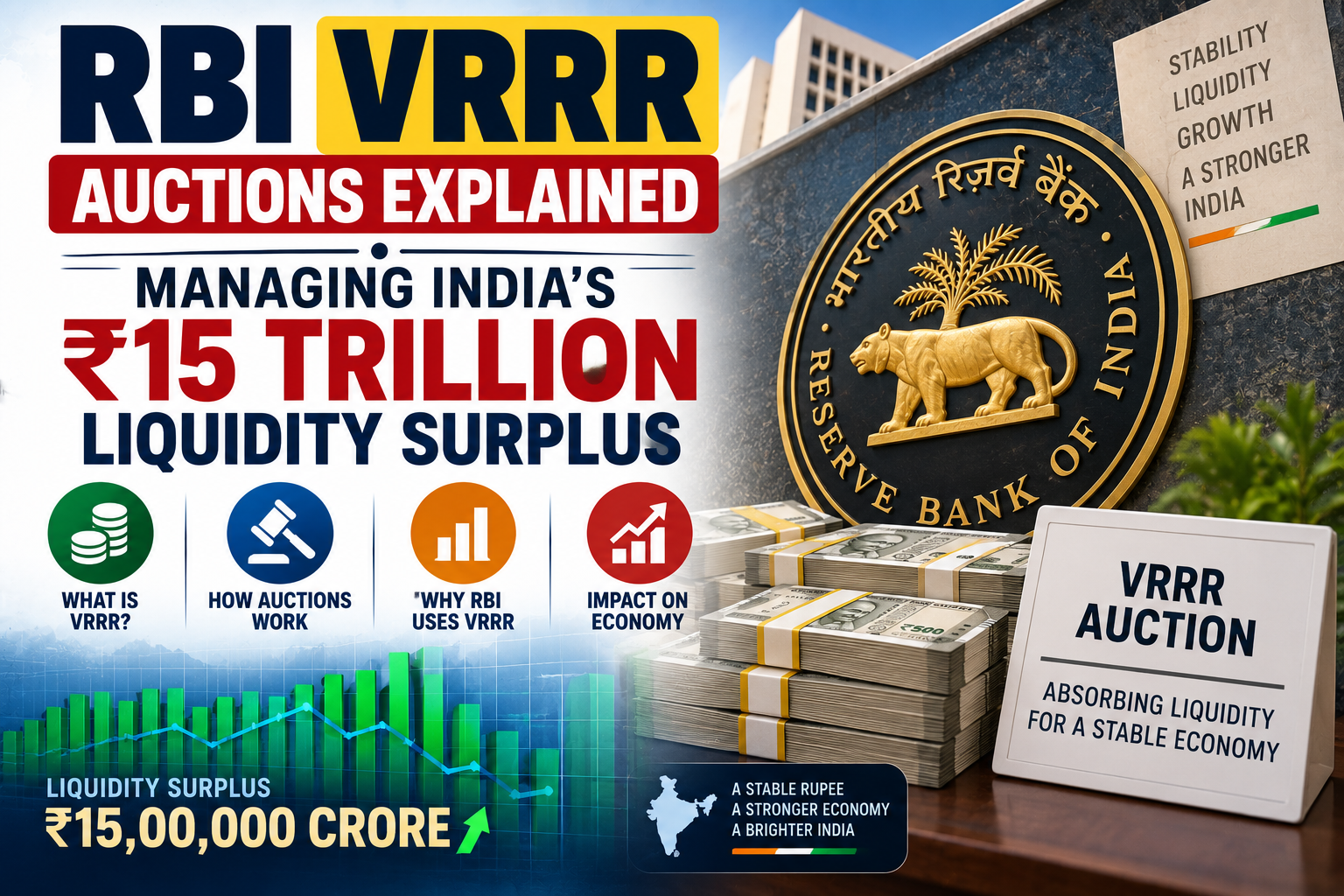
RBI VRRR Auctions Explained: India's Record ₹10-Lakh-Crore Surplus
On September 18, 2026, the Reserve Bank of India quietly pulled ₹2.23 lakh crore out of the banking system in a single afternoon. It was not a crisis measure. It was routine plumbing — the latest in a weeks-long series of Variable Rate Reverse Repo (VRRR) auctions designed to mop up what has become the largest banking-system liquidity surplus India has seen since the demonetisation overhang of 2016-17.
At its peak in mid-September 2026, that surplus touched an estimated ₹10.7 lakh crore — roughly the size of Bangladesh's entire GDP sitting idle in India's banking system, earning interest from the RBI instead of being lent out to businesses and households. If you are preparing for UPSC, SSC, Banking or State PSC exams, this single episode connects monetary policy, external sector management, banking regulation and macroeconomic stability in one live case study.
By the end of this article, you will understand exactly what a VRRR auction is, why India suddenly has more surplus cash sloshing through its banks than at almost any point in a decade, how the RBI's interest rate corridor actually functions, and precisely how examiners are likely to test this topic.
Table of Contents
- 1. What Is a VRRR Auction? The Core Definition
- 2. Historical Background: From Demonetisation Overhang to the SDF Era
- 3. How a VRRR Auction Actually Works
- 4. Why the Surplus Exploded: The FCNR(B) Story
- 5. The Interest Rate Corridor — Repo, SDF and MSF
- 6. Multi-Dimensional Impact Analysis
- 7. Key Stakeholders and Their Positions
- 8. Data, Statistics and Ground Reality
- 9. Critical Analysis: Beyond the Headlines
- 10. Challenges, Criticisms and Risks
- 11. India's Roadmap: What Happens When the Surplus Unwinds
- 12. Exam Preparation Strategy
- 13. Key Takeaways
- 14. FAQs
- 15. Related Topics
What Is a VRRR Auction? The Core Definition
A Variable Rate Reverse Repo (VRRR) auction is a tool the Reserve Bank of India uses to temporarily absorb surplus cash from commercial banks, paying them a market-determined interest rate in return, in order to keep short-term money market rates aligned with the policy repo rate. Unlike a fixed-rate operation, the interest rate in a VRRR is discovered through competitive bidding by banks, which is why the RBI's own bulletins describe the rate as "variable."
Think of it as the RBI running a reverse fixed deposit scheme for banks. When banks have more cash than they need for lending or regulatory requirements, they "deposit" it with the RBI for a fixed number of days — overnight, 3 days, 7 days, or longer — and earn interest at whatever rate emerges from the auction, generally close to the repo rate.
Quick Fact Box
- VRRR cut-off rate in September 2026 auctions: 5.24%, just below the repo rate of 5.25%
- Record single-day absorption: ₹6.02 lakh crore across two auctions on September 3, 2026
- Peak banking system liquidity surplus: approximately ₹10.7 lakh crore (mid-September 2026)
- RBI has run VRRR auctions almost continuously since August 2026
Historical Background: From Demonetisation Overhang to the SDF Era
India's liquidity management framework has been rebuilt in stages over the last decade, and each stage is directly relevant to understanding today's VRRR cycle.
| Year | Development | Significance |
|---|---|---|
| 2016-17 | Demonetisation liquidity overhang | Banking system liquidity surplus peaked near ₹7.96 lakh crore; RBI relied on reverse repo and market stabilisation bonds |
| 2013 | Original FCNR(B) swap scheme (Raghuram Rajan era) | Mobilised large NRI deposit inflows during a currency crisis — the direct template for the 2026 scheme |
| April 2022 | Standing Deposit Facility (SDF) introduced | Replaced the old fixed reverse repo rate as the uncollateralised floor of the policy corridor |
| 2020-2022 | Pandemic-era liquidity easing | RBI injected surplus liquidity of roughly ₹8.5 lakh crore, which had to be gradually withdrawn later |
| Dec 2024 – Dec 2025 | 125 bps rate-cutting cycle | Repo rate fell from 6.50% to 5.25%, the sharpest easing phase since 2019 |
| June 8, 2026 | New FCNR(B)/ECB/OFCB forex swap facility launched | Directly triggered the current record surplus by pulling in dollar deposits |
The pattern is consistent: whenever India draws in large foreign currency inflows or injects rupee liquidity for growth support, the RBI eventually has to reverse the flow through VRRR and open market sales. What is unusual in 2026 is the scale and speed of the swing.
How a VRRR Auction Actually Works
The mechanism follows a defined sequence each time the RBI conducts a VRRR auction under its Liquidity Adjustment Facility (LAF):
- Notification: The RBI announces the auction, the amount it wants to absorb, and the tenure (ranging from overnight to 56 days).
- Bidding window: Banks submit bids specifying how much surplus cash they want to park and at what rate, typically within a 30-minute window.
- Cut-off determination: The RBI ranks bids and determines a cut-off rate; all accepted bids settle at this weighted average rate.
- Fund transfer: Banks transfer the agreed amount to the RBI, which is removed from circulation for the auction's tenure.
- Reversal: On maturity, the RBI returns the principal plus interest, and the liquidity re-enters the system — often triggering the next auction.
In practice, the RBI frequently under-allots. On September 11, 2026, banks bid ₹3.93 lakh crore against a notified ₹5 lakh crore; the RBI accepted the full bid amount at 5.24%. This tells students something important: the RBI's notified amount signals intent, but the actual absorption depends on how eager banks are to park funds versus lend or invest them.
Why the Surplus Exploded: The FCNR(B) Story
This is the section most articles miss, yet it is the actual root cause examiners will expect you to know. On June 8, 2026, the RBI launched a special USD-INR forex swap facility for fresh FCNR(B) deposits, Overseas Foreign Currency Borrowings (OFCBs), and External Commercial Borrowings (ECBs) by public sector undertakings.
The scheme offered banks a concessional swap — roughly 3 percentage points cheaper than prevailing market hedging costs — letting them offer Non-Resident Indians unusually attractive FCNR(B) deposit rates of 6% to 7.1% on major currencies. Brokerages estimated NRIs using the leveraged structure (State Bank of India reportedly offered up to 9x leverage) could earn annualised returns of 15% to 27%.
The response overwhelmed even the RBI's own expectations. Against an initial target of $50-70 billion, banks mobilised $136.38 billion in total forex inflows by August 31, 2026 — with FCNR(B) deposits alone accounting for $127.23 billion. The closing date was advanced by a month because the response was so strong. Every dollar swapped into rupees by the RBI injects rupee liquidity into the banking system — which is precisely why the surplus mushroomed through August and September.
- FCNR(B) inflows: $127.23 billion
- OFCB inflows: $5.26 billion
- ECB inflows: $3.89 billion
- Additional liquidity source: month-end government spending on salaries and pensions
The Interest Rate Corridor — Repo, SDF and MSF
To understand why the RBI targets a specific rate through VRRR, you need the policy corridor framework, reaffirmed at the August 5, 2026 Monetary Policy Committee meeting (a unanimous 6-0 decision to hold rates).
| Rate | Current Level | Function |
|---|---|---|
| Marginal Standing Facility (MSF) | 5.50% | Ceiling — emergency overnight borrowing by banks against SLR securities |
| Policy Repo Rate | 5.25% | Centre of the corridor — the benchmark policy rate |
| Standing Deposit Facility (SDF) | 5.00% | Floor — uncollateralised overnight parking of surplus funds, introduced April 2022 |
| Bank Rate | 5.50% | Aligned to MSF; used for penal and long-term lending purposes |
The corridor is symmetric at 25 basis points on either side of the repo rate. When liquidity is in deep surplus, as in September 2026, the weighted average call rate (WACR) tends to drift toward the SDF floor rather than the repo rate — undermining monetary policy transmission. VRRR auctions exist precisely to pull the WACR back up closer to the 5.25% repo rate.
Multi-Dimensional Impact Analysis
Economic dimension: Excess liquidity, if left unchecked, risks fuelling asset-price inflation and weakening the RBI's inflation-targeting credibility, even though CPI inflation for FY27 is currently projected at a comfortable 5.0%.
Banking sector dimension: Surplus liquidity compresses bank margins on idle funds and can encourage aggressive, sometimes indiscriminate, credit growth if deployed too fast once absorbed.
External sector dimension: The entire episode is fundamentally a currency-stabilisation story. With the rupee under pressure (around ₹94.73/USD in June 2026) amid foreign institutional investor outflows, the FCNR(B) scheme was a deliberate lever to shore up forex reserves and diaspora confidence.
Social dimension: Higher FCNR(B) rates benefit NRI depositors directly; indirectly, a more stable rupee helps control imported inflation on items like fuel and edible oils that affect ordinary households.
Monetary policy dimension: The episode is a live demonstration of the RBI running an unusual dual mandate simultaneously — inviting dollar inflows for external stability while draining the resulting rupee liquidity to preserve domestic price and rate stability.
Key Stakeholders and Their Positions
| Stakeholder | Stated Position | Underlying Interest |
|---|---|---|
| RBI / Governor Sanjay Malhotra | Surplus is temporary and seasonal, will normalise by Q3-Q4 FY27 | Preserve monetary transmission and corridor credibility |
| Commercial banks | Support VRRR as a safe, RBI-backed avenue for idle funds | Earn near-repo-rate returns without credit risk; some resist locking funds into longer tenures |
| NRI depositors | Positive response to high FCNR(B) rates and leverage options | Attractive, hedged dollar returns of 15-27% under leveraged structures |
| Bond market participants | Welcome softer short-term yields from ample liquidity | Lower borrowing costs, but wary of eventual liquidity withdrawal pushing yields back up |
| Government / Finance Ministry | Benefits from a more stable rupee and lower borrowing costs | Fiscal space and external sector resilience ahead of global uncertainty |
Data, Statistics and Ground Reality
The single most striking statistic here is the swing itself: from a system that spent much of 2023-24 in deficit to a record surplus of ₹10.7 lakh crore in barely three months. Context matters more than the raw number — this is roughly 2.5 times the peak liquidity surplus seen during the July 2025 VRRR cycle (around ₹4 trillion), and comparable in scale to the demonetisation-era overhang of ₹7.96 lakh crore, but achieved not through domestic currency withdrawal, this time through foreign capital inflows.
| Date (2026) | Event | Amount |
|---|---|---|
| Sept 1 | 7-day VRRR auction notified | ₹6,00,000 crore notified |
| Sept 3 | Two VRRR auctions, cut-off 5.24% | ₹6.02 lakh crore absorbed |
| Sept 3 | Liquidity surplus reading | ₹10.32 lakh crore |
| Sept 11 | VRRR auction, cut-off 5.24% | ₹3.93 lakh crore absorbed (full bid accepted) |
| Sept 11 | Liquidity surplus reading | ₹10.73 lakh crore |
| Sept 16 | Liquidity surplus reading (post-absorption) | ₹7.38 lakh crore |
| Sept 17 | VRRR auction + OMO G-sec sale | ₹2.40 lakh crore VRRR + ₹50,000 crore OMO |
| Sept 18 | VRRR auction, cut-off 5.24% | ₹2.23 lakh crore absorbed |
Roughly 1 in every 9 rupees of India's estimated FY27 GDP was, at the September peak, sitting as surplus liquidity in the banking system — a scale that explains why the RBI has combined VRRR auctions with outright bond sales through Open Market Operations (OMOs) rather than relying on a single tool.
Critical Analysis: Beyond the Headlines
Most news coverage frames this purely as a "liquidity management" story. The deeper reading is that the RBI is testing a genuinely new external-sector playbook — deliberately engineering diaspora dollar inflows through a leveraged FCNR(B) structure, then absorbing the domestic side-effects through repeated VRRR and OMO operations, essentially running two simultaneous, opposite-direction monetary operations to achieve one external-stability objective.
RBI Governor Sanjay Malhotra has signalled that the surplus is a short-lived, seasonal phenomenon expected to peak around September 2026 before being absorbed naturally through rising currency in circulation, higher reserve requirements from deposit growth, and the maturing of related forex forward contracts.
A UPSC Mains examiner would likely probe whether this leveraged FCNR(B) approach creates hidden risks: what happens to the banking system's liquidity position when $127 billion of three-to-five-year deposits eventually seek repatriation, potentially in a less favourable global rate environment?
Challenges, Criticisms and Risks
- Reversal risk: A surplus this large, built on deposits with fixed 3-5 year maturities, could reverse abruptly and create a liquidity deficit at maturity if not carefully managed in advance.
- Cost to RBI: Analysts have flagged a potential foreign-exchange swap cost to the RBI running into billions of dollars, given the concessional terms offered to banks.
- Leverage concerns: Structures allowing up to 9x leverage on FCNR(B) deposits raise questions about contingent risk concentration in a few large banks.
- Transmission distortion: Extended periods with WACR near the SDF floor rather than the repo rate can blunt the intended effect of MPC rate decisions on the real economy.
- Frequent operations fatigue: Near-daily VRRR and OMO announcements create operational and forecasting complexity for bond desks and treasury teams.
India's Roadmap: What Happens When the Surplus Unwinds
The RBI's own guidance suggests a three-pronged natural unwind: rising currency in circulation as festive-season and year-end spending picks up, higher cash reserve requirements as bank deposits grow, and the scheduled maturity of associated forex forward contracts through late 2026 and into 2027.
Analysts will be watching the October 5-7, 2026 MPC meeting closely for any explicit liquidity guidance, alongside the pace of further OMO bond sales, which the RBI is using alongside VRRR to permanently — rather than temporarily — remove liquidity from the system.
3-5 year outlook: If managed well, this episode could become a template for using diaspora capital to smooth India's external financing needs during global volatility. If mismanaged, the leveraged structures and concessional swap costs could become a point of criticism in future RBI annual reports and Parliamentary Standing Committee reviews.
Exam Preparation Strategy: How to Use This Topic
GS Paper mapping: This topic sits primarily in GS Paper III (Indian Economy — mobilisation of resources, monetary policy) with strong linkages to GS Paper II (International Relations — external sector diplomacy) and GS Paper I concepts if a historical comparison with 2013 is drawn.
- MCQ angle: Match the corridor rates (SDF/Repo/MSF) with their current values and functions.
- Mains angle: "Discuss how India's monetary and external sector policies interact, with reference to the 2026 FCNR(B) swap scheme and its liquidity consequences." (GS III, 15 marks)
- Prelims-style statement analysis: Evaluate true/false statements on VRRR tenure, SDF collateral requirement, and MSF spread.
Key terms glossary: VRRR, LAF, SDF, MSF, WACR, FCNR(B), OMO, NDTL, corridor width, cut-off rate.
Model answer framework (Mains): Introduction (define VRRR and the current surplus figure) → Body (mechanism, FCNR(B) trigger, corridor rationale, impact dimensions, risks) → Conclusion (balanced outlook citing RBI's own guidance).
Common student mistake: Confusing VRRR (RBI absorbing liquidity) with VRR — Variable Rate Repo (RBI injecting liquidity) — these are opposite operations and are a favourite prelims trap.
If you have 10 minutes: Focus on the corridor table and the definition. If you have an hour: Add the FCNR(B) mechanism and the stakeholder table, since GS II-GS III cross-linkage questions reward this depth.
Key Takeaways
- A VRRR auction lets the RBI temporarily absorb bank surplus liquidity at a competitively bid rate, keeping short-term rates aligned with the repo rate.
- India's banking system liquidity surplus peaked near ₹10.7 lakh crore in mid-September 2026 — a record since the 2016-17 demonetisation overhang.
- The surplus was triggered chiefly by the RBI's June 2026 FCNR(B)/ECB/OFCB forex swap scheme, which mobilised $136.38 billion, far exceeding its $50-70 billion target.
- The policy corridor stands at Repo 5.25%, SDF 5.00% (floor), MSF/Bank Rate 5.50% (ceiling), unchanged since the August 2026 MPC meeting.
- The RBI is combining VRRR auctions with Open Market Operation bond sales to drain liquidity both temporarily and permanently.
- Governor Sanjay Malhotra has called the surplus a temporary, seasonal phenomenon expected to normalise through late FY27.
- Exam-relevant angle: distinguishing VRRR (absorption) from VRR (injection) is a frequent prelims trap.
- The next MPC meeting (October 5-7, 2026) is the key date to watch for fresh liquidity guidance.
Frequently Asked Questions
What is a VRRR auction?
A Variable Rate Reverse Repo auction is a Reserve Bank of India tool that temporarily absorbs surplus cash from banks at a competitively bid interest rate, helping align short-term money market rates with the policy repo rate.
Why is India's liquidity surplus important for exams?
It links monetary policy, banking regulation and external sector management in one live example, making it a favourite for GS III economy questions and prelims statement-based MCQs on RBI tools.
How does a VRRR auction work?
The RBI notifies an amount and tenure, banks submit competitive bids, a cut-off rate is set, funds are transferred to the RBI for the tenure, and both principal and interest are returned on maturity.
What is India's current stand on liquidity management?
The RBI is treating the surplus as temporary, using VRRR auctions and OMO bond sales together while keeping the repo rate unchanged at 5.25% with a neutral policy stance.
Which UPSC topics are related to VRRR auctions?
Related topics include the Liquidity Adjustment Facility, Monetary Policy Committee, Standing Deposit Facility, FCNR(B) deposits, Open Market Operations, and India's balance of payments.
What are the challenges with the current liquidity surplus?
Key risks include eventual reversal when FCNR(B) deposits mature, concessional swap costs to the RBI, leverage concentration in a few banks, and distorted monetary policy transmission.
VRRR vs VRR — what's the difference?
VRRR absorbs surplus liquidity from banks (RBI borrows), while VRR (Variable Rate Repo) injects liquidity into banks (RBI lends) — they are opposite operations under the same LAF framework.
What triggered the 2026 liquidity surplus?
The RBI's June 2026 special forex swap facility for FCNR(B) deposits mobilised $136.38 billion from the Indian diaspora, and every dollar swapped into rupees added to domestic banking system liquidity.
Related Topics & Internal Linking
- Monetary Policy Committee (MPC) and Inflation Targeting — understand the body that sets the repo rate this entire framework revolves around.
- FCNR(B) Deposits and NRI Banking Schemes — go deeper into the external-sector trigger behind this liquidity episode.
- Open Market Operations (OMOs) Explained — the RBI's other, more permanent liquidity-draining tool used alongside VRRR.
- India's Balance of Payments and Forex Reserves — the broader external-sector context driving RBI's forex interventions.
- Standing Deposit Facility vs Reverse Repo — the 2022 reform that reshaped India's policy corridor.
- Demonetisation and Its Liquidity Aftermath (2016-17) — the closest historical parallel to today's surplus.
- Repo Rate Cutting Cycle 2024-2026 — the broader monetary easing backdrop against which this surplus emerged.
Conclusion
What looks like a routine central-bank auction is, on closer reading, a story about how India is learning to use diaspora capital as a strategic lever for external stability — and the domestic monetary trade-offs that come with it. The RBI's VRRR auctions are not fighting a problem; they are managing the deliberate, engineered consequence of a policy success.
For exam aspirants, the real skill this topic tests is connecting dots across GS papers rather than memorising isolated facts. Revisit the corridor table, the FCNR(B) timeline, and the stakeholder map until you can explain the entire chain — from a Non-Resident Indian's fixed deposit in London to a VRRR auction cut-off rate in Mumbai — in under two minutes. That is exactly the kind of synthesis a UPSC Mains answer rewards.
Keep tracking the October 5-7, 2026 MPC meeting for the next data point in this evolving story, and explore the related topics above to build full topical command before your next test.
About the Author
School Principal at Khalsa Inter College, Naka Hindola, Lucknow, Uttar Pradesh. Committed to providing free, quality education for students preparing for competitive examinations.
Learn more about our mission →