Pralhad Joshi: New Education Minister After Pradhan Exit
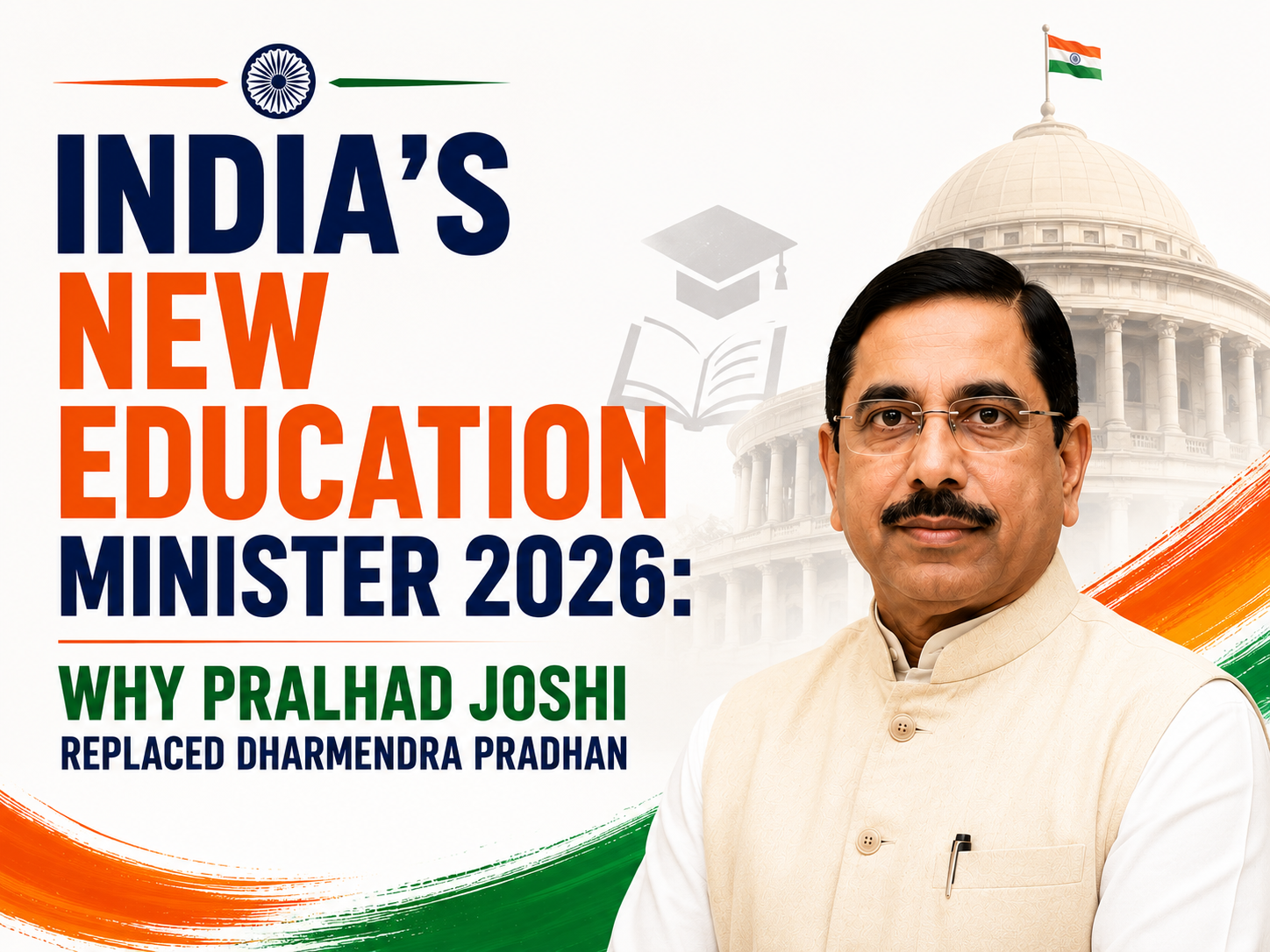
On the evening of 25 July 2026, as police fired tear gas at protesters camped near Jantar Mantar, Union Education Minister Dharmendra Pradhan posted his resignation letter on X. Within hours, President Droupadi Murmu had accepted it — and handed the Education Ministry, as an additional charge, to Pralhad Joshi, the veteran Karnataka BJP leader who already held three other Cabinet portfolios.
For the roughly 2.27 million students who sat the NEET-UG 2026 exam — and the many more preparing for it, JEE, and other national tests — this is not a routine reshuffle. It is the direct outcome of a two-month agitation over an alleged paper leak, one that a satirical youth movement calling itself the Cockroach Janta Party (CJP) turned into the year's most consequential student protest.
This article breaks down exactly what happened, why Pradhan resigned, who Pralhad Joshi is, and — critically — how this development fits into the UPSC, SSC, Banking, Railway, and State PSC syllabus. By the end, you will understand the full timeline, the stakeholders involved, and exactly how examiners are likely to frame questions on this event.
Table of Contents
- What Happened: The Cabinet Reshuffle Explained
- Background: The Road to Resignation — The NEET-UG 2026 Controversy
- Who Is Pralhad Joshi? Profile of India's New Education Minister
- Why This Matters: Multi-Dimensional Impact Analysis
- Key Stakeholders and Their Positions
- Data and Numbers: The Scale of the NEET Crisis
- Critical Analysis: Reading Beyond the Headlines
- Challenges and Criticisms
- Road Ahead: India's Examination Reform Roadmap
- Exam Preparation Strategy: How to Use This Topic
- Key Takeaways
- Frequently Asked Questions
- Related Topics
What Happened: The Cabinet Reshuffle Explained
Pralhad Joshi is India's new Union Education Minister, appointed on 25 July 2026 as an additional charge after President Droupadi Murmu accepted Dharmendra Pradhan's resignation over the 2026 NEET-UG paper leak controversy and the National Testing Agency's handling of it. Joshi continues to hold his existing portfolios — Consumer Affairs, Food and Public Distribution, and New and Renewable Energy — while now also steering the Ministry of Education.
Pradhan had served as Education Minister since 7 July 2021, across two Modi governments, making him one of the longest-serving holders of the portfolio in recent memory. His exit follows nearly two months of continuous protests at Delhi's Jantar Mantar, led by student groups and the CJP, demanding accountability for the compromised examination.
| Aspect | Dharmendra Pradhan (Outgoing) | Pralhad Joshi (Incoming) |
|---|---|---|
| Tenure as Education Minister | 7 July 2021 – 25 July 2026 | From 25 July 2026 (additional charge) |
| Other portfolios held | None concurrently at exit | Consumer Affairs, Food & Public Distribution; New & Renewable Energy |
| Parliamentary base | Sambalpur, Odisha | Dharwad, Karnataka |
| Reason for change | Resigned over NEET-UG 2026 controversy | Appointed to restore confidence in examination system |
Background: The Road to Resignation — The NEET-UG 2026 Controversy
To understand why an Education Minister resigned in 2026, you have to trace the timeline of the exam that triggered it.
- 3 May 2026 — NEET-UG 2026 is conducted nationwide by the National Testing Agency (NTA) for roughly 2.27 million medical aspirants.
- Days later — Investigators find overlaps between a pre-circulated guess paper and the actual question paper, raising serious leak allegations.
- 12 May 2026 — The NTA cancels the examination; the Centre hands the probe to the Central Bureau of Investigation (CBI).
- 18 May 2026 — CBI arrests a coaching-institute owner in Latur, Maharashtra, linked to the leak racket; investigators later find the same network had compromised the NEET-UG 2025 paper too.
- 6 June 2026 — The Cockroach Janta Party, a Gen-Z satirical movement founded by digital strategist Abhijeet Dipke, along with student bodies including AISF, AISA, and SFI, begins sit-in protests at Jantar Mantar, demanding Pradhan's resignation and CBSE on-screen marking reforms.
- 28 June 2026 — Ladakh-based education reformer Sonam Wangchuk joins the protest with an indefinite hunger strike.
- 20 July 2026 — A police crackdown at the protest site draws national criticism; Wangchuk, hospitalised, seeks assurance that no student will face charges under laws like the UAPA.
- 24 July 2026 — Wangchuk ends his 26-day fast after talks with Union ministers.
- 25 July 2026 — Pradhan resigns, citing the need to protect students and preserve national unity; the CJP declares its protest over, saying its core demands have been met.
This is not India's first paper-leak crisis — NEET-UG 2024 also saw large-scale protests over irregularities and grace marks. But the 2026 episode is the first to end with a sitting Union Cabinet minister stepping down over an examination scandal, making it a genuinely unprecedented moment in India's education governance.
"I have submitted my resignation letter to the Honorable Prime Minister," Pradhan wrote, framing his exit as necessary so that "national unity remains intact" and students can return to their studies.
Who Is Pralhad Joshi? Profile of India's New Education Minister
Pralhad Venkatesh Joshi is a six-time Lok Sabha MP from Dharwad, Karnataka, born on 27 November 1962 in Vijayapura. He studied at a Railway School and New English School in Hubballi before completing a Bachelor of Arts from K.S. Arts College, Hubballi, affiliated with Karnataka University, Dharwad. He has been associated with the Rashtriya Swayamsevak Sangh since his youth and built his political career largely through the BJP's organisational structure in Karnataka before entering national politics.
Joshi has represented Dharwad continuously since 2004 and has held a string of significant Cabinet portfolios over the past decade:
- Union Minister of Coal and Mines (2019–2024) — oversaw commercial coal mining reforms and auction processes
- Union Minister of Parliamentary Affairs (2019–2024) — coordinated legislative business across party lines
- Union Minister of Consumer Affairs, Food and Public Distribution (since 2024)
- Union Minister of New and Renewable Energy (since 2024)
- Union Minister of Education (since 25 July 2026, additional charge)
Political observers describe him as an experienced consensus-builder, though several commentators have flagged that managing four major ministries simultaneously will be a real administrative test — particularly for a ministry as sensitive as Education, currently under intense public scrutiny.
Why This Matters: Multi-Dimensional Impact Analysis
Political dimension: A sitting minister's resignation under sustained street pressure is a rare event in India's recent political history and signals the government's sensitivity to youth-led mobilisation ahead of future election cycles. It also raises the profile of the CJP as a new form of digitally native student politics.
Administrative dimension: Joshi now holds four Cabinet-level portfolios — Education, Consumer Affairs & Food, New & Renewable Energy, and (given his other duties). Whether the Education Ministry gets a dedicated full-time Cabinet minister later, or Joshi retains it long-term, is likely to shape how quickly reforms move.
Social dimension: Millions of medical aspirants faced a cancelled exam, a delayed admission cycle, and, according to protesters, the tragic loss of some students to suicide after being told to retake the test. The controversy has intensified national debate on examination stress and mental health support for aspirants.
Legal dimension: The CBI probe, the arrests linked to the Latur coaching network, and protesters' concerns over potential UAPA charges against demonstrators bring in questions of due process, free assembly, and proportionate law enforcement.
Policy dimension: Pradhan had already announced plans to shift NEET to a fully computer-based test format from 2027 and admitted a "breach in the command chain" at the NTA. Joshi inherits the task of implementing this shift, alongside broader National Education Policy (NEP) 2020 goals.
Key Stakeholders and Their Positions
| Stakeholder | Stated Position |
|---|---|
| Union Government / BJP | Accepted Pradhan's resignation; committed to CBI investigation and a 2027 computer-based NEET |
| Cockroach Janta Party (CJP) | Declared victory after resignation, compensation commitments, and assurances of no punitive action against protesters |
| Sonam Wangchuk | Sought guarantees against UAPA action on students before ending his hunger strike |
| National Testing Agency (NTA) | Cancelled the exam, cooperated with the CBI probe, faces reform pressure |
| Opposition parties | Have long demanded accountability on paper leaks, citing the 2024 NEET episode as a precedent |
| Student aspirants and families | Seeking a fair, transparent re-examination process and support for affected students |
Data and Numbers: The Scale of the NEET Crisis
Roughly 2.27 million candidates appeared for NEET-UG 2026 on 3 May — one of the largest single-day competitive examinations in the world. The exam was cancelled just nine days later, on 12 May, once investigators established overlaps between a circulating guess paper and the actual questions.
The protest that followed at Jantar Mantar ran for close to seven weeks, from 6 June to 25 July 2026, and included a 26-day hunger strike by Sonam Wangchuk — one of the longest such fasts linked to an education-policy protest in recent Indian history. For comparison, the 2024 NEET paper-leak protests, which also demanded ministerial accountability, did not result in a resignation, making the 2026 outcome a clear escalation in consequence.
Critical Analysis: Reading Beyond the Headlines
The headline story is simple: a minister resigned, a new one was appointed. The deeper story is about institutional accountability. Pradhan's own admission of a "breach in the command chain" inside the NTA points to a systemic vulnerability — repeated leaks across 2024, 2025, and 2026 exam cycles suggest the same coaching-linked networks were never fully dismantled after earlier scandals.
There is also a generational story here. The CJP began as internet satire before becoming an organised political force capable of sustaining a multi-week agitation and extracting a ministerial resignation — a template that other youth movements across South Asia have used in 2025–26 to pressure governments over unrelated grievances.
Analysts note that Joshi's reputation as a "consensus builder" may matter less than his bandwidth: overseeing four ministries during an active reform window leaves little room for sustained personal attention to NEET reform.
For UPSC Mains aspirants, this episode offers rich material for questions on accountability in public institutions, examination reform, and the changing nature of student political mobilisation in the digital age.
Challenges and Criticisms
- Administrative overload: Critics argue that giving Education as an "additional charge" to an already multi-tasking minister signals it is not being treated as a first-order priority.
- Trust deficit: With leaks reported across three consecutive exam cycles, restoring aspirant confidence in NTA-conducted exams will take more than a change of minister.
- Due process concerns: Civil liberties groups have flagged the use of force during the 20 July crackdown and possible UAPA application against student protesters as disproportionate.
- Implementation risk: The promised shift to computer-based testing by 2027 requires massive infrastructure — reliable centres, power backup, and cybersecurity — across rural and semi-urban India.
- Political framing: Opposition parties have questioned whether the resignation reflects genuine accountability or crisis management ahead of electoral considerations.
Road Ahead: India's Examination Reform Roadmap
The government's stated plan includes completing the CBI investigation, conducting a credible re-examination process for affected NEET-UG 2026 candidates, and transitioning NEET to a computer-based test from 2027. Analysts expect scrutiny of the National Testing Agency's internal security protocols, coaching-centre regulation, and possibly a fresh look at CBSE's on-screen marking system, which protesters also flagged.
Milestones to watch over the next 6–12 months: the CBI chargesheet in the paper-leak case, any announcement on compensation for affected families, the rollout plan for computer-based NEET, and whether Education remains with Joshi or is handed to a dedicated Cabinet minister in a future reshuffle.
Key Exam Takeaways (UPSC, SSC & Banking)
This is a high-probability current affairs topic across UPSC, SSC, Banking, Railway, and State PSC exams for late 2026 and early 2027 cycles.
- MCQ angle: Name of new Education Minister, his constituency, other portfolios held, date of Pradhan's resignation, and the agency conducting the CBI probe.
- UPSC Mains angle (GS2 — Governance): "Discuss the challenges of ensuring integrity in large-scale public examinations in India, with reference to the 2026 NEET-UG controversy." Structure your answer around institutional accountability, technology-driven reform, and student welfare.
- GS4 (Ethics) angle: Accountability of public office holders and the ethical basis for ministerial resignation over institutional failure.
- Key terms to remember: NEET-UG, National Testing Agency (NTA), Cockroach Janta Party (CJP), computer-based test (CBT), command-chain breach, Jantar Mantar protests.
- Common mistake: Confusing Pradhan's resignation date (25 July 2026) with the exam cancellation date (12 May 2026) — examiners often test this kind of timeline precision.
- Model answer framework: (1) State the event and date, (2) trace the NEET-UG controversy briefly, (3) analyse governance and accountability dimensions, (4) conclude with the reform roadmap.
Key Takeaways
- Pralhad Joshi is India's new Education Minister, appointed 25 July 2026 as an additional charge after Dharmendra Pradhan's resignation.
- Pradhan resigned over the NEET-UG 2026 paper leak controversy following nearly two months of protests led by the Cockroach Janta Party.
- NEET-UG 2026 was cancelled on 12 May 2026 after evidence of a leak affecting roughly 2.27 million candidates.
- Joshi is a six-time MP from Dharwad, Karnataka, and continues to hold Consumer Affairs and New & Renewable Energy portfolios.
- The government has committed to shifting NEET to a computer-based test format from 2027.
- This is a high-yield current affairs topic for GS2 (Governance) and GS4 (Ethics) in UPSC Mains, and a strong MCQ topic for all other exams.
Frequently Asked Questions
Who is India's new Education Minister in 2026?
Pralhad Joshi, a six-time BJP Lok Sabha MP from Dharwad, Karnataka, was given additional charge of the Ministry of Education on 25 July 2026, after Dharmendra Pradhan's resignation.
Why did Dharmendra Pradhan resign as Education Minister?
Pradhan resigned amid weeks of protests over the NEET-UG 2026 paper leak controversy, stating he wanted to protect students and preserve national unity.
What is the NEET-UG 2026 controversy?
It refers to the alleged leak of the NEET-UG 2026 question paper, which led the National Testing Agency to cancel the 3 May exam and hand the case to the CBI.
What is the Cockroach Janta Party (CJP)?
It is a Gen-Z satirical youth movement, founded in May 2026, that led sustained protests at Jantar Mantar demanding accountability for the NEET paper leak.
Does Pralhad Joshi hold other ministries besides Education?
Yes. He continues to serve as Minister of Consumer Affairs, Food and Public Distribution, and Minister of New and Renewable Energy.
What reforms has the government promised after the NEET controversy?
The government has said NEET will move to a computer-based test format from 2027, alongside a CBI investigation into the 2026 paper leak.
Which UPSC topics connect to this news?
It links to GS2 topics on governance and accountability, and GS4 topics on ethics in public administration, as well as education policy under NEP 2020.
How is this different from the 2024 NEET controversy?
Both involved paper-leak allegations, but the 2026 controversy is the first to result in a Union Cabinet minister's resignation.
Related Topics
- Jantar Mantar Protest 2026: Causes, Demands & Timeline — for the full protest timeline behind this resignation.
- Sonam Wangchuk's Hunger Strike 2026 — to understand the activist whose fast kept national attention on the issue.
- E20 Fuel India 2026 — another policy story overseen by ministries under review this year.
- India-Japan Summit 2026 — for broader governance and foreign policy current affairs.
- Record Exports vs. $28.2B Deficit — for economic current affairs relevant to GS3.
Conclusion
This reshuffle is less about one minister replacing another and more about what it took to force the change: nearly two months of sustained, largely peaceful, digitally organised student protest. Whether Pralhad Joshi's tenure restores trust in India's examination system will depend on how quickly the promised computer-based NEET rolls out — and whether the NTA's next "command chain" holds.
For your exam preparation, treat this as a live case study in governance and accountability rather than a one-off fact to memorise. Bookmark this page, revisit it closer to your exam date, and explore the related articles above to build the full picture.
Editorial & Verification Standards
This article was researched, written, and verified by the CurrentAffairs360 editorial team in collaboration with educators at Khalsa Inter College, Naka Hindola, Lucknow. All insights are cross-verified against official government sources (PIB, RBI, The Hindu, Indian Express) to ensure rigorous exam authenticity.
Meet our editorial and teaching team →