
Jantar Mantar Protest 2026: Causes, Demands & Timeline
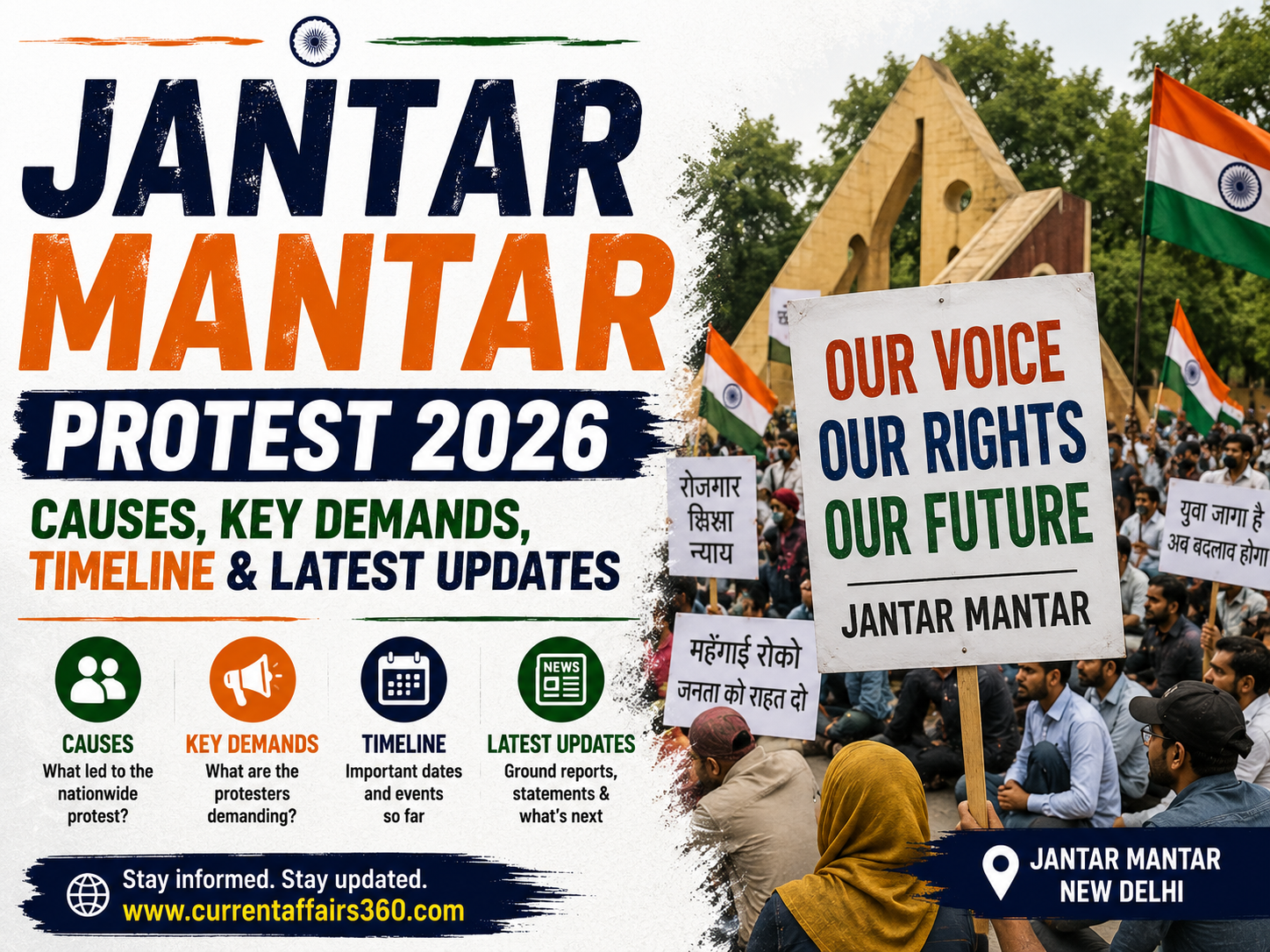
On 20 July 2026, more than 10,000 young Indians tried to walk from Jantar Mantar to Parliament House. They did not get far. Police lines met them with tear gas shells and baton charges, and by nightfall, Delhi Police itself put the injury count at nearly 180 people — 60 protesters and 118 security personnel. Within 48 hours, the images of students being dragged and beaten had done what two months of hunger strikes and hashtags had not: they turned a satirical online joke called the 'Cockroach Janta Party' into the most serious sustained challenge Prime Minister Narendra Modi's third-term government has faced on the streets of the capital.
For competitive exam aspirants, this is not just news — it is a live case study touching India's examination system, federal policing, the right to protest, and Centre-Opposition relations, all at once. This article walks through what happened, why it happened, who is involved, and how to use this topic in your UPSC, SSC, Banking, Railway, or State PSC preparation, without repeating the same three headlines you have already scrolled past on social media.
Table of Contents
- Background: How a Meme Became a Movement
- What Is the Cockroach Janta Party Protest, Exactly?
- Timeline at a Glance
- Why This Matters: Multi-Dimensional Impact
- Key Stakeholders and Their Positions
- Data, Statistics and Ground Reality
- Critical Analysis
- Challenges and Counterarguments
- Government Response and the Road Ahead
- Exam Preparation Strategy
- Key Takeaways
- FAQs
- Related Topics
Background: How a Meme Became a Movement
The roots of this protest lie in India's troubled recent history with entrance examinations. NEET-UG, the single gateway exam for roughly 2.2 million aspiring doctors, had already been rocked by a major leak controversy in 2024. In 2026, the problem repeated itself: the National Testing Agency was forced to cancel the NEET-UG papers held on 3 and 7 May 2026 after evidence emerged that questions had been sold in advance under the guise of a 'guess paper.' Education Minister Dharmendra Pradhan confirmed the breach at a media briefing on 15 May, and a re-examination was eventually held on 21 June, alongside a CBI investigation.
Parallel to the NEET fiasco, the Congress party and other critics flagged separate irregularities in the CBSE's On-Screen Marking (OSM) system procurement, along with disputes over Vice-Chancellor appointments at central universities and governance concerns at bodies like the UGC and NAAC. Taken together, these became the basis for a single, unified demand: the resignation of Union Education Minister Dharmendra Pradhan.
The movement's name has an unusual origin. In May 2026, after a remark by a senior judicial figure that was widely read as comparing unemployed young Indians to 'cockroaches,' a digital strategist named Abhijeet Dipke turned the insult into satire, launching the 'Cockroach Janta Party' (CJP) as a tongue-in-cheek mirror of the ruling party's name. What began as memes and social media mockery evolved, within weeks, into an organised on-ground protest, joined by established student bodies such as the Students' Federation of India (SFI), the All India Students Association (AISA), and the All India Students Federation (AISF).
What Is the Cockroach Janta Party Protest, Exactly?
The 2026 Delhi Jantar Mantar protests are an ongoing series of demonstrations, begun on 6 June 2026, that bring together the CJP, student organisations, and — since late June — a wider coalition including Ladakhi activist Sonam Wangchuk and the principal Opposition party, Congress. The core, unifying demand is the resignation of Dharmendra Pradhan, framed as accountability for repeated NTA failures; the broader demands include structural reform of India's examination system and compensation for the families of students who died by suicide after past paper leaks.
What separates this from earlier one-off protests at the same historic site — the 2023 wrestlers' sit-in, the 2020 Hathras protests, or the farmers' 2021 agitation — is its scale, its youth-led character, and the way it has drawn in a Ladakhi statehood activist, Bollywood commentary, and a direct standoff with the Prime Minister's Office, all within about seven weeks.
| Aspect | Detail |
|---|---|
| Started | 6 June 2026, at Jantar Mantar, New Delhi |
| Core organiser | Cockroach Janta Party (CJP), founded by Abhijeet Dipke |
| Key allies | SFI, AISA, AISF, Sonam Wangchuk, Indian National Congress |
| Primary demand | Resignation of Education Minister Dharmendra Pradhan |
| Trigger event | NEET-UG 2026 paper leak and CBSE On-Screen Marking irregularities |
Timeline at a Glance
- 3 & 7 May 2026: NEET-UG exams held; irregularities suspected.
- 15 May 2026: Pradhan confirms the paper leak at a press briefing; NTA cancels the two exam sittings.
- May 2026: Cockroach Janta Party launched online as satire, following a remark comparing jobless youth to 'cockroaches.'
- 6 June 2026: Sit-in protests begin at Jantar Mantar, joined by student unions.
- 21 June 2026: NEET-UG re-examination conducted; CBI probe continues.
- 28 June 2026: Sonam Wangchuk joins the protest and begins an indefinite hunger strike demanding Pradhan's resignation.
- 18 July 2026: After 20 days without food, Wangchuk is forcibly removed and hospitalised on High Court orders following medical advice; Delhi Police cite a 'slight commotion' as protesters resisted.
- 20 July 2026: Over 10,000 protesters attempt to march to Parliament during the Monsoon Session; police use tear gas and batons. Nearly 180 people are injured and roughly 70 detained.
- 21–22 July 2026: CJP halts further street marches citing safety, but continues the Jantar Mantar sit-in; solidarity protests spread to Mumbai and other cities; Congress leader Rahul Gandhi marches to the Prime Minister's residence.
- 24 July 2026: Government signals a possible parliamentary discussion on the NEET issue; Health Minister J.P. Nadda holds outreach talks with a CJP representative; the CJP calls for nationwide peaceful protests.
Why This Matters: Multi-Dimensional Impact
Political dimension: This is the first large, sustained, youth-driven street challenge to the Modi government since it returned for a third term, and it has drawn the Opposition, led by Rahul Gandhi, directly into solidarity with a movement it did not create.
Social dimension: The protest speaks to a generation of exam aspirants — many preparing for NEET, JEE, or other competitive tests — who feel the credibility of India's testing infrastructure is at stake, along with the demand for compensation for families who lost children to suicide after earlier leaks.
Governance dimension: It raises direct questions about ministerial accountability, the functioning of the National Testing Agency, and oversight of statutory bodies like the UGC, NAAC, and CBSE.
Law and order dimension: The Delhi Police's use of force on 20 July has triggered a parallel debate on the right to peaceful assembly under Article 19, and on how protests are policed near Parliament during a sitting session.
Federal/administrative dimension: Because Delhi Police reports to the Union Home Ministry rather than the Delhi state government, the crackdown has also become a flashpoint in the broader debate over Centre-versus-Delhi administrative control.
Key Stakeholders and Their Positions
- Cockroach Janta Party (Abhijeet Dipke, spokesperson Saurav Das): Demands Pradhan's resignation and exam-system reform; has paused street marches but continues the sit-in.
- Sonam Wangchuk: Joined as a solidarity figure through his hunger strike; has repeatedly urged protesters to keep the movement strictly peaceful.
- Student unions (SFI, AISA, AISF): Provide organisational muscle and have long campaigned on exam-fairness issues.
- Union Education Minister Dharmendra Pradhan: Has rejected the resignation demand and characterised some protest actions as being against the national interest, while acknowledging failures at the NTA.
- Delhi Police / Union Home Ministry: Maintain that the 20 July march was unauthorised during the Parliament session and that force was used to prevent barricades from being breached; deny any disproportionate or unprovoked violence.
- Congress and Opposition parties: Have backed the protesters' demands, with Rahul Gandhi calling for accountability from the Prime Minister and Home Minister Amit Shah, and pushing for a parliamentary debate.
- Health Minister J.P. Nadda: Represented an initial government outreach, holding talks with movement representatives after the 20 July clash.
Data, Statistics and Ground Reality
Delhi Police recorded close to 180 injuries from the 20 July clash — 118 among security personnel and 60 among protesters — alongside around 70 detentions.
Roughly 2.2 million candidates were affected by the NEET-UG re-examination process this year, underlining the scale of what is, for many families, a once-a-year, career-defining test. Solidarity action was not confined to Delhi: police in Mumbai alone registered 13 FIRs and booked around 400 people in connection with related demonstrations, and sixteen Delhi Metro stations near the protest and parliamentary zone were shut on security grounds on 24 July. These are not the numbers of a fringe protest; they reflect a movement that, within seven weeks of forming as an internet meme, had produced one of the largest single-day protest mobilisations New Delhi has seen in recent years.
Critical Analysis
Beyond the headlines, three things are worth noting for anyone analysing this event seriously. First, the movement's staying power came less from the paper leak itself — India has, unfortunately, seen this story before, including a near-identical 2024 controversy involving the same minister — and more from Wangchuk's hunger strike, which gave a diffuse, largely leaderless youth movement a recognisable face and moral weight.
Second, the 20 July police action appears to have been a turning point that expanded, rather than shrank, the protest's base: multiple international outlets reported footage of officers striking demonstrators while finding no comparable video evidence of protester-initiated violence, a discrepancy that has shaped both domestic and global media coverage of the episode.
Third, the government's posture has visibly shifted over the course of the protest — from Pradhan's initial hard line to the Health Minister's outreach talks by 20–24 July — suggesting the administration is now weighing the political cost of prolonged confrontation against the political cost of appearing to reward street pressure with a resignation.
Challenges and Counterarguments
The government's position deserves fair representation. Delhi Police maintains the 20 July march was not authorised, that Parliament's Monsoon Session made heightened security near the barricaded zone necessary, and that force was used only after protesters attempted to breach security lines — not as an unprovoked attack. Pradhan and other ministers have argued that isolated incidents at the NTA do not amount to ministerial failure warranting resignation, and some officials have suggested that certain elements within the wider protest ecosystem have used the moment to pursue unrelated political goals.
Critics of the movement also point out that repeated, large, unauthorised marches toward Parliament carry genuine public-order and security risks in a dense capital city, and that a demand centred entirely on one minister's resignation may crowd out more substantive discussion of structural NTA reform — the kind of reform that would actually reduce the odds of a repeat leak.
Government Response and the Road Ahead
As of late July 2026, the government has not agreed to Pradhan's resignation but has opened a channel of dialogue through Health Minister Nadda, and sources indicate the ruling side is willing to allow a parliamentary discussion on the NEET-UG 2026 issue, provided the Opposition does not attach preconditions such as a resignation demand. The CJP, for its part, has paused fresh street marches on safety grounds but has called for nationwide, decentralised peaceful protests, and Wangchuk's supporters continue the sit-in at Jantar Mantar. Watch for three things in the coming weeks: whether Parliament actually debates NTA reform, whether the CBI probe produces findings that shift political pressure, and whether the movement can sustain momentum without the visual anchor of an ongoing hunger strike.
Key Exam Takeaways (UPSC, SSC & Banking)
This is a genuinely high-yield current affairs topic across exams. For UPSC Mains, it connects naturally to GS2 (governance, accountability of ministers, functioning of statutory bodies like the NTA and UGC, right to peaceful assembly under Article 19) and GS4 (ethics in public examinations, ministerial responsibility). A possible analytical question: Discuss the institutional weaknesses exposed by recurring examination irregularities in India, and evaluate the adequacy of existing accountability mechanisms. Structure your answer with (a) background on NTA's mandate, (b) specific institutional gaps, (c) reform suggestions such as independent oversight or a dedicated examination ombudsman, and (d) a balanced conclusion on ministerial accountability versus systemic reform.
For SSC, Banking, and Railway exams, focus on MCQ-ready facts: the CJP's founding month and founder, the dates of exam cancellation and re-examination, the injury and detention figures from 20 July, and the names of the key institutions involved (NTA, CBSE, UGC, NAAC). For State PSC aspirants, be alert to how state governments and state Congress units have echoed the resignation demand locally — a common pattern in previous NEET controversies too.
Key terms to remember: NEET-UG, National Testing Agency (NTA), CBSE On-Screen Marking (OSM), Cockroach Janta Party (CJP), Article 19 (freedom of assembly), ministerial accountability.
Key Takeaways
- The protest was triggered by the NEET-UG 2026 paper leak and CBSE On-Screen Marking irregularities.
- It began as satire in May 2026 and became an organised sit-in at Jantar Mantar from 6 June 2026.
- Sonam Wangchuk's hunger strike, begun 28 June, gave the movement national visibility.
- The 20 July 2026 police crackdown left nearly 180 injured and marked a turning point in scale and coverage.
- The core demand remains Education Minister Dharmendra Pradhan's resignation; the government has not agreed but has opened dialogue via Health Minister Nadda.
- Exam-relevant angles include ministerial accountability, NTA governance, and the right to peaceful protest.
Frequently Asked Questions
What is the Jantar Mantar protest of 2026 about?
It is a youth-led protest demanding Education Minister Dharmendra Pradhan's resignation over the 2026 NEET-UG paper leak and related examination system failures.
Who started the Cockroach Janta Party?
It was launched in May 2026 by digital strategist Abhijeet Dipke, initially as online satire, before evolving into an organised street movement.
Why did Sonam Wangchuk join the protest?
Wangchuk joined on 28 June 2026 and began an indefinite hunger strike in solidarity with student demands, lending the movement wider national attention.
What happened on 20 July 2026?
Police used tear gas and batons to stop a march of over 10,000 protesters toward Parliament, resulting in nearly 180 injuries and around 70 detentions.
What is the government's official position?
Pradhan has declined to resign, while the government has since opened dialogue through Health Minister J.P. Nadda and signalled openness to a parliamentary discussion.
How is this relevant for UPSC preparation?
It links to GS2 topics on governance, statutory body accountability, and the right to peaceful assembly, making it useful for both Prelims facts and Mains analytical answers.
Is the protest still ongoing?
As of late July 2026, the sit-in at Jantar Mantar continues, though large street marches have been paused after the 20 July crackdown.
Related Topics
- Sonam Wangchuk's Hunger Strike 2026: A deeper look at his demands and the Ladakh statehood movement that first brought him to Jantar Mantar in earlier years.
- NEET-UG Examination Reforms: Understand the structural changes proposed for India's medical entrance exam system.
- Role and Functions of the National Testing Agency: A GS2 staple worth revisiting given the NTA's repeated controversies.
- Article 19 and the Right to Peaceful Assembly: Constitutional basis for protest rights and their reasonable restrictions.
- Ministerial Accountability in the Indian Parliamentary System: A recurring GS2 theme this episode illustrates well.
Conclusion
What makes the 2026 Jantar Mantar protests worth understanding closely is not any single dramatic image — not the tear gas, not the hunger strike — but how quickly an online joke about being called 'cockroaches' turned into a genuine test of accountability for one of India's most consequential, and most frequently troubled, institutions: its examination system. Whether or not Dharmendra Pradhan eventually resigns, the pressure this movement has built for NTA reform is unlikely to simply disappear once the cameras move on. For exam aspirants, that makes this less a passing headline and more a live governance case study worth revisiting through the rest of 2026.
Editorial & Verification Standards
This article was researched, written, and verified by the CurrentAffairs360 editorial team in collaboration with educators at Khalsa Inter College, Naka Hindola, Lucknow. All insights are cross-verified against official government sources (PIB, RBI, The Hindu, Indian Express) to ensure rigorous exam authenticity.
Meet our editorial and teaching team →