Asian Games 2026 Medal Tally: India's 85 Medals & Full List
On 15 October 2026, New Delhi’s Major Dhyan Chand National Stadium hosted a grand reception where Prime Minister Narendra Modi interacted with and felicitated India’s contingent returning from the 20th Asian Games in Aichi-Nagoya, Japan. The ceremony celebrated a fiercely contested international campaign that concluded with India securing fourth place on the continental medal table.
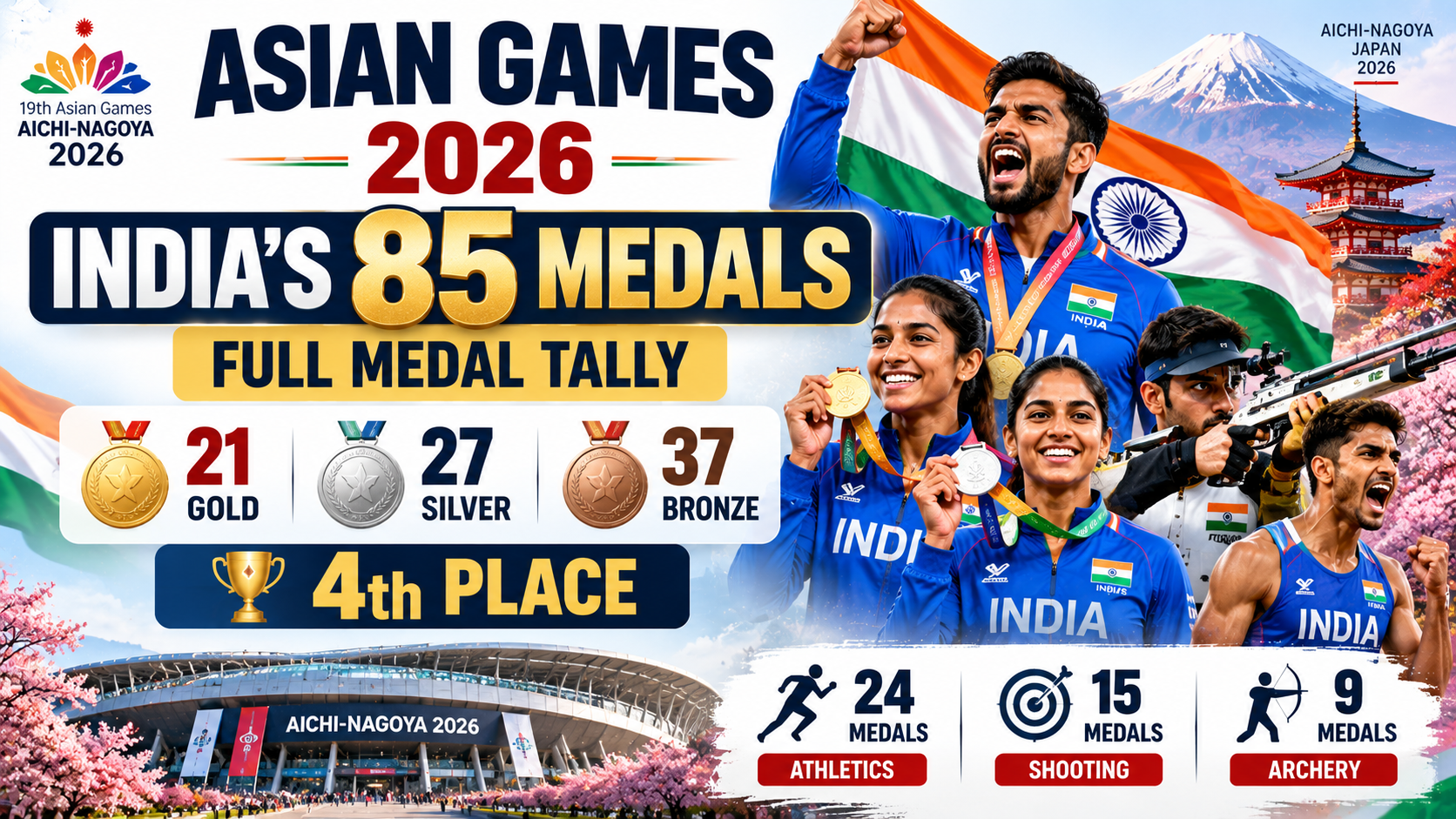
India concluded the Aichi-Nagoya Games with an aggregate of 85 medals: 21 gold, 27 silver, and 37 bronze. While the total fell 22 medals shy of the record-shattering 107 medals won at Hangzhou 2022, the 2026 campaign revealed a significant structural evolution. Indian athletes swept both men’s and women’s titles across three marquee team sports—hockey, cricket, and kabaddi—while shooting and archery cemented their status as world-class disciplines. Most notably, for the first time since the 2002 Busan Asian Games, Indian women athletes outperformed their male counterparts in the gold medal column, securing 11 of India’s 21 top-podium finishes.
India at Aichi-Nagoya 2026: Medal Tally and Comparative Standing
At the close of 16 days of competition spanning 469 events across 43 sports and disciplines, India matched its fourth-place continental ranking from Hangzhou. Host nation Japan finished second, trailing China—which topped the table for a twelfth consecutive edition—while South Korea secured third place.
A critical technical highlight of the final table was India’s edge over fifth-placed Uzbekistan. Both nations finished level with 21 gold medals each. Under Olympic Council of Asia (OCA) ranking protocols, ties in gold medals are resolved strictly by silver medal count. India’s tally of 27 silvers decisively surpassed Uzbekistan’s 18, cementing India’s position in the top four.
| Edition & Host City | Gold | Silver | Bronze | Total | Rank |
|---|---|---|---|---|---|
| Aichi-Nagoya 2026 (Japan) | 21 | 27 | 37 | 85 | 4th |
| Hangzhou 2022 (China, held 2023) | 28 | 38 | 41 | 107 | 4th |
| Jakarta-Palembang 2018 (Indonesia) | 16 | 23 | 31 | 70 | 8th |
India’s trajectory during the Games was marked by a dramatic late turnaround. During the opening week, the contingent hovered in eighth place due to early eliminations in secondary disciplines. However, a blistering surge over the final 72 hours—yielding 10 medals on 2 October and nine medals on 3 October (including five golds)—vaulted India past Uzbekistan and Chinese Taipei into fourth position.
Sport-by-Sport Breakdown: The 21 Gold Medals
India’s gold collection was characterized by heavy concentration: six core disciplines accounted for 17 of the 21 gold medals. Archery led all sports with five titles, followed by shooting, boxing, hockey, cricket, and kabaddi.
| Discipline | Gold | Champions & Winning Events |
|---|---|---|
| Archery | 5 | Women’s Compound Team (Chikitha Taniparthi, Prithika Pradeep, Jyothi Surekha Vennam); Men’s Compound Team (Sahil Jadhav, Kushal Dalal, Mani Ratnam); Mixed Compound Team (Chikitha Taniparthi, Sahil Jadhav); Women’s Recurve Team (Ankita Bhakat, Kirti Sharma, Kumkum Mohod); Kumkum Mohod (Women’s Individual Recurve) |
| Shooting | 3 | Suruchi Singh & Kamaljeet (10m Air Pistol Mixed Team); Neeru Dhanda (Women’s Trap); Kynan Chenai & Neeru Dhanda (Mixed Trap Team) |
| Boxing | 3 | Lovlina Borgohain (Women’s 75 kg); Parveen Hooda (Women’s 65 kg); Ankush Panghal (Men’s 80 kg) |
| Hockey | 2 | Men’s National Team; Women’s National Team |
| Cricket | 2 | Men’s National Team; Women’s National Team |
| Kabaddi | 2 | Men’s National Team; Women’s National Team |
| Wrestling | 2 | Sujeet Kalkal (Men’s Freestyle 65 kg); Aman Sehrawat (Men’s Freestyle 57 kg) |
| Athletics | 1 | Women’s 4×400m Relay (Kiran Pahal, Poovamma Machettira, Prachi Choudhary, Vithya Ramraj) |
| Golf | 1 | Pranavi Urs (Women’s Individual) |
| Total | 21 | Achieved across 9 disciplines |
Four Indian athletes distinguished themselves as triple-medallists at Aichi-Nagoya:
- Neeru Dhanda (Shooting): 2 Golds (Women’s Trap, Mixed Trap) and 1 Silver (Women’s Trap Team); appointed India’s flag-bearer at the Closing Ceremony.
- Kumkum Mohod (Archery): 2 Golds (Individual Recurve, Recurve Team) and 1 Silver (Mixed Recurve Team).
- Gulveer Singh (Athletics): 2 Silvers (5000m, 10000m) and 1 Bronze (3000m Steeplechase), demonstrating extraordinary distance-running endurance.
- Vithya Ramraj (Athletics): 1 Gold (Women’s 4×400m relay), 1 Silver (Mixed 4×400m relay), and 1 Bronze (400m hurdles).
Landmark Records and Breakthrough Moments
Beyond the raw medal tallies, Aichi-Nagoya produced several watershed moments that redefined historical benchmarks for Indian sports:
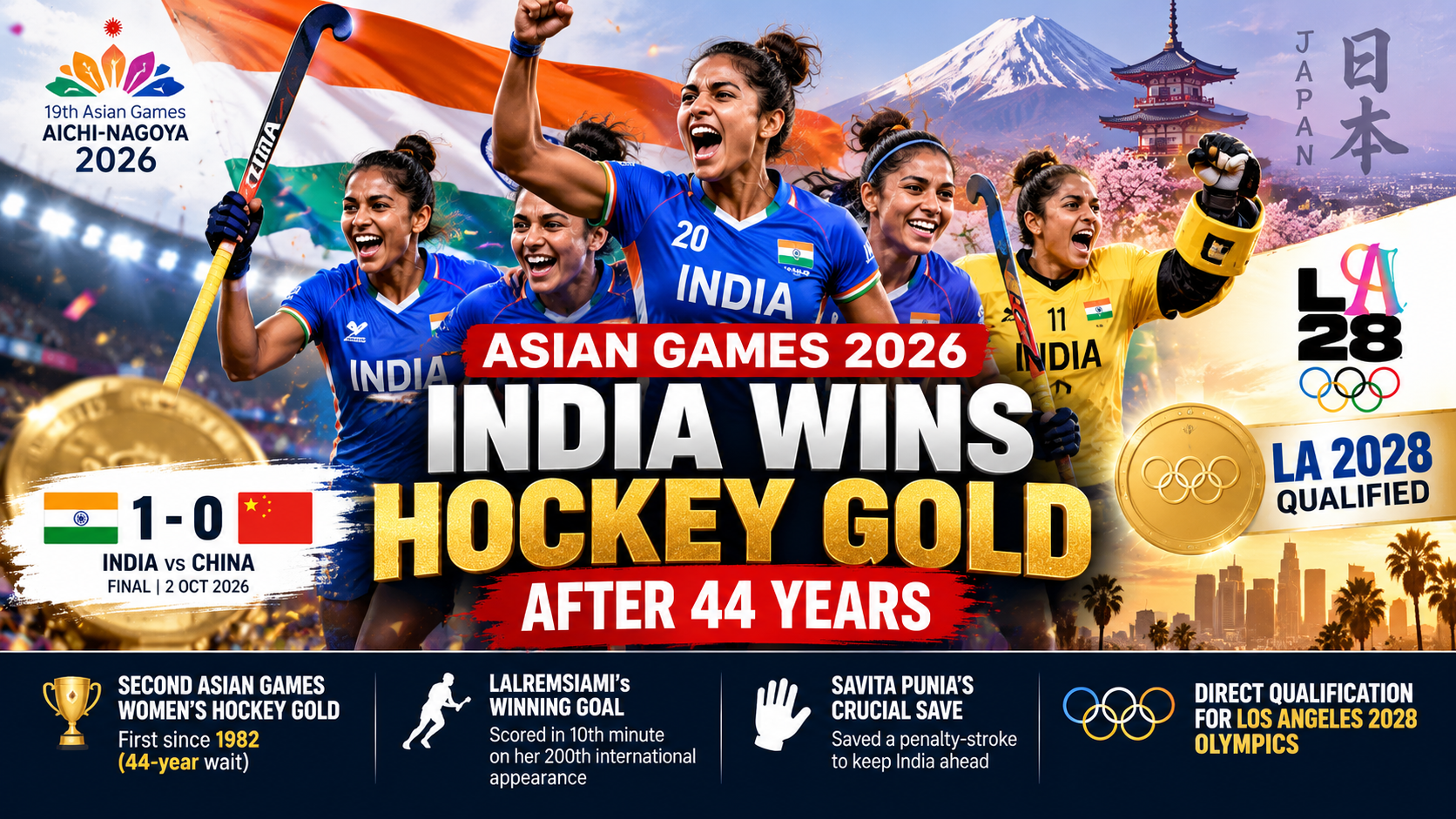
- The Historic Hockey Double and Olympic Qualification: For the first time in Asian Games history, India won both the men’s and women’s field hockey titles at the same edition. The women’s team defeated powerhouse China 1–0 through a clinical 10th-minute strike by Lalremsiami, ending a 44-year gold medal drought dating back to the 1982 New Delhi Games. The men’s squad, captained by drag-flicker Harmanpreet Singh, survived a 4–3 semifinal thriller against Pakistan before overwhelming Malaysia 5–1 in the final to claim back-to-back Asian Games golds. Crucially, both gold medals secured direct, automatic qualification spots for the 2028 Los Angeles Olympic Games.
- Dual Clean Sweeps in Cricket and Kabaddi: India maintained complete continental supremacy in its traditional team sports. The women’s cricket team defeated Sri Lanka by 147 runs, while Shreyas Iyer led the men’s team to a 19-run triumph over Pakistan. In kabaddi, the Indian women edged Iran 37–34 in a tense encounter, while the men’s team rallied from an early deficit to vanquish Iran 40–34.
- Asian Records in Shooting: Suruchi Singh and Kamaljeet clinched India’s first-ever Asian Games gold in the 10m Air Pistol Mixed Team event while shattering the Asian Games record. Trap shooter Neeru Dhanda became the first Indian woman to win an Asian Games shotgun gold, setting a continental record in women’s trap before partnering with Kynan Chenai for mixed trap gold.
- Pioneering Individual Milestones: Kumkum Mohod made history by securing India’s first-ever individual Asian Games gold in recurve archery, breaking a long-standing dominance by South Korean and Chinese archers. On the greens, Pranavi Urs became the first Indian woman to win an individual golf gold at the Asian Games.
- Boxing and Wrestling Resurgence: India topped the Asian Games boxing medal tally with three golds and three bronzes, recording its best-ever gold haul in the sport. In wrestling, six medals (two golds, two silvers, and two bronzes) marked the contingent’s most successful wrestling campaign since the 1962 Jakarta Games.
- Expansion into Emerging Disciplines: India earned debut medals in Mixed Martial Arts (MMA), Soft Tennis, and Sepak Takraw, signaling the early stages of diversification away from traditional strongholds.
The 85 vs 107 Paradox: An Honest Diagnostic of India’s Campaign
While the celebratory tone is justified by India’s retained fourth-place standing, an objective assessment reveals distinct structural vulnerabilities that explain the 22-medal drop from Hangzhou 2022.
A podium tally concentrated across six sports reflects world-class elite specialization, but it also signals a dangerously narrow competitive pyramid that leaves India vulnerable whenever a single powerhouse sport falters.
Three primary factors account for the lower aggregate:
- The Slump in Track and Field: In Hangzhou, athletics was India’s crown jewel, contributing 29 total medals, including six golds. At Aichi-Nagoya, track and field produced just a single gold (the women’s 4×400m relay) and a modest total of 14 medals. The unexpected withdrawal of Olympic champion Neeraj Chopra due to an elbow aggravation, combined with form dips in middle-distance events, dramatically diminished India’s medal volume.
- Stringent Selection Norms and Roster Reductions: Ahead of the Games, the Ministry of Youth Affairs and Sports strictly enforced criteria requiring athletes to rank within Asia’s top six to receive government funding. This led to contentious squad cuts—the tennis delegation was reduced from twelve players to seven, while entire squads in wushu, judo, and kurash were excluded after failing to clear benchmark trials. These omissions eliminated potential bronze and silver cushions in secondary events.
- Anti-Doping Sanctions and Administrative Turmoil: In the six months preceding the Games, pre-competition testing by NADA and WADA resulted in provisional suspensions for several prospective medallists across wrestling, shooting, and weightlifting. Furthermore, factional governance disputes within certain national sports federations disrupted training camps and international exposure tours.
Nevertheless, the quality-to-volume ratio in 2026 was notably superior. Eleven golds won by female athletes and six team golds demonstrate that where India invested in high-performance coaching and modern sports science, outcomes were durable.
Institutional Realities: Khelo India, TOPS, and the Road to LA 2028
Prime Minister Modi’s engagement with the contingent at Dhyan Chand Stadium highlights the political and institutional priority attached to international sporting success. The transition from continental podiums to Olympic glory, however, requires addressing clear systemic gaps.
Both the Target Olympic Podium Scheme (TOPS) and the Khelo India initiative have successfully modernized elite training. TOPS currently provides customized financial support, foreign coaches, and physical therapy to core athletes. However, the conversion challenge remains steep. While India routinely contends for top honours at the Asian Games, the Olympic arena introduces fierce competition from European, North American, and East Asian powerhouses.
To convert Nagoya’s 85 medals into double-digit podium finishes at the 2028 Los Angeles Olympics, India’s sports administration must prioritize three strategic areas:
- Decentralizing Sports Science: Integrating high-performance biomechanics, data analytics, and recovery protocols at state-level centers, reducing sole reliance on central National Centres of Excellence (NCOEs).
- Broadening the High-Yield Discipline Base: Investing aggressively in multi-medal sports such as swimming, cycling, gymnastics, and fencing, where countries like Japan and South Korea regularly harvest 30 to 40 medals.
- Governance and Coaching Continuity: Ensuring four-year contract guarantees for top international coaches and establishing autonomous governance structures free from administrative litigation.
Competitive Exam Masterclass: High-Yield Insights and Analysis
For aspirants preparing for UPSC Civil Services, State PSCs, SSC CGL, and Banking examinations, the 2026 Asian Games provides critical material across objective facts and governance analysis.
Key Prelims and Objective Exam Factsheet
- Edition and Host: 20th Asian Games; Aichi Prefecture and Nagoya, Japan (19 September – 4 October 2026).
- India’s Final Standing: 4th Place (85 Medals: 21 Gold, 27 Silver, 37 Bronze).
- Top Three Nations: China (1st), Japan (2nd), South Korea (3rd).
- OCA Ranking Protocol: Standings are determined strictly by Gold count, followed by Silver, then Bronze (explaining why India placed above Uzbekistan despite equal gold counts).
- Ceremonial Flag-Bearers: Opening Ceremony: Manu Bhaker (Shooting) and Pawan Sehrawat (Kabaddi); Closing Ceremony: Neeru Dhanda (Shooting).
- Historical Origins & Future Hosts: First Asian Games held in New Delhi (1951); 21st edition scheduled for Doha, Qatar (2030); 22nd edition awarded to Riyadh, Saudi Arabia (2034).
- Direct Olympic Quotas: Gold medals in Men’s and Women’s Hockey secured direct berths for the 2028 Los Angeles Olympics.
UPSC Mains Analytical Framework (GS Paper 2: Governance & Human Resource Development)
Theme: Evaluating India’s Transition from Continental Sports Power to Global Olympic Contender.
- Institutional Ecosystem: Analyze how the tripartite collaboration between the Sports Authority of India (SAI), National Sports Federations (NSFs), and the Indian Olympic Association (IOA) impacts athlete development. Highlight the success of TOPS in creating bespoke training regimens.
- Gender Parity and Social Transformation: Discuss how women leading India’s gold count (11 of 21) reflects the decentralization of sports culture into rural Haryana, Manipur, and tribal pockets of Odisha and Jharkhand.
- Structural Deficits: Critically assess the concentration risk—relying on six sports for 81% of gold medals—and the persistent lag in Olympic core sports (athletics, aquatics). Examine the impact of administrative disputes and anti-doping governance on international reputation.
- Strategic Imperatives: Propose public-private partnerships (PPP) under corporate social responsibility (CSR) for grassroots academies, mandatory sports science cells at regional universities, and national sports legislation to professionalize federation elections.
Syllabus Relevance: UPSC Prelims (Current events of national and international importance), Mains GS Paper 2 (Government policies and interventions in human development), and Essay Paper (Sports as an instrument of national soft power).
Frequently Asked Questions
How did India secure fourth place over Uzbekistan when both had 21 gold medals?
Under the official Olympic Council of Asia (OCA) charter, participating nations are ranked primarily by the number of gold medals. In the event of a tie in golds, the tie-breaker is determined by the total number of silver medals won. India captured 27 silver medals compared to Uzbekistan’s 18 silvers, definitively securing fourth position on the continental leaderboard.
Which Indian teams earned direct qualification for the 2028 Los Angeles Olympics from Aichi-Nagoya?
Both the Indian Men’s and Women’s Field Hockey teams secured direct, automatic quotas for the 2028 Los Angeles Olympic Games by winning gold in their respective Asian Games tournaments. Under International Hockey Federation (FIH) regulations, continental champions receive direct Olympic berths without requiring secondary qualification tournaments.
What explains the dip in India’s total medal count compared to Hangzhou 2022?
The 22-medal reduction was driven primarily by three factors: a sharp downturn in track and field (which dropped from 29 medals in Hangzhou to 14 in Nagoya), the injury-enforced absence of key champions including Neeraj Chopra, and strict pre-Games selection cut-offs by the Sports Ministry that trimmed squads in tennis, martial arts, and secondary disciplines.
Which Indian athletes achieved multiple podium finishes at the 2026 Asian Games?
Four athletes secured three medals each: shooter Neeru Dhanda (2 gold, 1 silver), recurve archer Kumkum Mohod (2 gold, 1 silver), middle-distance runner Gulveer Singh (2 silver, 1 bronze), and 400m specialist Vithya Ramraj (1 gold, 1 silver, 1 bronze).
Where are the next editions of the Asian Games scheduled to be held?
The Olympic Council of Asia has confirmed that the 21st Asian Games will take place in Doha, Qatar, in 2030, followed by the 22nd Asian Games in Riyadh, Saudi Arabia, in 2034. Both host nations are investing heavily in world-class sporting infrastructure across the West Asian corridor.
Editorial Perspective: The True Measure of Nagoya 2026
The 85 medals secured at Aichi-Nagoya demonstrate that Indian sports have established a stable, respectable baseline on the Asian continent. Fourth place is no longer an occasional windfall; it is becoming an institutional expectation.
Yet true sporting maturity is not measured merely by holding ground. As Prime Minister Modi’s felicitation highlighted, continental victories are stepping stones toward the global crucible of Los Angeles 2028. For civil services aspirants and students analyzing this trajectory, the lesson mirrors their own preparation: consistent excellence requires identifying structural weaknesses early, trusting institutional discipline, and turning setbacks into tactical adjustments.
About the Author
School Principal at Khalsa Inter College, Naka Hindola, Lucknow, Uttar Pradesh. Committed to providing free, quality education for students preparing for competitive examinations.
Learn more about our mission →