CWG 2026: India's Historic Boxing Gold Rush and the Road to Ahmedabad 2030
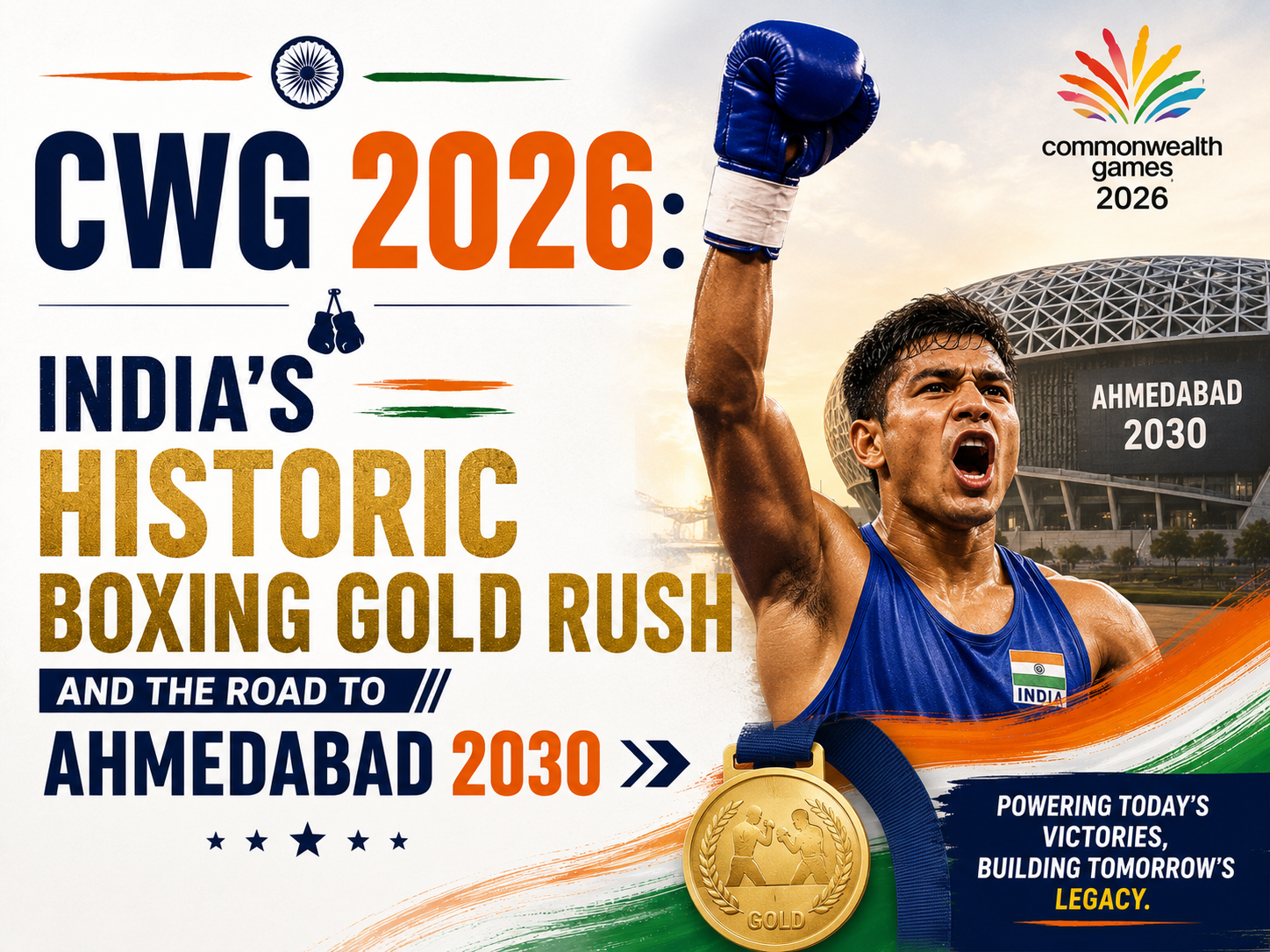
Seven gold medals. One nation. One edition of the Commonwealth Games. When India's boxers stepped off the ring at the Emirates Arena in Glasgow on 1 August 2026, they had done something no boxing contingent from any country had ever managed at a single Commonwealth Games — not England, not Canada, not Australia.
India's seven-gold, three-silver boxing campaign at CWG 2026 did not just top the sport's medal table in Glasgow. It rewrote Commonwealth boxing history, eclipsing the previous record of six golds held jointly by England (London 1934 and Gold Coast 2018) and Canada (Edinburgh 1986). For a country whose previous best boxing haul at any single Commonwealth Games was three golds, this is not incremental progress — it is a structural shift in Indian combat sports.
By the end of this article, you will understand exactly how India's boxers pulled off this historic sweep, what it reveals about the depth of India's boxing pipeline, how this feeds into India's preparations to host the 2030 Centenary Commonwealth Games in Ahmedabad, and — critically — how to convert this current affairs story into exam-ready answers for UPSC, SSC, Banking, Railway and State PSC examinations.
Table of Contents
- Background: India's Boxing Journey at the Commonwealth Games
- What Exactly Happened at Glasgow 2026
- Why This Matters: Multi-Dimensional Impact
- Key Stakeholders and Their Roles
- Data, Statistics and Ground Reality
- Critical Analysis and Expert Perspective
- Challenges and Criticisms
- India's Roadmap to Ahmedabad 2030
- Exam Preparation Strategy
- Key Takeaways
- Frequently Asked Questions
- Related Topics
Background: India's Boxing Journey at the Commonwealth Games
Indian boxing's Commonwealth story has been one of steady, unglamorous progress punctuated by occasional flashes of brilliance. Before Glasgow 2026, India's best single-edition boxing gold tally stood at three — achieved on three separate occasions: at home in Delhi 2010, at Gold Coast 2018, and at Birmingham 2022.
The sport itself has a longer pedigree in India's Commonwealth history than most fans realise, with Indian boxers earning podium finishes since the mid-20th century. But it is only in the last decade — coinciding with structured funding through the Target Olympic Podium Scheme (TOPS), better sparring exposure abroad, and a deepening women's boxing culture inspired by pioneers like Mary Kom — that India's boxing depth has genuinely caught up with its ambition.
| Commonwealth Games Edition | India's Boxing Gold Medals |
|---|---|
| Delhi 2010 | 3 |
| Glasgow 2014 | 0 |
| Gold Coast 2018 | 3 |
| Birmingham 2022 | 3 |
| Glasgow 2026 | 7 (record) |
What Exactly Happened at Glasgow 2026
India's boxing campaign at the 2026 Commonwealth Games is best defined as a comprehensive, position-by-position dominance in the ring: seven gold medals, three silver medals, and zero bronze — a podium finish, quite literally, in every single weight category India contested.
The gold rush began with Preeti Pawar, who defeated Canada's Scarlett Delgado in the women's 54kg final to open India's account. Sakshi Chaudhary then delivered a statement win in the women's 51kg category, ending England's Ruby White's long unbeaten senior streak. Jaismine Lamboria, the reigning world champion in her division, overcame defending champion Michaela Walsh of Northern Ireland in the women's 57kg final. Priya Ghanghas and Arundhati Choudhary added further women's golds in the 60kg and 70kg categories respectively, with Choudhary's win over England's Chantelle Reid completing India's best-ever women's boxing campaign at any Commonwealth Games.
On the men's side, Sachin Siwach produced the campaign's most dramatic moment: trailing after two rounds in the 60kg final against Namibia's Tryagain Morning Ndevelo, he forced a strong final round to snatch a split-decision gold. Ankush Panghal completed India's seventh gold with a split-decision win over England's Dimeji Shittu in the 80kg final.
Not every Indian boxer finished on top of the podium — but even the near-misses were medals. Jadumani Singh (men's 55kg), Lovlina Borgohain (women's 75kg) and Narender Berwal (men's +90kg) all reached their finals but settled for silver, losing to opponents from Australia, England and England respectively.
No nation has ever won more than six boxing gold medals at a single edition of the Commonwealth Games. India's seven golds at Glasgow 2026 sets an outright new benchmark for the sport at the Games.
Why This Matters: Multi-Dimensional Impact
Sporting dimension: Boxing alone delivered more than half of India's 13 gold medals at Glasgow 2026, out of a total tally of 39 medals across all disciplines. This makes boxing, statistically, India's single most productive sport at this edition of the Games — a dramatic shift from earlier editions where shooting, weightlifting, and wrestling typically anchored India's medal count.
Gender dimension: Six of India's seven boxing golds came from the women's team, underlining how far Indian women's boxing has developed since Mary Kom's pioneering era. This has direct relevance for policy discussions on women's sports participation, Khelo India funding allocation, and grassroots coaching infrastructure for girls.
Economic dimension: A strong medal-table showing strengthens India's negotiating position and credibility as it finalises preparations to host the 2030 Commonwealth Games. Host nations typically see a bump in sponsorship interest, broadcast revenue negotiations, and sports infrastructure investment in the run-up to a home Games — all of which are more easily justified politically when the underlying sport is already producing results.
Geopolitical and soft-power dimension: India's confirmation as host of the Centenary 2030 Commonwealth Games in Amdavad (Ahmedabad) was itself a significant soft-power win, ratified at the Commonwealth Sport General Assembly in Glasgow in November 2025. A dominant boxing campaign just months before that host city begins detailed venue planning adds momentum and public buy-in for the 2030 project.
Key Stakeholders and Their Roles
- Boxing Federation of India (BFI): Responsible for athlete selection, coaching structure, and international exposure trips that fed into this result.
- Sports Authority of India (SAI) and TOPS: Provided funding, foreign training camps, and sports science support to the core group of boxers.
- Indian Olympic Association (IOA): Led by PT Usha, the IOA has also been the primary body driving India's Ahmedabad 2030 host bid, connecting this boxing success to the larger hosting narrative.
- Government of Gujarat: As the host state for 2030, Gujarat's sports infrastructure investment and venue planning benefit directly from the credibility boxing's results bring to India's Games preparations.
- Ministry of Youth Affairs and Sports: Oversees Khelo India and TOPS funding decisions that will shape the next generation of boxing talent heading into Amdavad 2030.
- Commonwealth Sport (the erstwhile Commonwealth Games Federation): The confirming authority for both the Glasgow 2026 Games and the awarding of the 2030 Games to Amdavad.
Data, Statistics and Ground Reality
Numbers give this story its real weight. India's boxing contingent of 14 athletes — seven men and seven women — delivered a 71% medal conversion rate, with 10 of the 14 boxers reaching the podium. That is an extraordinarily high strike rate for any combat-sport squad at a major multi-sport Games.
| Category | Figure |
|---|---|
| Total Indian boxing medals, Glasgow 2026 | 10 (7 gold, 3 silver) |
| Previous record for golds by any nation in CWG boxing (single edition) | 6 (England, twice; Canada, once) |
| India's total medal tally, Glasgow 2026 | 39 (13 gold, 17 silver, 9 bronze) |
| Share of India's total golds coming from boxing | Just over half (7 of 13) |
| India's all-time Commonwealth Games medal tally (post-2026) | 4th highest of any nation historically |
Put another way: for every two gold medals India won at the entire Glasgow 2026 Games, one came from the boxing ring alone. That is a level of sport-specific dominance India has rarely achieved outside shooting at earlier editions of the Games.
Critical Analysis and Expert Perspective
Beyond the headline medal count, three structural factors explain this result. First, India's boxing selection trials in 2025-26 were unusually competitive — Sakshi Chaudhary, for instance, had to beat two former world champions, Nikhat Zareen and Minakshi Hooda, simply to make the Glasgow squad. That level of internal competition tends to produce sharper, tournament-hardened athletes.
Second, India's April 2026 showing at the Asian Boxing Championships in Ulaanbaatar — where the women's team alone won ten medals, including four golds — signalled that this Glasgow result was not a one-off but the visible peak of a broader upward trend across the year.
Third, the timing is not coincidental. With Amdavad confirmed as 2030 host and boxing already included in the provisional sports list for that edition, funding bodies had every incentive to front-load investment into boxing ahead of Glasgow, both to build momentum and to identify the athletes most likely to peak for a home Games four years later.
Sports administrators note that a nation rarely produces a genuine medal surge in a discipline without a preceding multi-year investment cycle — Glasgow 2026's boxing haul likely reflects funding and training decisions made as early as 2022-23.
For UPSC Mains aspirants, this episode offers a useful analytical frame: a single sporting outcome (seven golds) is rarely explained by a single cause. Talent, funding architecture, competitive domestic trials, and strategic timing around a home Games bid all combined here — a pattern worth applying when analysing any "sudden" policy or sporting success story.
Challenges and Criticisms
- Sustainability concern: Critics note that a single-edition surge does not guarantee sustained dominance; India's boxing gold count fluctuated between zero (Glasgow 2014) and three in earlier editions, showing the sport can be volatile.
- Depth beyond flagship athletes: Analysts caution that success is currently concentrated in specific weight categories and a small pool of elite boxers; broader grassroots pipeline development is needed to convert this into decade-long dominance.
- Olympic transferability: Commonwealth Games boxing draws a narrower, less globally competitive field than the Olympics or World Championships; some commentators argue Glasgow's results, while historic, should be read cautiously as an Olympic medal predictor.
- Infrastructure gap ahead of 2030: With Amdavad now confirmed as host, questions remain about whether India's boxing training infrastructure — training halls, qualified coaches, sports science support — can scale fast enough to convert a home-Games advantage into an even bigger medal haul in 2030.
India's Roadmap to Ahmedabad 2030
India's Glasgow 2026 boxing triumph lands at a strategically important moment. In November 2025, the Commonwealth Sport General Assembly in Glasgow formally ratified Amdavad (Ahmedabad), Gujarat, as host of the 2030 Centenary Commonwealth Games — only the second time India will host the Games after New Delhi 2010. Boxing has already been confirmed among the initial sports list for the 2030 edition, alongside athletics, swimming, table tennis, bowls, weightlifting, artistic gymnastics and netball, with 15 to 17 total sports expected once the full programme is finalised.
India's path to becoming host followed a multi-year process: an expression of interest submitted in March 2025, a formal bid submission in August 2025, IOA and Executive Board recommendation in October 2025, and final ratification by 74 Commonwealth member nations in November 2025. Canada, an early rival bidder, withdrew from the race in mid-2025.
- 2026-27: Detailed venue planning and infrastructure upgrades begin in Ahmedabad, building on facilities used for the 2023 Cricket World Cup final.
- 2027-28: Finalisation of the full 2030 sports programme by Commonwealth Sport, expanding on the confirmed core list.
- 2028-29: Test events, qualification pathways, and accelerated athlete development funding, particularly in high-medal sports like boxing.
- 2030: Amdavad hosts the Centenary Commonwealth Games — India's first home Games since Delhi 2010, where India recorded its best-ever haul of 101 medals including 38 golds.
A dominant home-soil boxing performance in 2030 is now a realistic ambition rather than aspiration, given the depth demonstrated in Glasgow.
Exam Preparation Strategy: How to Use This Topic
For UPSC (GS Paper II / Essay / Prelims): This topic connects to sports governance (National Sports Policy, Khelo India, TOPS), women's empowerment through sport, and India's soft-power diplomacy via hosting international events. A Mains answer could ask: "Discuss how India's performance at multi-sport events reflects the effectiveness of its sports development schemes" — structure your answer with funding architecture, selection-trial competitiveness, and infrastructure gaps as the three analytical pillars used above.
For SSC/Banking/Railway (Prelims-style GK): Focus on hard facts — host city and year of CWG 2030 (Amdavad/Ahmedabad), number of Indian boxing golds at Glasgow 2026 (7), India's overall medal tally at Glasgow 2026 (39), and India's best-ever CWG performance (Delhi 2010, 101 medals).
- Key terms to memorise: Centenary Commonwealth Games, Amdavad/Ahmedabad 2030, Target Olympic Podium Scheme (TOPS), Khelo India, split-decision, Commonwealth Sport (formerly CGF).
- Common mistakes: Confusing "Ahmedabad" with "Amdavad" as different cities (they are the same city, both names used officially); confusing India's boxing gold count (7) with India's total gold count at Glasgow 2026 (13).
- Model answer framework: Introduction (state the record) → Body (causes: funding, trials, timing; impact: sporting, gender, soft power) → Conclusion (link to Amdavad 2030 outlook).
Key Takeaways
- India won a record 7 gold and 3 silver medals in boxing at the 2026 Commonwealth Games in Glasgow — the most golds any nation has ever won in CWG boxing at a single edition.
- Six of India's seven boxing golds came from the women's team, led by Preeti Pawar, Sakshi Chaudhary, Jaismine Lamboria, Priya Ghanghas and Arundhati Choudhary.
- India's overall Glasgow 2026 tally stood at 39 medals (13 gold, 17 silver, 9 bronze); boxing alone contributed just over half of all Indian golds.
- India's previous best boxing haul at any single CWG was three golds (Delhi 2010, Gold Coast 2018, Birmingham 2022).
- Amdavad (Ahmedabad), Gujarat has been confirmed as host of the 2030 Centenary Commonwealth Games, India's second time hosting after Delhi 2010.
- Boxing is already confirmed among the core sports for the Amdavad 2030 Games.
- India's all-time Commonwealth Games medal tally now ranks among the top four nations historically.
- The Glasgow boxing performance strengthens India's momentum heading into detailed 2030 host-city preparations.
Frequently Asked Questions
What is CWG 2026?
CWG 2026 refers to the 2026 Commonwealth Games, held in Glasgow, Scotland from 23 July to 2 August 2026, featuring athletes from Commonwealth nations across athletics, boxing, swimming, weightlifting and other disciplines.
How many gold medals did India win in boxing at CWG 2026?
India won seven gold medals and three silver medals in boxing at CWG 2026 — the most golds ever won by any single nation in Commonwealth Games boxing history.
Who won India's first boxing gold at CWG 2026?
Preeti Pawar won India's first boxing gold at CWG 2026, defeating Canada's Scarlett Delgado in the women's 54kg final.
Why is Ahmedabad important for CWG 2030?
Amdavad (Ahmedabad), Gujarat has been officially confirmed as the host city for the 2030 Centenary Commonwealth Games, making it only India's second time hosting the Games after Delhi in 2010.
What was India's total medal tally at CWG 2026?
India finished the 2026 Commonwealth Games with 39 medals overall — 13 gold, 17 silver and 9 bronze — with boxing contributing the largest single share of India's golds.
Which UPSC topics are related to India's boxing success at CWG 2026?
This topic connects to Khelo India, the Target Olympic Podium Scheme, women's empowerment through sport, sports governance, and India's soft-power diplomacy through hosting major international events.
Is boxing confirmed for the 2030 Commonwealth Games?
Yes, boxing is among the sports already confirmed for the Amdavad 2030 Commonwealth Games, alongside athletics, swimming, weightlifting, table tennis, bowls, artistic gymnastics and netball.
What was India's best-ever Commonwealth Games performance?
India's best-ever Commonwealth Games performance remains Delhi 2010, where the host nation won 101 medals, including 38 golds, finishing second on the overall medal table.
Related Topics
- Khelo India Scheme: Understand the grassroots funding architecture that feeds athletes like India's Glasgow boxing squad into the elite pipeline.
- Target Olympic Podium Scheme (TOPS): Learn how India identifies and funds athletes for major multi-sport Games, directly relevant to this boxing success.
- India's 2036 Olympic bid: A related soft-power ambition running parallel to the Amdavad 2030 Commonwealth Games hosting project.
- Women's empowerment through sport in India: Explore how programmes supporting women boxers connect to broader gender-policy debates.
- India at the 2010 Commonwealth Games (Delhi): The historical benchmark every future Indian home Games, including Amdavad 2030, will be measured against.
- Sports diplomacy and India's soft power: How hosting major Games fits into India's broader foreign-policy and global-image strategy.
Conclusion
India's seven-gold boxing sweep at Glasgow 2026 is more than a sporting headline — it is a data point in a much larger story about how structured investment, competitive selection, and strategic timing around a home Games bid can convert into results inside the ring. As India now turns its attention to hosting the Centenary Commonwealth Games in Amdavad in 2030, this Glasgow campaign sets both a benchmark and a challenge: can India's boxers not just match but exceed this record on home soil?
For exam aspirants, this story is a template for how a single current-affairs event can be unpacked across polity, economy, society and international relations dimensions — exactly the multi-dimensional thinking that UPSC Mains, SSC and Banking exams reward. Keep tracking the Amdavad 2030 preparations closely; this will remain a live current-affairs theme for years to come.
About the Author
School Principal at Khalsa Inter College, Naka Hindola, Lucknow, Uttar Pradesh. Committed to providing free, quality education for students preparing for competitive examinations.
Learn more about our mission →