Nepal Glacial Collapse & Flash Floods: Climate Change Warning for the Himalayas
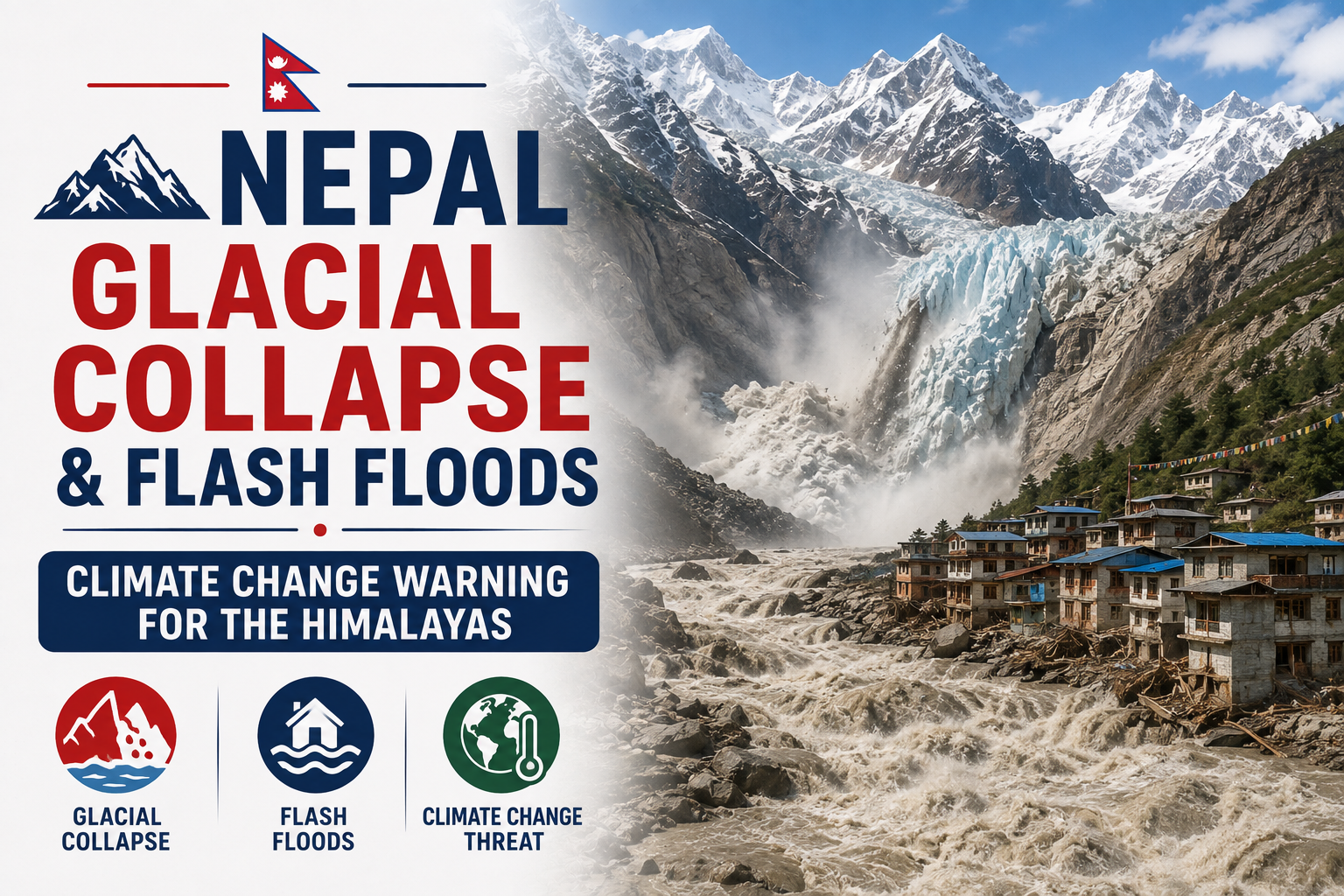
At 8:37 in the morning on 26 August 2026, seismographs from Colorado to Potsdam picked up a jolt centred just north of Langtang Lirung, a 7,227-metre peak on the Nepal-China border. It measured 5.2 on the Richter scale, but the United States Geological Survey quickly ruled out an earthquake. Within minutes, a wall of ice, rock, mud and water was roaring down the Bhote Koshi and Trishuli valleys, and by the time it finally settled, more than a thousand people across two countries were dead or unaccounted for.
This was not Nepal's first glacier disaster, and glaciologists warn it will not be the last. The Nepal glacial collapse and flash floods of August 2026 have become the deadliest Himalayan cryosphere disaster on record, surpassing even the catastrophic 2023 South Lhonak Lake outburst that devastated Sikkim. For India, which shares the same mountain range, the same monsoon system and the same warming climate, this is not a distant tragedy playing out next door — it is a preview of a risk sitting inside India's own Himalayan states.
By the end of this article, you will understand exactly what triggered the Langtang Lirung collapse, why scientists insist on distinguishing it from a classic glacial lake outburst flood (GLOF), how the disaster is reshaping India-Nepal-China relations and Himalayan disaster policy, and how to convert this single current-affairs event into exam-ready material for UPSC, SSC, state PSC and banking examinations.
Table of Contents
- The Himalaya's Recurring Cryosphere Disasters
- What Exactly Happened on 26 August 2026
- Why This Disaster Matters: A Multi-Dimensional Impact
- Key Stakeholders and Their Positions
- The Numbers: Death Toll, Damage and Ground Reality
- Critical Analysis: What the Headlines Miss
- Challenges, Criticisms and the Early-Warning Gap
- India's Response and the Road Ahead
- Exam Preparation Strategy
- Key Takeaways
- Frequently Asked Questions
- Related Topics
The Himalaya's Recurring Cryosphere Disasters
To understand August 2026, you have to go back more than a decade — to the same mountain. When the 2015 Gorkha earthquake struck Nepal, it triggered a massive ice and debris avalanche off Langtang Lirung that buried the village of Langtang and killed over 350 people. Eleven years later, the same peak failed again, this time without any tectonic trigger at all.
Between those two events, the wider Hindu Kush Himalaya (HKH) region has logged a rising drumbeat of glacier-related disasters. In October 2023, a rockfall into South Lhonak Lake in Sikkim unleashed more than 13 billion gallons of water, damaging over 25,000 buildings and more than 30 bridges — India's worst GLOF disaster in living memory. In August 2024, two glacial lakes burst in a chain reaction above Thame village in the Everest region, and Nepal recorded further GLOF events at Tilgau in Humla and near Rasuwagadhi in 2025, the latter washing away the very border bridge that would be destroyed again in 2026.
- 2015: Gorkha earthquake triggers a Langtang Lirung ice avalanche; 350+ killed
- 2023: South Lhonak Lake GLOF devastates Sikkim, India
- 2024: Thame village GLOF damages homes in Solukhumbu district
- 2025: Tilgau GLOF (Humla) and a GLOF-linked flood at Rasuwagadhi
- 2026: Langtang Lirung collapses again, triggering Nepal's deadliest recorded flood disaster
The pattern is unmistakable: nearly every major Himalayan valley bordering Nepal, China and India now carries some form of cryosphere risk, and the frequency of these events has visibly accelerated since 2023.
What Exactly Happened on 26 August 2026
A glacier collapse is the sudden detachment of a large mass of glacier ice from its bed — sometimes millions of cubic metres of ice, rock and water — that transforms into a fast-moving avalanche or debris flow. Unlike a glacial lake outburst flood, it does not require an existing lake to fail; the ice-rock mass itself becomes the flood.
Satellite imagery analysed by glaciologists at AntarcticGlaciers.org and the International Centre for Integrated Mountain Development (ICIMOD) shows a large scar on the northern flank of Langtang Lirung where a combined ice-and-bedrock mass broke free. ICIMOD cryosphere expert Dr Farooq Azam has described the trigger as a snow-and-rock avalanche linked to local seismic activity, while ICIMOD's Sarthak Shrestha noted that the avalanche briefly dammed the Lhende River on the Nepali side before that natural dam failed catastrophically.
What followed was what scientists call a multi-hazard cascade: ice-rock avalanche, temporary river blockage, an unstable barrier lake, and then a debris flow that travelled nearly 100 kilometres downstream through the Bhote Koshi and Trishuli valleys, destroying settlements across a 72-kilometre stretch. Because the initiating failure happened on the Nepali side of the border, it fell outside the reach of the long-standing Nepal-China flash flood early-warning system, which is credited with limiting casualties in past events but simply could not see this one coming.
A newly formed barrier lake straddling the Nepal-China border briefly threatened a second catastrophic release. Chinese authorities estimated it held around two million cubic metres of water on 28 August, with three million more expected within days, prompting a temporary pause in rescue operations. The lake drained gradually and was largely empty by 30 August, though scientists cautioned that fractured bedrock and disturbed slopes above the collapse site could still trigger further instability.
Why This Disaster Matters: A Multi-Dimensional Impact
A news bulletin can tell you what happened. Understanding why it matters requires looking at the disaster from six different angles at once.
Political Dimension
Nepal's Prime Minister Balendra "Balen" Shah has publicly stated there is no doubt climate change contributed to the disaster, placing the government's climate messaging under scrutiny even as it manages an active rescue operation. Foreign Minister Shisir Khanal has called for a stronger global response, arguing that Nepal bears a disproportionate share of climate consequences it did little to cause — a familiar refrain from low-emission, high-vulnerability nations at international climate forums.
Economic Dimension
Over a dozen major hydropower generation and transmission facilities were knocked offline, including the 111-MW Rasuwagadhi project, Chilime and Trishuli-3A. The Rasuwagadhi border crossing — a key trade artery with China — was disrupted just as Nepal approached its Dashain festival season, threatening the supply of imported goods at the country's most commercially active time of year.
Social Dimension
Thousands of trekkers on the popular Langtang and Gosaikunda routes, along with pilgrims travelling toward Mount Kailash, were caught in or near the disaster zone. Nepal's government has since deployed over 50 psychiatrists, psychologists and counsellors to Rasuwa and Nuwakot to run psychosocial and telemedicine services for survivors.
Environmental Dimension
The United Nations Development Programme's preliminary estimate puts debris generated by the disaster at over 2.4 million tonnes — material that has reshaped riverbeds and floodplains for kilometres downstream, with long-term implications for agriculture, water quality and future flood behaviour in the valley.
Geopolitical Dimension
The disaster exposed a real gap between Nepal's and China's respective monitoring systems, since the trigger originated on Nepali territory but the resulting barrier lake and drainage patterns crossed into Tibet. It has also become a live test of India's "Neighbourhood First" policy, with New Delhi moving quickly to position itself as the first responder.
Disaster-Governance Dimension
For India specifically, the event is a direct prompt to examine its own framework under the Disaster Management Act, 2005, the National Disaster Management Authority's mandate, and the pace of its glacial-lake early-warning rollout in Sikkim, Himachal Pradesh, Uttarakhand and Ladakh.
Key Stakeholders and Their Positions
| Stakeholder | Role / Stated Position |
|---|---|
| Government of Nepal / NDRRMA | Leading search, rescue and relief; issuing daily casualty bulletins; initially wary of accepting foreign search-and-rescue teams, citing coordination problems from the 2015 earthquake response |
| China / Tibet Autonomous Region authorities | Managing the cross-border barrier lake, issuing flood warnings, reporting separate casualty figures for Tibet, coordinating with Nepal on the shared river system |
| ICIMOD | Independent regional scientific body providing satellite analysis, glacier-stability assessments and early-warning guidance to both governments |
| Government of India | Positioning itself as "first responder," providing airlifted relief and forensic assistance under its Neighbourhood First policy |
| Hydropower developers | Reporting production losses across a dozen-plus projects; represented by Nepal's Independent Power Producers' Association |
| International donors (EU, Canada, Ireland, ADB, etc.) | Pledging emergency funds and rescue assistance ranging from grants to dedicated relief packages |
| Affected local communities and foreign trekkers/pilgrims | Bearing the direct human cost; hundreds of foreign nationals from dozens of countries remain among the missing |
The Numbers: Death Toll, Damage and Ground Reality
As of Nepal's disaster authority bulletin on 1 September 2026, at least 1,010 people have died in Nepal, 1,473 were injured, 11,814 have been rescued, and 3,916 remain listed as missing — including 583 foreign nationals from 38 countries. China's state broadcaster has separately reported 16 deaths and 546 missing (261 of them foreign nationals) on the Tibetan side. The combined death toll crossed 1,000 for the first time on 1 September 2026, a grim milestone in what is now Nepal's deadliest recorded flood disaster.
Nepal's Ministry of Health has confirmed that only about 4% of the roughly 900 bodies recovered so far have been formally identified — a reflection of how many victims were swept far from home, including trekkers and pilgrims from dozens of countries.
District-wise recovery data from the 1 September bulletin shows how far the debris travelled downstream:
| District | Bodies Recovered (as of 1 Sept 2026) |
|---|---|
| Chitwan | 321 |
| Nawalparasi East | 216 |
| Nawalparasi West | 170 |
| Nuwakot | 95 |
| Gorkha | 65 |
| Dhading | 55 |
| Tanahun | 38 |
| Rasuwa (origin district) | 27 |
Notice that Rasuwa, where the disaster began, recorded the fewest recovered bodies — most victims and remains were carried far downstream, some reportedly as far as 240 kilometres, crossing into Indian territory.
These figures sit inside a larger, worsening regional trend. According to ICIMOD research, the Hindu Kush Himalaya lost 12% of its total glacier area and 9% of its ice volume between 1990 and 2020. More than 200 glacial lakes across India, Nepal, China, Pakistan and Bhutan are now classified as high-hazard, and India alone has identified 56 at-risk glacial lakes in its own Himalayan territory.
How 2026 Compares to Recent Himalayan Cryosphere Disasters
| Event | Trigger | Deaths (approx.) | Key Damage |
|---|---|---|---|
| 2026 Nepal-Tibet floods | Glacier/rock-ice collapse, Langtang Lirung | 1,000+ | 12+ hydropower projects, border crossing, 72 km of river valley |
| 2023 Sikkim South Lhonak GLOF | Rockfall into glacial lake (India) | 50+ | 25,000+ buildings, 30+ bridges, Teesta III dam |
| 2024 Thame GLOF | Chain-reaction lake burst, Everest region | No fatalities reported | Multiple households damaged |
Critical Analysis: What the Headlines Miss
Most coverage in the first 48 hours called this a glacial lake outburst flood. That framing is only partly accurate, and the distinction is not academic — it goes to the heart of why early warning failed. A GLOF originates from an existing lake breaching its natural dam; this event began instead with a direct detachment of glacier ice and bedrock, which only created a lake afterward. Monitoring networks built to watch known lakes for overflow signs are simply not designed to catch a slope that fails without warning.
Scientists studying the site have pointed to a deeper mechanism at work: permafrost that has bound rock and ice together on Himalayan slopes for millennia is thawing under sustained warming, and researchers increasingly link this loosening "glue" to the growing frequency of ice avalanches and glacier detachments across the region. A report released around 1 September 2026 by a consortium of glaciologists further found that the Langtang Lirung glacier had shown visible signs of surface change in the days before it failed — evidence that, in hindsight, existed but was not being systematically monitored.
For UPSC Mains-style critical thinking, three questions are worth sitting with:
- If early-warning systems are built around known glacial lakes, what should a Himalayan-wide monitoring architecture for glacier and slope instability look like?
- Does a disaster that begins in one country and floods a neighbour demand a binding, real-time trans-boundary data-sharing mechanism rather than voluntary cooperation?
- How should India weigh continued hydropower expansion in seismically and thermally unstable Himalayan valleys against the rising frequency of cryosphere disasters?
Challenges, Criticisms and the Early-Warning Gap
Balanced coverage requires acknowledging where the response fell short, not just where it succeeded.
- Coverage gap: The existing Nepal-China early-warning system monitors specific glacial lakes and river gauges; it did not — and structurally could not — anticipate a slope failure originating deep inside Nepali territory.
- Coordination hesitancy: Nepal's Ministry of Foreign Affairs initially turned down some countries' search-and-rescue team offers, citing lessons from mismanaged coordination after the 2015 earthquake, a decision that drew criticism even as it later accepted select international support.
- Aid distribution gaps: Nepal's own disaster authority has acknowledged that some communities in Rasuwa and Nuwakot faced shortages or a total lack of aid supplies in the days after the disaster.
- Identification bottleneck: With only about 4% of recovered bodies identified, forensic capacity — including DNA-matching support brought in from India — has become a genuine constraint on closure for grieving families.
- Chronic underinvestment: Commentators have noted that despite repeated ICIMOD warnings about accelerating glacier loss, most Himalayan nations, Nepal included, have yet to build a comprehensive, forward-looking early-warning network rather than a reactive, event-by-event response.
India's Response and the Road Ahead
Prime Minister Narendra Modi spoke directly with Nepal's Prime Minister Balen Shah within hours of the disaster and offered full assistance. India, positioning itself once again as the region's "first responder," airlifted relief material by Indian Air Force C-130J aircraft — an initial 10 tonnes on the evening of 26 August, followed by further consignments in subsequent flights. An Indian forensic team was deployed to assist with DNA identification of victims, and 403 Indian nationals were confirmed to have safely crossed into Nepal from the Chinese side amid the chaos.
Nepal's own roadmap centres on three tracks: completing search and rescue with roughly 30,000 deployed security personnel, restoring the Rasuwagadhi trade and transport corridor before Dashain, and continuing psychosocial support in the worst-hit districts. The harder, multi-year task is structural — rebuilding hydropower capacity in a valley that has now failed catastrophically twice in eleven years, and deciding whether some settlements should be relocated rather than rebuilt in place.
For India, the strategic takeaway is closer to home. The country identified 56 high-risk glacial lakes after the 2023 Sikkim disaster and began piloting early-warning systems at South Lhonak and Shako Cho lakes with Swiss technical support, but India still lags several neighbours in deploying this infrastructure at scale. If the current pace continues, more Himalayan states remain exposed through the next monsoon and post-monsoon seasons; if India accelerates funding and cross-border data-sharing arrangements with Nepal and China, it narrows a genuine national-security-adjacent vulnerability rather than an abstract climate concern.
Key Exam Takeaways (UPSC, SSC & Banking)
This single event touches at least three GS papers and deserves a structured study approach rather than a passive read.
Syllabus Connections
- GS1 (Geography): Himalayan geomorphology, glaciers, mountain hazards
- GS2 (International Relations): India-Nepal relations, Neighbourhood First policy, trans-boundary river cooperation with China
- GS3 (Disaster Management & Environment): Disaster Management Act 2005, NDMA/NDRRMA mechanisms, climate change and the cryosphere, early-warning systems, hydropower risk
- Essay: Climate justice, "small emitters bearing large costs," Himalayan ecological fragility
Key Terms Glossary
- GLOF — Glacial Lake Outburst Flood, sudden release of water from a glacier-fed lake
- Glacier collapse / detachment — sudden failure of a glacier mass without an existing lake
- Cryosphere — the frozen parts of the Earth's system: glaciers, permafrost, snow and ice
- Permafrost — ground that remains frozen for at least two consecutive years
- Moraine — rock and debris deposited by a glacier, often forming a natural dam
- Barrier/landslide lake — a lake formed when debris blocks a river channel
- HKH region — the Hindu Kush Himalaya, spanning eight countries including India and Nepal
- NDRRMA — Nepal's National Disaster Risk Reduction and Management Authority
- ICIMOD — International Centre for Integrated Mountain Development, based in Kathmandu
- Debris flow — a fast-moving mixture of water, mud, rock and ice down a slope or valley
Study Strategy by Time Available
- 10 minutes: Focus on the "What Exactly Happened" and "Key Takeaways" sections — enough for MCQ-level current affairs.
- 30 minutes: Add the "Why This Matters" and "Data" sections for Mains-level context and comparative facts.
- 1 hour: Work through "Critical Analysis," "Challenges," and the exam-strategy glossary to build a genuine analytical answer framework.
Common Mistakes Aspirants Make
- Calling every Himalayan flood a "GLOF" without checking the actual triggering mechanism.
- Quoting an unverified, rapidly changing death toll as a fixed exam fact instead of citing it as "over 1,000, as of early September 2026."
- Treating this as a purely humanitarian story and missing the India-Nepal-China trans-boundary governance angle.
Model Answer Framework (Outline)
- Introduction: One line stating what happened, when, and why it is significant beyond Nepal's borders.
- Body: Cause (glacier collapse vs GLOF) → Impact (human, economic, ecological) → Governance gap (early warning, trans-boundary cooperation) → India's stake.
- Conclusion: A forward-looking line on regional cooperation or India's own preparedness.
Key Takeaways
- On 26 August 2026, a glacier and rock-ice mass collapsed off Langtang Lirung on the Nepal-China border, triggering Nepal's deadliest recorded flood disaster.
- As of 1 September 2026, the combined Nepal-Tibet death toll has crossed 1,000, with thousands still missing.
- Scientists distinguish this event from a classic GLOF — it began as a glacier detachment, not a lake breach, which is why early-warning systems missed it.
- Over a dozen hydropower projects and a key China-Nepal border trade route were destroyed or disrupted.
- India responded as "first responder," airlifting relief via IAF aircraft and sending forensic support.
- The Hindu Kush Himalaya lost 12% of glacier area and 9% of ice volume between 1990-2020; over 200 lakes region-wide are high-hazard.
- For UPSC/SSC aspirants, this event links Geography, Disaster Management, and India's Nepal/China foreign policy in a single current-affairs topic.
- India's own 56 at-risk glacial lakes make this far more than a "Nepal story."
Frequently Asked Questions
What caused the Nepal glacial collapse of August 2026?
A large mass of ice and rock detached from Langtang Lirung, a 7,227-metre peak on the Nepal-China border, on 26 August 2026. Scientists have linked local seismic activity to the collapse and identified permafrost thaw, driven by long-term warming, as a contributing factor.
Was the Nepal 2026 disaster a GLOF?
Not in the classic sense. Early reports suspected a glacial lake outburst flood, but satellite and seismic analysis suggests the event began with a direct glacier and rock-ice collapse, which then created a temporary barrier lake — the reverse order of a typical GLOF.
Why is this important for India?
India shares the same Himalayan cryosphere, has 56 identified at-risk glacial lakes of its own, and experienced a comparable disaster in Sikkim in 2023. The event also tests India's disaster diplomacy and Neighbourhood First policy toward Nepal.
How does India-Nepal-China cooperation work on Himalayan disasters?
Nepal and China maintain a flash-flood early-warning system along shared rivers, but this event originated inside Nepal, outside that system's monitoring reach. India engages separately through bilateral disaster relief and its own domestic glacial-lake monitoring programme.
Which UPSC topics connect to this event?
GS1 (Himalayan geography and hazards), GS2 (India-Nepal relations, Neighbourhood First policy), and GS3 (Disaster Management Act, climate change, cryosphere science, hydropower risk) all connect directly to this topic.
What are the biggest challenges in the ongoing response?
Identifying recovered bodies (only about 4% identified so far), reaching communities cut off by destroyed roads and bridges, and managing the risk of a second release from a newly formed barrier lake are the most pressing operational challenges.
Nepal glacial collapse vs Sikkim GLOF 2023 — what's the difference?
The Sikkim disaster was a classic GLOF: a rockfall into South Lhonak Lake breached its moraine dam. The 2026 Nepal event was a direct glacier/rock-ice collapse that only formed a lake afterward — a different mechanism with different early-warning implications.
Is climate change definitively linked to the 2026 Nepal floods?
Nepal's Prime Minister and several scientists have stated climate change likely raised the probability of the event by accelerating permafrost thaw and glacier melt, though some researchers caution that a single disaster cannot be attributed to climate change with total certainty — only a shift in overall risk.
Related Topics
- 2023 South Lhonak Lake GLOF (Sikkim): India's own recent glacial lake disaster and the direct domestic parallel to this event.
- Hindu Kush Himalaya glacier melt (ICIMOD reports): The broader scientific backdrop explaining why these disasters are becoming more frequent.
- India's Neighbourhood First policy: The foreign-policy framework shaping India's disaster-relief response to Nepal.
- Disaster Management Act, 2005 and NDMA: India's own legal and institutional architecture for handling comparable disasters.
- Permafrost thaw and climate tipping points: The deeper climate-science mechanism behind rising ice-avalanche frequency.
- Trans-boundary river governance in South Asia: The India-Nepal-China data-sharing gap this disaster has exposed.
- Himalayan hydropower risk: Why energy infrastructure sited in unstable valleys faces recurring exposure.
Conclusion
The Langtang Lirung collapse will eventually fade from daily headlines, but the underlying trend line will not: a warming Himalaya is producing cryosphere failures faster than the region's monitoring networks are being built to catch them. The most important insight from August 2026 is not the death toll alone — it is that Nepal's disaster was, in a very real sense, a warning shot for every Himalayan nation, India included, still relying on incomplete early-warning coverage.
If you are preparing for a competitive exam, do not treat this as a one-time current-affairs entry to memorise and forget. Revisit it alongside the 2023 Sikkim GLOF, track how India's own early-warning rollout progresses in the coming months, and use the framework in this article to build answers that connect geography, governance and climate together — exactly the kind of layered thinking examiners reward.
Have questions about how to structure a Mains answer on this topic, or want the Hindi version for regional-language preparation? Explore the related resources linked above, and check back as this still-developing disaster's figures are updated.
Editorial & Verification Standards
This article was researched, written, and verified by the CurrentAffairs360 editorial team in collaboration with educators at Khalsa Inter College, Naka Hindola, Lucknow. All insights are cross-verified against official government sources (PIB, RBI, The Hindu, Indian Express) to ensure rigorous exam authenticity.
Meet our editorial and teaching team →