
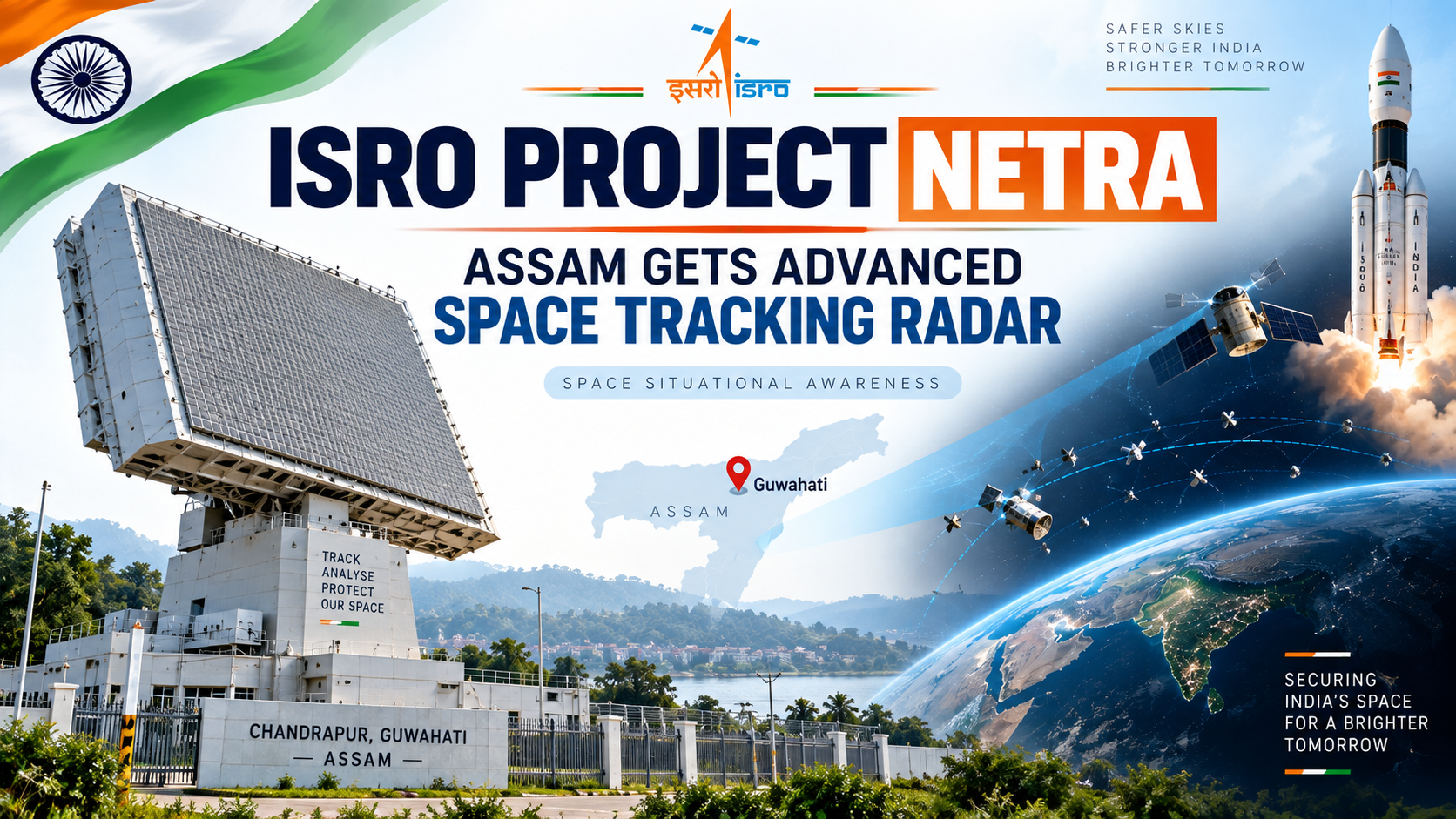
ISRO Project NETRA: Assam Gets Advanced Space Tracking Radar
In 2025, ISRO's flight-dynamics teams sifted through more than 1.5 lakh conjunction alerts — each one a warning that a satellite or a scrap of debris might pass dangerously close to an Indian spacecraft. Those alerts came from the US Space Command's Combined Space Operations Center, not from an Indian sensor network. Project NETRA exists to change that dependence.
On 21 September 2026, the change took a visible step forward. Assam Chief Minister Himanta Biswa Sarma announced that the foundation stone of ISRO's Advanced Radar Research Centre would be laid that day at Chandrapur, near Guwahati. The centre is the radar backbone of NETRA — the Network for Space Object Tracking and Analysis.
Why should an aspirant care? Because space debris, strategic autonomy and orbital governance now sit at the crossroads of GS2, GS3 and Essay papers. The topic also carries a fresh news peg, the kind of hook that often migrates into question papers.
By the end of this guide, you will be able to explain what NETRA is, describe what Assam's radar adds, analyse the strategic and legal stakes, and draft a Mains-ready answer with confidence.
Background: How Earth's Orbits Became a Crowded Junkyard
Orbits are finite, and almost nothing launched into them ever fully disappears. Since Sputnik in 1957, every mission has left behind spent rocket stages, dead satellites and fragments. The Outer Space Treaty of 1967 made states responsible for their space activities, yet it created neither a tracking system nor a clean-up mandate.
The Debris Crisis Takes Shape
In 1978, NASA scientists Donald Kessler and Burton Cour-Palais warned that collisions could trigger a self-sustaining cascade of debris — now called Kessler Syndrome. Later events made the fear real: China's 2007 anti-satellite (ASAT) test, the 2009 collision of Iridium-33 and Cosmos-2251, and Russia's ASAT test in November 2021 each created well over a thousand trackable fragments.
India's own Mission Shakti test on 27 March 2019 destroyed a satellite at roughly 300 km altitude. The low altitude meant most fragments decayed quickly, but the episode showed why a sovereign tracking capability is not optional for a spacefaring nation.
India's Road to NETRA: A Timeline
- Around 2015: The Multi-Object Tracking Radar (MOTR) at Sriharikota becomes a precursor tracking asset.
- 2019: Mission Shakti in March; Project NETRA announced in September, reportedly with an initial outlay of about ₹400 crore.
- 2020: ISRO's Space Situational Awareness (SSA) Control Centre is established in Bengaluru.
- 2022: ISRO sets up IS4OM to monitor risks and manage safe space operations.
- November 2023: Land for the Chandrapur radar is transferred, according to ISRO's 2025-26 annual report.
- 2 April 2025: ISRO Chairman V. Narayanan inspects the Chandrapur site.
- 7 November 2025: Final registration of the 67-acre site is completed.
- April 2026: ISSAR 2025 is released at the SMOPS-2026 conference in Bengaluru.
- 21 September 2026: Foundation stone of the Advanced Radar Research Centre.
The exam lesson: NETRA is not a knee-jerk reaction to one crisis but a decade-long build-up, and every milestone above is a potential MCQ.
What Is Project NETRA? Definition, Components and Working
Project NETRA (Network for Space Object Tracking and Analysis) is ISRO's indigenous space situational awareness programme. It combines radars, optical telescopes and a Bengaluru control centre to detect, track and catalogue satellites and debris, predict close approaches, and help India protect its satellites through timely collision-avoidance manoeuvres.
Core Components of NETRA
ISRO has identified three pillars: radar, optical telescopes and a centralised control centre. Radars excel at tracking objects in low Earth orbit (LEO), while telescopes suit high orbits such as geostationary orbit (GEO). The Bengaluru centre fuses everything into one picture.
| Component | Role | Location and Status |
|---|---|---|
| Multi-Object Tracking Radar (MOTR) | Precursor radar tracking several objects at once | Sriharikota; operational since about 2015 |
| Advanced radar at Chandrapur | Dedicated tracking of satellites and debris in LEO | Near Guwahati; foundation stone on 21 September 2026 |
| Optical telescopes | Track higher orbits and refine orbit estimates | Reported at Ponmudi, Mount Abu and Leh |
| SSA Control Centre | Data fusion, orbit determination, conjunction alerts | Bengaluru; established 2020 |
How NETRA Works: Step by Step
- Radars and telescopes detect objects in orbit.
- Sensor data flows to the Bengaluru control centre.
- Software correlates tracks and computes orbits.
- Close approaches with Indian satellites are predicted.
- Engineers estimate the probability of collision.
- ISRO plans a manoeuvre if the risk is high.
- The object catalogue is updated continuously.
Think of NETRA as air-traffic control for orbit — except the aircraft travel at about 28,000 km/h, many are dead, and none files a flight plan.
The Chandrapur Radar: What Assam Is Getting
ISRO has earmarked a 67-acre site at Chandrapur, roughly 200 bighas allotted by the Assam government. The land transfer was executed in November 2023 and final registration was completed on 7 November 2025.
In April 2025, Chairman Narayanan said the radar would monitor space up to 2,000 km, detect objects as small as 10 cm and track satellites and debris in real time. He indicated the full project would take around four years. Treat these as indicative figures, since detailed technical parameters have not been widely published.
Sarma called the foundation-stone event a “landmark moment for Assam” and presented the state as an emerging home for strategic technology infrastructure.
Why the Assam Radar Matters: Multi-Dimensional Impact
NETRA touches security, economics, regional development and law at once, which makes it useful for both GS3 and GS2 answers.
Political and Strategic Dimension
Independent tracking reduces dependence on foreign catalogues and gives India its own evidence in any orbital dispute. A nation that must trust another country's data before moving a strategic satellite has limited autonomy. Sensors of its own convert trust into verification.
Economic Dimension
India's 53 operational satellites underpin telecom, navigation, weather forecasting and broadcasting. Every manoeuvre burns fuel and shortens a satellite's life, so better data means fewer unnecessary manoeuvres. The project also signals long-term demand for indigenous radar electronics.
Social and Regional Dimension
For Assam and the wider Northeast, the project brings a national scientific facility to a region long seen as peripheral to India's technology map. It can anchor skilled jobs and supplier ecosystems if institutions such as IIT Guwahati are drawn in — an outcome that depends on policy choices.
Environmental Dimension
Space debris is an environmental problem beyond the atmosphere. Every avoided collision prevents thousands of new fragments that could endanger orbits for decades. Better tracking also supports planned re-entries and the goal of debris-free missions.
International and Geopolitical Dimension
Quality data strengthens India's voice in forums such as the Inter-Agency Space Debris Coordination Committee (IADC) and the UN Committee on the Peaceful Uses of Outer Space (COPUOS). In principle, a radar in the east also complements southern assets at Sriharikota by widening coverage geometry.
Constitutional and Legal Dimension
India's framework rests on the Outer Space Treaty (1967), the Liability Convention (1972), the Indian Space Policy 2023 and the IN-SPACe authorisation regime. Under these treaties, states bear responsibility and liability for national space objects. Robust tracking supplies the evidence base, though a comprehensive national space law is still awaited.
Key Stakeholders and Their Positions
Good policy reporting maps interests, not just statements. Here is who matters and what each wants.
| Stakeholder | Stated Position | Underlying Interest |
|---|---|---|
| ISRO / Department of Space | NETRA will strengthen tracking and protect space assets | Self-reliance in SSA; safer operations; support for Gaganyaan |
| Assam Government | Welcomes a landmark national facility | Regional development, investment image, political credit |
| Armed forces and Defence Space Agency | No NETRA-specific public statement | Space-domain awareness; independent verification of activity in orbit |
| Private space sector and IN-SPACe | Support for indigenous capability | Business in sensors, tracking data and services |
| Foreign partners and IADC | Continued data sharing and cooperation | Shared safety of crowded orbits |
| Local communities and civil society | No organised objection reported | Jobs, land rights, transparency |
The core tension is openness versus security. Civil agencies favour data sharing for safety, while defence users may want sensitive tracking capability restricted. Watch how ISRO balances the two.
Data, Statistics and Ground Reality
About 1.6 lakh close-approach alerts were recorded worldwide in 2025 — roughly 440 every single day.
The figure comes from ISRO's Indian Space Situational Awareness Report (ISSAR) 2025, released in April 2026. It shows how quickly orbital traffic is rising: 2025 saw a record 328 launch attempts, 315 of them successful, placing over 4,600 objects in orbit.
| Indicator | Figure (2025) | Context |
|---|---|---|
| Global launch attempts | 328 (315 successful) | Record high |
| Close-approach alerts, global | About 1.6 lakh | Roughly 440 per day |
| India's operational satellites | 53 (22 LEO, 31 GEO) | The fleet to be protected |
| Collision-avoidance manoeuvres | 18 (14 LEO, 4 GEO) | ISSAR 2025 count |
| LEO manoeuvre plans revised | 82 | Prevents new close approaches |
The government also told Parliament in August 2026 that ISRO carried out 29 collision-avoidance manoeuvres over roughly 18 months, including nine in 2026 so far. Figures vary slightly between sources, so quote the specific report in an exam answer.
In human terms, ISRO watches a sky where debris travels at about 28,000 km/h and a centimetre-sized fragment can cripple a satellite. A bar chart of yearly collision-avoidance manoeuvres since 2015 would make a powerful infographic here.
| Feature | Radar | Optical Telescope |
|---|---|---|
| Best suited for | Low Earth orbit | Geostationary and high orbits |
| Works in | Day, night, cloud | Night and clear skies |
| Signal used | Its own transmitted pulses | Reflected sunlight |
Critical Analysis, Challenges and Counterarguments
What the Headlines Miss
The headline says India is getting a radar. The deeper story is that data ownership is becoming as important as launch capability. A country that launches but depends on others to locate hazards is exposed at the most sensitive moment — when a decision to manoeuvre a strategic satellite must be quick and confident.
Editorial insight: in orbit, sovereignty is not just the ability to put a satellite up — it is the ability to know, independently, what else is up there.
A second implication is schedule risk. In April 2025, ISRO indicated the radar would be installed within a year and the project would take about four years. The foundation stone has come roughly 17 months later, so commissioning milestones deserve close tracking.
Expert Perspective
ISRO's leadership presents NETRA as continuous monitoring meant to protect Indian satellites and national space assets. Policy analysts of space situational awareness generally argue that national sensor networks combined with shared data are the most credible route to safe and responsible orbital behaviour.
Mains-Style Critical Questions
- Is space situational awareness a civilian safety measure or a strategic military capability? Argue both sides.
- How far can indigenous tracking reduce India's dependence on foreign data?
- Should India enact a binding space law to manage debris and commercial operators?
Challenges and Criticisms
- Delivery risk: Large radars need complex indigenous electronics, and timelines have already shifted from earlier indications.
- Coverage limits: One radar cannot watch every orbit; it must integrate with telescopes, more radars and space-based sensors.
- Data governance: Rules on sharing, classification and commercial use of tracking data remain unclear.
- Transparency: Public disclosure of costs and commissioning milestones appears limited.
- Clean-up gap: Tracking warns but does not remove debris; India's active debris-removal capability is still at a demonstration stage.
Counterarguments
Supporters call tracking the cheapest insurance India can buy, since one saved satellite is worth far more than the sensor. Critics reply that money might be better spent on launch capacity or clean-up technology, and that strategic value depends on integration with defence networks, not on a single site. A fair reading: NETRA is necessary but not sufficient.
India's Strategic Response and the Project NETRA Roadmap
The government's stated direction is to build indigenous SSA sensors, reduce debris and prepare for larger missions. Several strands run in parallel.
- Sensors: Chandrapur radar, telescopes and the Bengaluru control centre forming one network.
- Institutions: IS4OM, set up in 2022, coordinates safe and sustainable operations.
- Debris-Free Space Missions (DFSM): ISRO targets debris-free missions by 2030.
- In-orbit capability: SpaDeX demonstrated autonomous docking in January 2025, a stepping stone toward servicing and debris removal.
- Human spaceflight: Gaganyaan and a planned Indian space station raise the stakes for tracking accuracy.
What to Watch in the Next 3-5 Years
- Commissioning date and performance tests of the Chandrapur radar
- Additional radars for nationwide, all-weather coverage
- Integration with defence space assets
- Data-sharing rules and a national space law
- Active debris-removal trials with Indian start-ups
If all goes well, India could by the end of the decade run a largely self-reliant orbital picture and manoeuvre only when truly necessary. If delays and integration gaps persist, ISRO would stay dependent on foreign data just as orbital traffic keeps growing. The difference between the two futures is execution.
Exam Preparation Strategy: How to Use This Topic
Where NETRA Fits in the Syllabus
- GS3: Space technology, indigenisation, internal and external security, environment (debris).
- GS2: Treaties, space governance and international cooperation.
- Essay: Technology and sovereignty; Northeast as a technology frontier.
- Prelims: Missions, orbits, treaties and acronyms.
- SSC, Banking, Railway: Full forms, places, dates and numbers.
Previous Year Question Patterns
A direct previous-year question on NETRA is rare, but the surrounding themes recur. UPSC Mains has asked about India's space achievements and their socio-economic use, and Prelims regularly tests satellites, orbits and space technology. Expect NETRA to appear inside a broader question on space security, debris or strategic autonomy.
Must-Know MCQ Facts
- NETRA = Network for Space Object Tracking and Analysis (ISRO, announced 2019)
- Control centre: Bengaluru, established 2020
- Radar site: Chandrapur, near Guwahati, Assam; about 67 acres
- Indicative capability: range up to 2,000 km; objects down to 10 cm
- IS4OM established 2022; DFSM target year: 2030
- Foundation stone date: 21 September 2026
Key Terms to Memorise
- SSA: tracking and predicting the positions of objects in orbit
- CAM: collision-avoidance manoeuvre
- Kessler Syndrome: cascading collisions that make orbits unusable
- ASAT: anti-satellite weapon or test
- LEO / GEO: low Earth orbit (up to about 2,000 km) / geostationary orbit (about 36,000 km)
- ADR: active debris removal
| Concept | Meaning | Example |
|---|---|---|
| Space Situational Awareness | Knowing what is in orbit and where risks lie | Project NETRA |
| Space Traffic Management | Rules and coordination for safe movement | Standards agreed through COPUOS |
| Active Debris Removal | Physically removing junk from orbit | Demonstration missions worldwide |
Common Mistakes Students Make
- Confusing NETRA with DRDO's Netra airborne early warning aircraft — the two are unrelated.
- Treating NETRA as a satellite; it is a ground-based network.
- Writing that the Assam radar is operational; only its foundation stone has been laid.
- Ignoring the legal dimension, although treaties earn marks in GS2.
Model Answer Framework
Question: Discuss the significance of Project NETRA for India's space security. (250 words)
- Introduction: Define SSA; cite rising congestion, about 1.6 lakh alerts in 2025; mention the Chandrapur foundation stone.
- Body: Components and working; strategic autonomy; protection of 53 satellites; treaty obligations; regional development.
- Challenges: Delivery timelines, coverage, data governance, no operational debris removal yet.
- Conclusion: NETRA is necessary but not sufficient; pair it with law, integration and clean-up technology.
Study plan: With 10 minutes, read the definition, MCQ facts and Key Takeaways. With 30 minutes, add the impact analysis and data tables. With one hour, study the critical analysis, write the model answer from memory and review the FAQs.
Key Takeaways
- Most important fact: The foundation stone of ISRO's Advanced Radar Research Centre at Chandrapur, near Guwahati, was scheduled for 21 September 2026 under Project NETRA.
- Core mechanism: Radars and telescopes feed a Bengaluru control centre that predicts collisions and triggers manoeuvres.
- Biggest impact: Strategic autonomy — India can verify orbital hazards with its own sensors.
- Key actor: ISRO, with the Assam government providing land and support.
- Timeline: Announced 2019; control centre 2020; site registered November 2025; about four years for the project, per ISRO in April 2025.
- Exam angle: GS3 science and security, GS2 space governance; remember NETRA, IS4OM and DFSM 2030.
- Global context: A record 328 launch attempts and about 1.6 lakh alerts in 2025 show rising congestion.
- Next step: Practise one 250-word answer on NETRA and revise the key terms.
Frequently Asked Questions on Project NETRA
What is Project NETRA?
Project NETRA stands for Network for Space Object Tracking and Analysis. It is ISRO's indigenous space situational awareness programme, announced in 2019. Using radars, telescopes and a Bengaluru control centre, it tracks satellites and debris, predicts close approaches and helps protect Indian satellites.
Why is Project NETRA important for India?
India operates 53 satellites supporting communication, navigation, weather and security. Debris and crowded orbits threaten them. NETRA provides independent tracking data, reduces reliance on foreign alerts and supports timely collision-avoidance manoeuvres, including safety for future missions such as Gaganyaan.
How does the Chandrapur radar work?
The radar transmits signals and analyses the echoes to locate objects and estimate their orbits. ISRO has indicated it can monitor space up to 2,000 km and detect objects as small as 10 cm. Data flows to Bengaluru, where software refines orbits and predicts dangerous approaches.
What is India's stand on space debris?
India favours responsible and sustainable use of outer space. ISRO takes part in the IADC and other forums, runs IS4OM for safe operations, and aims for Debris-Free Space Missions by 2030, combining tracking, mitigation and future debris-removal technologies.
Which UPSC topics are related to Project NETRA?
NETRA links to GS3 science and technology, space security and environment, and to GS2 treaties and governance. Related themes include the Outer Space Treaty, Mission Shakti, Gaganyaan, IN-SPACe, the Indian Space Policy 2023, Kessler Syndrome and strategic autonomy.
What are the challenges with Project NETRA?
Key challenges include timely commissioning of complex indigenous radars, limited coverage from a single site, unclear data-sharing rules, integration with defence networks and the absence of operational debris removal. Transparent milestones and additional sensors would strengthen the network.
NETRA vs space traffic management — what is the difference?
NETRA is a sensing and analysis network that tells operators what is in orbit and where risks lie. Space traffic management is the wider system of rules, coordination and standards for safe movement. Tracking is the foundation on which traffic management builds.
When will the Assam radar be operational?
No official commissioning date has been publicly reported. In April 2025, ISRO's chairman indicated the full project would take around four years. Follow ISRO announcements and Parliament replies for updates, since timelines for large radar projects often shift.
Related Topics for Further Reading
Build topical mastery with these connected subjects:
- Space Debris and Kessler Syndrome: the scientific problem NETRA exists to manage.
- Mission Shakti and India's ASAT Capability: explains India's deterrence posture and the debris debate.
- Indian Space Policy 2023 and IN-SPACe: the rules shaping private participation, including tracking services.
- Gaganyaan and the Bharatiya Antariksh Station: human spaceflight raises the demand for precise orbital data.
- Outer Space Treaty 1967 and Liability Convention 1972: the legal backbone of state responsibility.
- SpaDeX and In-Orbit Servicing: the technology road toward debris removal.
For primary sources, bookmark ISRO for its ISSAR reports, the Press Information Bureau for Parliament replies, and the UN Office for Outer Space Affairs for treaty texts.
Conclusion: Project NETRA and India's Eyes on the Sky
Project NETRA is often described as a debris-tracking programme. The deeper reading is that it marks India's shift from space user to space steward — a nation that can see, verify and act on orbital risks with its own instruments. The Chandrapur foundation stone is the start of that transition, not its completion.
The real test lies ahead: commissioning on schedule, integrating the radar with telescopes and defence users, and pairing sensors with law and clean-up technology. Get these right and NETRA could become a model for a responsible spacefaring power.
Your next step: subscribe for daily updates, bookmark this pillar guide and explore the related topics above. Which matters more for India — better tracking or better clean-up? Share your view and your practice answer in the comments.
Master Project NETRA today, and you will carry a fresh, high-value example into your next UPSC, SSC or Banking answer. Keep going — your preparation is building the same discipline that orbits demand: precision, patience and vigilance.
About the Author
School Principal at Khalsa Inter College, Naka Hindola, Lucknow, Uttar Pradesh. Committed to providing free, quality education for students preparing for competitive examinations.
Learn more about our mission →