
BHEEM & Axiom-4: India's Blueprint for a Mars Habitat
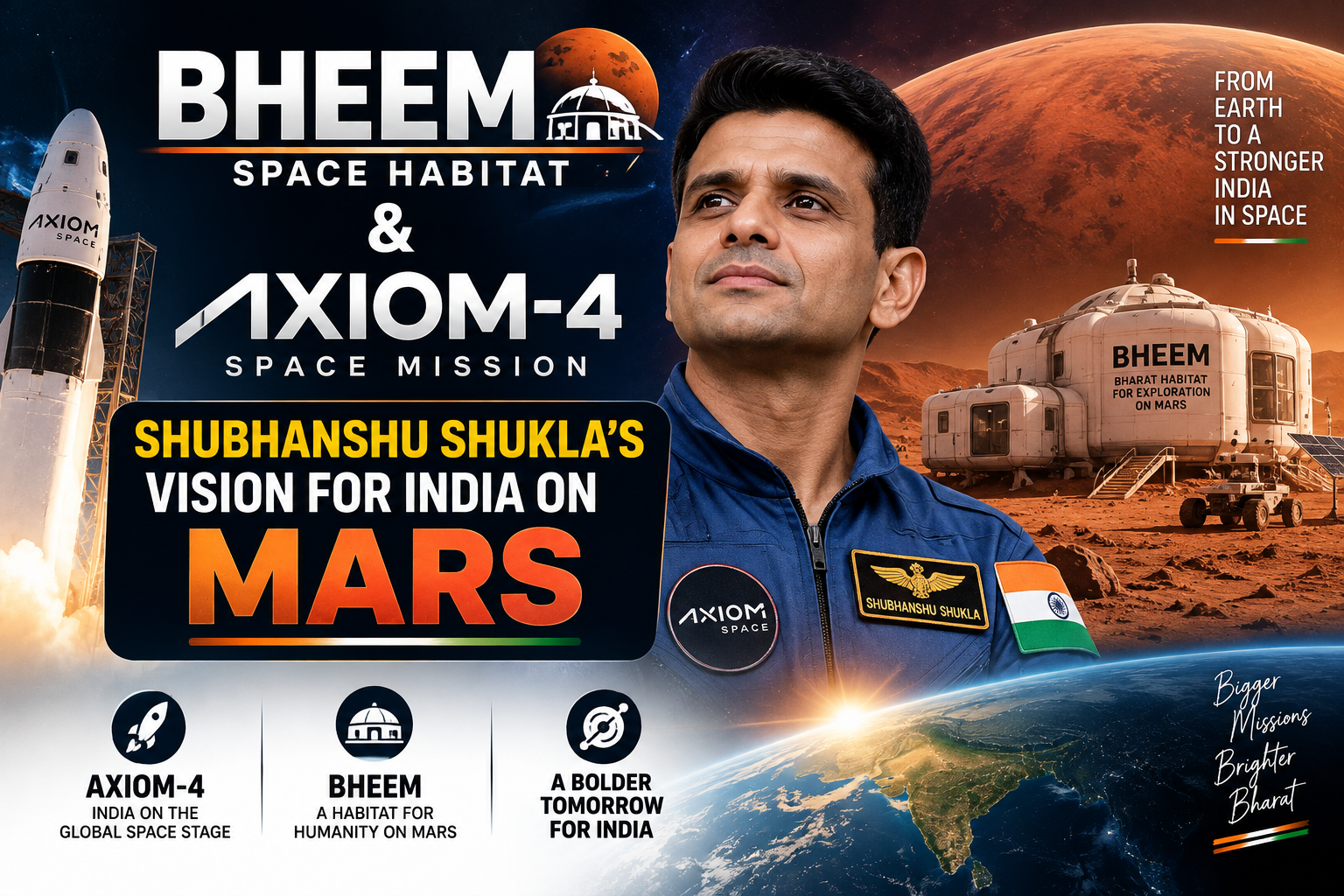
On September 1, 2026, Group Captain Shubhanshu Shukla — the Indian Air Force test pilot who piloted Axiom Mission 4 (Ax-4) to the International Space Station in 2025 — posted a thread describing a project he had co-authored with scientists at the Indian Institute of Science (IISc), Bengaluru. The project has a name that sounds like it belongs in Indian mythology before it belongs in an engineering journal: BHEEM.
BHEEM stands for the Bhartiya Extraterrestrial Expandable Modular Habitat — a design concept for a panel-based living structure that could be assembled on the Moon or Mars, and that a single Starship launch could deliver with roughly double the habitable volume of the entire International Space Station. It is not a funded ISRO mission. It is a peer-reviewed design proposal. But it sits at the intersection of two things every competitive exam aspirant should already be tracking closely: India's post-Axiom-4 human spaceflight momentum, and ISRO's declared roadmap toward a Bharatiya Antariksh Station by 2035 and a crewed Moon landing by 2040.
By the end of this article, you will understand exactly what BHEEM proposes, how it connects to Shukla's Axiom-4 mission and India's Gaganyaan programme, why it matters across political, economic and strategic dimensions, and how to convert this single current-affairs item into exam-ready answers for UPSC, SSC, Banking, Railway and State PSC papers.
Table of Contents
- 1. Background: From Rakesh Sharma to Axiom-4
- 2. What Is BHEEM, Exactly?
- 3. Why This Matters: Multi-Dimensional Impact
- 4. Key Stakeholders
- 5. Data, Numbers and Ground Reality
- 6. Critical Analysis and Expert Perspective
- 7. Challenges and Criticisms
- 8. India's Roadmap: Gaganyaan to BAS to the Moon
- 9. Exam Preparation Strategy
- 10. Key Takeaways
- 11. FAQs
- 12. Related Topics
Background: From Rakesh Sharma to Axiom-4
India's human spaceflight story has long stretches of silence between short bursts of history. Rakesh Sharma flew aboard the Soviet Soyuz T-11 in 1984 and became the first Indian in space. For the next 41 years, no Indian left the ground again as a government-sponsored astronaut.
That changed on June 25, 2025, when Axiom Mission 4 (Ax-4) lifted off from Launch Complex 39A at NASA's Kennedy Space Center aboard a SpaceX Falcon 9, carrying a SpaceX Dragon crew capsule. Group Captain Shubhanshu Shukla flew as Mission Pilot alongside Commander Peggy Whitson (a former NASA astronaut and Axiom Space's Director of Human Spaceflight), and Mission Specialists Sławosz Uznański-Wiśniewski of Poland and Tibor Kapu of Hungary.
- 2019: Shukla is selected by ISRO and begins a year of training at the Yuri Gagarin Cosmonaut Training Centre, Star City, Russia.
- February 27, 2024: Prime Minister Narendra Modi names Shukla among the four Gaganyaan astronaut-designates.
- August 2024: Shukla is selected as India's "Prime" astronaut for the Indo-US Ax-4 mission, with Group Captain Prasanth Balakrishnan Nair as backup.
- June 25-26, 2025: Ax-4 launches and docks with the ISS roughly 28 hours later, beginning a mission that ran about two weeks.
- September 1, 2026: Shukla publicly discusses BHEEM, a Mars/Moon habitat concept co-authored during his post-mission academic work with IISc researchers.
The Rs 550-crore Ax-4 mission was ISRO's way of buying real astronaut experience ahead of Gaganyaan, India's own crewed orbital programme. BHEEM is an early sign of what that experience is already producing: Indian-authored research on what comes after Gaganyaan.
What Is BHEEM, Exactly?
BHEEM (Bhartiya Extraterrestrial Expandable Modular Habitat) is a design concept from IISc Bengaluru researchers — Mritunjay Baruah, Amogh Jadhav, and Bimalendu Mahapatra, with Shubhanshu Shukla as a co-author — for a habitat built from small, stackable panels rather than one large pre-built module, so it can be launched compactly and assembled after landing on the Moon or Mars.
The mechanism works like this: three basic panel shapes — squares, pentagons, and triangles — are combined using seven types of connectors called "joineries" to form different modules. Each panel is about 0.2 metres thick, layered to shield residents from radiation, micrometeoroids and extreme temperature swings. A single SpaceX Starship launch could carry enough panels to assemble roughly 2,130 cubic metres of pressurised volume — about double the ISS — spread across eight living quarters able to support up to 16 astronauts on missions lasting more than six months.
Assembly is planned in four stages:
- Stage 1: A central module with communication equipment goes up first, supporting up to five astronauts and basic mission operations.
- Stage 2: Private crew quarters and shared living areas are added.
- Stage 3: Storage for equipment, food and other supplies follows.
- Stage 4: Medical facilities, science laboratories and a greenhouse complete the habitat.
| Feature | BHEEM (Proposed) | International Space Station |
|---|---|---|
| Pressurised volume | ~2,130 m³ (target) | ~916 m³ |
| Crew capacity | Up to 16 | Typically 7 |
| Construction method | Modular panels assembled on-site | Pre-built modules launched whole |
| Target environment | Lunar/Martian surface | Low Earth Orbit |
| Launch vehicle | Single Starship (proposed) | Multiple Space Shuttle/Proton/Soyuz launches over years |
Like the ISS, each BHEEM module would have its own independent life-support system and connect to the rest of the habitat through hatches — so a single module can be depressurised or repaired without shutting down the whole structure.
Why This Matters: Multi-Dimensional Impact
Scientific and technological dimension: BHEEM is one of the first Indian-authored technical proposals aimed specifically at Mars and lunar surface habitation, rather than orbital spaceflight. It signals that Indian researchers — including an active astronaut — are now contributing original architecture to a field long dominated by NASA, Roscosmos, and increasingly SpaceX and China's CNSA.
Strategic and geopolitical dimension: Designing for a Starship-class launch vehicle implicitly ties an Indian concept to a US commercial rocket that does not yet exist in operational form for deep-space missions. This raises questions about how India's indigenous Next Generation Launch Vehicle (NGLV) programme and its own Bharatiya Antariksh Station ambitions relate to reliance on foreign heavy-lift capacity.
Economic dimension: Modular, panel-based construction is explicitly framed by the authors as a way to reduce the logistics cost of space habitats — fewer dedicated launches, more standardised components. If validated, such approaches could lower the cost floor for any nation's deep-space ambitions, India's included.
Social and educational dimension: That an active ISRO astronaut co-authored a peer-reviewed engineering concept is itself a soft-power and STEM-inspiration signal, reinforcing the narrative the Ax-4 mission built around student outreach and youth interest in space careers.
Governance dimension: BHEEM remains a design study, not a sanctioned ISRO project. Its future depends on how the Department of Space chooses to fold academic proposals like this into its formal Gaganyaan-to-BAS-to-Moon roadmap, and on future budgetary allocations for post-Gaganyaan human spaceflight R&D.
Key Stakeholders
- Indian Institute of Science (IISc), Bengaluru: Home institution of the BHEEM design team; positions IISc as a contributor to India's civil space research base alongside ISRO's own centres.
- ISRO / Department of Space: The formal owner of India's human spaceflight roadmap (Gaganyaan, BAS, Moon 2040); BHEEM is not yet an ISRO-funded programme but sits adjacent to its long-term interests.
- Shubhanshu Shukla: Bridges the astronaut-training track and the academic-research track — his Ax-4 flight experience feeds directly into habitat-design thinking.
- Axiom Space and NASA: The commercial and government partners that made Ax-4 possible, and by extension gave India's astronaut corps its first hands-on microgravity experience since 1984.
- SpaceX: BHEEM's four-stage assembly plan is explicitly built around a single Starship-class launch, making SpaceX's still-developing heavy-lift vehicle an implicit dependency of the concept.
Data, Numbers and Ground Reality
Numbers anchor this story in something more concrete than headlines. Consider the scale involved:
| Metric | Figure |
|---|---|
| ISRO investment in Ax-4 mission | Rs 550 crore |
| Ax-4 mission duration on ISS | ~14 days |
| Scientific investigations aboard Ax-4 | ~60 studies from 31 countries |
| BHEEM target habitable volume | ~2,130 cubic metres |
| BHEEM panel thickness | ~0.2 metres |
| BHEEM crew capacity | Up to 16 astronauts |
| Years since India's last human spaceflight (pre-Ax-4) | 41 years (since Rakesh Sharma, 1984) |
| Target year for Bharatiya Antariksh Station | 2035 (first module by 2028) |
| Target year for Indian crewed Moon landing | 2040 |
Shukla's own microgravity work on Ax-4 included ISRO-Department of Biotechnology food and nutrition experiments and Indian-developed studies on plant growth, muscle regeneration, and tardigrade biology — the kind of applied research that directly informs long-duration habitat design like BHEEM.
Expert Analysis & Critical Assessment
What most headline coverage misses is that BHEEM is not really "India's Mars habitat" in the sense of a funded mission — it is closer to a proof-of-concept thesis emerging from the exact overlap ISRO wanted Ax-4 to create: line astronauts feeding real flight experience back into India's engineering research base.
Shukla described BHEEM, in his own words on social media, as work that began once the crew returned from Russian training and started the "Indian leg" of astronaut preparation — situating the habitat concept as a product of that domestic training pipeline, not a standalone ISRO announcement.
A UPSC Mains examiner would likely probe this distinction directly. Consider these practice-style questions:
- "Distinguish between a government-sanctioned space mission and an academic design proposal. Illustrate using a recent Indian example." (GS3)
- "Examine how India's human spaceflight programme is building indigenous research capacity beyond flight operations alone." (GS3)
- "What are the risks of designing national space infrastructure around foreign commercial launch vehicles that are still in development?" (GS2/GS3)
Challenges and Criticisms
The BHEEM authors themselves are candid about how much work remains before this moves from paper to prototype:
- Material selection: No panel material has been finalised that meets radiation-shielding, weight, and manufacturing-cost requirements simultaneously.
- Sealing and leak prevention: Modular panel joints are inherently harder to seal against atmospheric leaks than a single pre-built pressure vessel.
- No full-scale prototype yet: The current proposal covers panel transport only; connectors, interior systems, and life-support integration will require additional design work and launches.
- Underground shielding: The team has flagged a need for subterranean facilities to protect astronauts during extreme radiation events, which BHEEM's surface panels alone cannot fully address.
- Dependency on unproven heavy-lift capacity: The entire "single Starship launch" economics collapse if Starship's crewed, deep-space-capable version is delayed.
- No confirmed funding line: BHEEM remains an academic proposal; it competes for attention and budget against India's already-ambitious Gaganyaan, BAS, and Chandrayaan-4 commitments.
India's Roadmap: Gaganyaan to BAS to the Moon
BHEEM sits inside a much larger, already-announced Indian timeline. In 2023, the Prime Minister directed ISRO to target a Bharatiya Antariksh Station (BAS) by 2035 and a crewed Moon landing by 2040. In August 2026, ISRO's chairman reaffirmed that the first BAS module is scheduled to launch by 2028, alongside Chandrayaan-4 and a Venus Orbiter Mission. Gaganyaan's own uncrewed test flight has been targeted for late 2026, ahead of a crewed flight expected around 2027.
Read against that backdrop, BHEEM looks less like a stray design paper and more like early groundwork for the habitat technology BAS and any future lunar surface base would eventually need — years before ISRO is likely to formally commit budget to surface habitats.
Key Exam Takeaways (UPSC, SSC & Banking)
Note on PYQs: Because BHEEM and Ax-4's aftermath are very recent developments, no verified previous-year questions exist yet on BHEEM specifically. Past UPSC/SSC questions on Gaganyaan, Chandrayaan-3, and India's space station ambitions are the closest analogues, and this topic is highly likely to appear as a "recent developments" prompt in the next exam cycle.
- MCQ angle: Full form of BHEEM; crew of Ax-4; year of Rakesh Sharma's flight; target year for BAS and Moon landing.
- Mains angle (GS3 – Science & Technology): India's human spaceflight roadmap; indigenous vs collaborative approaches to space infrastructure.
- Mains angle (GS2 – International Relations): India-US space cooperation via Axiom/NASA; Artemis Accords context.
- Essay angle: "From Earth orbit to Mars: India's incremental approach to space exploration."
Key terms glossary: BHEEM, Ax-4, Gaganyaan, Bharatiya Antariksh Station (BAS), joinery (panel connector), analog mission, Next Generation Launch Vehicle (NGLV), microgravity, human-rated launch vehicle.
Model answer framework for a GS3 question on this topic: (1) Introduction — one line stating India's post-Ax-4 momentum; (2) Body — background (Ax-4), core concept (BHEEM's design), significance (research capacity, cost efficiency); (3) Body — challenges (technical, funding, dependency risks); (4) Conclusion — link to BAS/Moon 2040 roadmap and India's long-term space strategy.
Common mistake: Students often conflate BHEEM with an official ISRO mission. Always clarify in an answer that it is a research-institute design proposal co-authored by an ISRO astronaut, not a funded government project.
Key Takeaways
- BHEEM is a modular, panel-based Mars/Moon habitat design concept from IISc Bengaluru, co-authored by Axiom-4 astronaut Shubhanshu Shukla.
- A single Starship-class launch could theoretically deliver ~2,130 m³ of habitable volume — roughly double the ISS.
- BHEEM is an academic proposal, not a funded ISRO mission — a distinction exam answers must get right.
- Axiom-4 (June 2025) ended India's 41-year gap in human spaceflight since Rakesh Sharma's 1984 mission.
- India's declared roadmap targets a Bharatiya Antariksh Station by 2035 (first module by 2028) and a crewed Moon landing by 2040.
- Major unresolved challenges include panel sealing, material selection, and dependency on an unproven heavy-lift launch vehicle.
- The topic bridges GS3 (Science & Technology) and GS2 (International Relations) syllabus areas.
- Expect this to surface as a "recent developments" current-affairs question rather than a repeated PYQ, given how new the story is.
Frequently Asked Questions
What does BHEEM stand for?
BHEEM stands for the Bhartiya Extraterrestrial Expandable Modular Habitat, a modular panel-based habitat design proposed by IISc Bengaluru researchers for the Moon and Mars.
Is BHEEM an official ISRO mission?
No. BHEEM is an academic design concept from IISc Bengaluru, co-authored by astronaut Shubhanshu Shukla. It has not been announced as a funded ISRO programme.
How is BHEEM different from the International Space Station?
The ISS was built from large pre-built modules launched separately over years. BHEEM proposes small, stackable panels assembled on-site after a single launch, targeting roughly double the ISS's habitable volume.
What was Shubhanshu Shukla's role on Axiom-4?
Shukla served as Mission Pilot on Ax-4, alongside Commander Peggy Whitson and Mission Specialists from Poland and Hungary, becoming the first Indian in space since Rakesh Sharma in 1984.
Which UPSC topics connect to this story?
It links to GS3 (Science & Technology, India's space programme) and GS2 (International Relations, India-US space cooperation), and can support essay answers on India's incremental space strategy.
What launch vehicle does BHEEM depend on?
The proposal is designed around a single SpaceX Starship-class launch to transport the modular panels in one payload, though Starship's crewed deep-space variant is still under development.
What is India's target date for its own space station?
ISRO aims to establish the Bharatiya Antariksh Station (BAS) by 2035, with the first module targeted for launch by 2028.
What are the biggest challenges facing BHEEM?
Unresolved issues include selecting a suitable panel material, sealing modular joints against leaks, building a full-scale prototype, and securing dedicated funding.
Related Topics to Explore Next
- Gaganyaan Mission: India's own crewed orbital programme, whose uncrewed test flight is targeted for late 2026 — the direct predecessor to any Indian-built habitat like BHEEM.
- Bharatiya Antariksh Station (BAS): India's planned space station by 2035, the most likely near-term destination for habitat technologies developed alongside BHEEM.
- Chandrayaan-4: India's next lunar mission, part of the same roadmap that targets a crewed Moon landing by 2040.
- Artemis Accords and India-US space cooperation: The diplomatic framework underpinning missions like Ax-4.
- Analog space missions (e.g., Ladakh): ISRO's Earth-based habitat simulations that test the same isolation and life-support questions BHEEM is designed to answer.
- Next Generation Launch Vehicle (NGLV): India's own upcoming heavy-lift rocket programme, relevant to questions about self-reliance versus dependency on foreign vehicles like Starship.
Conclusion
BHEEM will not put an Indian habitat on Mars by itself, and it should not be mistaken for one. What it represents is more interesting for an exam aspirant to understand: the moment India's human spaceflight programme stopped being only about getting an astronaut into orbit and started generating original engineering research about what comes after. That shift — from flight to infrastructure, from mission to habitat — is exactly the kind of inflection point that shows up in GS3 answers and essay papers for years afterward.
Track this topic alongside Gaganyaan's uncrewed test flight and the first BAS module launch — the next 24 months will likely decide whether BHEEM's ideas move from a research paper into India's official roadmap.
Editorial & Verification Standards
This article was researched, written, and verified by the CurrentAffairs360 editorial team in collaboration with educators at Khalsa Inter College, Naka Hindola, Lucknow. All insights are cross-verified against official government sources (PIB, RBI, The Hindu, Indian Express) to ensure rigorous exam authenticity.
Meet our editorial and teaching team →